Nishijin-ori and Kyo-yuzen: weaving or dyeing, two ways to make a kimono
Kyoto is the historic capital of Japanese textiles, and two crafts have dominated there for centuries. Visitors often confuse them, yet they rest on opposite principles.
- Nishijin-ori is weaving: silk threads are dyed before being woven, and the loom creates the pattern, thread by thread. In Japan this is called "dyed before" (saki-zome) textile. It is the technique behind the most precious obi (kimono sashes), gold brocades, Noh costume fabrics and religious textiles.
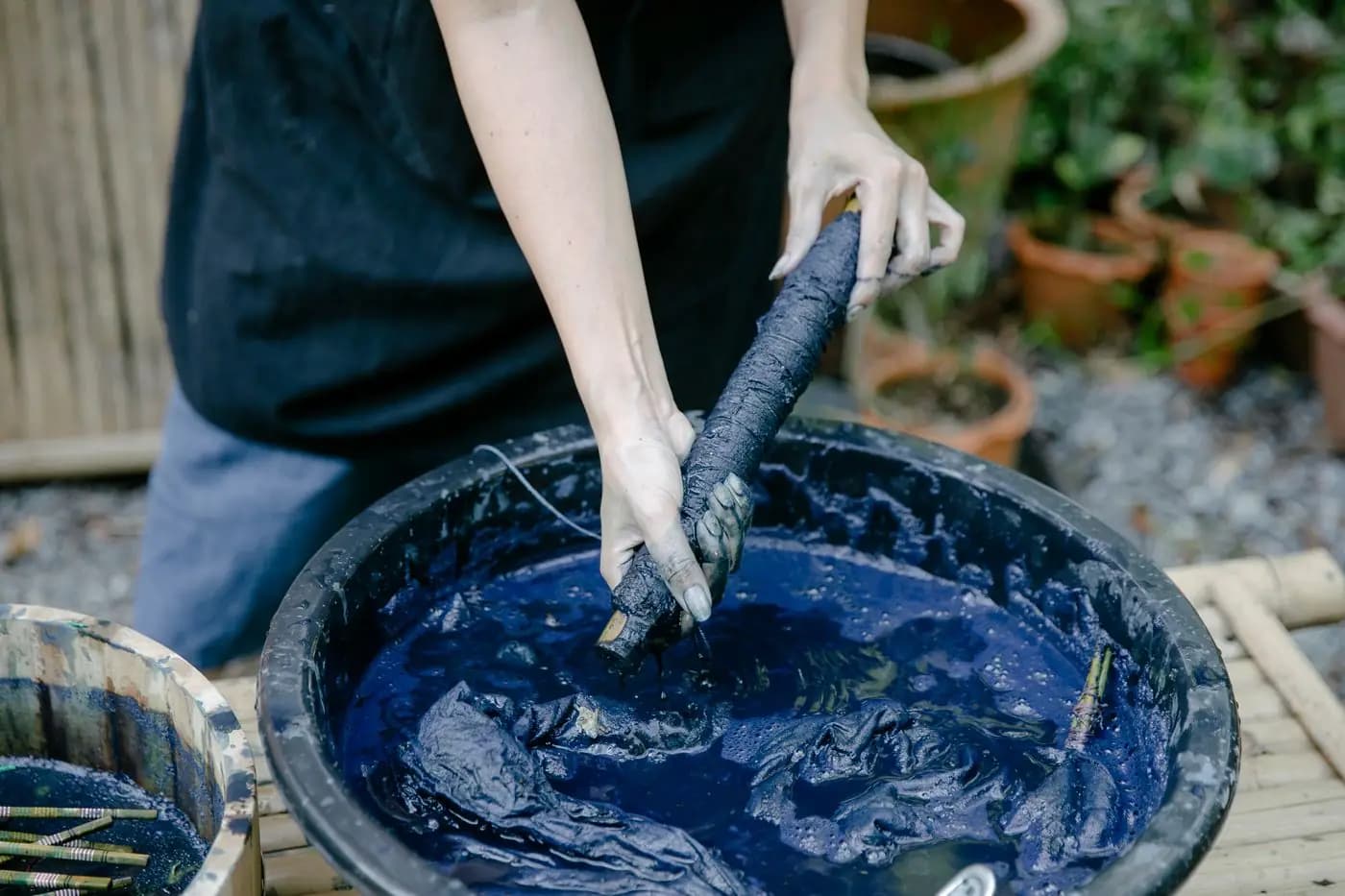
- Kyo-yuzen is dyeing: you start from a plain white woven silk, and the design is painted or stencilled onto the cloth (ato-zome, "dyed after"). It is the technique of kimonos with pictorial motifs, flowers, landscapes, fans, with gradations that weaving cannot achieve.
A rule of thumb in the kimono world sums up the traditional hierarchy: "dyed kimono, woven obi". The most formal outfits often pair a yuzen kimono with a Nishijin obi.
Both have been recognised as traditional crafts by the Ministry of Economy (METI) since 1976. And both can be visited within Kyoto itself: Nishijin north-west of the Imperial Palace, yuzen workshops scattered through the centre and west, and a museum presenting them all in Okazaki.
Nishijin-ori: history and making, from the Onin War to Lyon's Jacquard looms
Silk weaving has existed in Kyoto since the capital was founded in the late 8th century. The name Nishijin, "western camp", comes from the Onin War (1467–1477), which devastated the city: the western army had set up camp in this district. When peace returned, the scattered weavers regrouped there, and the name stuck. There is in fact no administrative district called Nishijin: the term covers the weaving area around Kamigyo and Kita wards, and it is a registered trademark of the weavers' cooperative.
The link with France is direct. In 1872, three Nishijin weavers were sent to Lyon to study the Jacquard loom, which reads patterns from punched cards. They brought the technique home, and the first wooden Jacquard loom built in Japan, a Kyoto City cultural property, is now on display at the Nishijin Textile Center.
Production relies on a highly developed division of labour, with around twenty different trades:
- designing the motif (zuan), then translating it into a technical plan, point by point, to program the loom (once punched cards, now often digital data);
- preparing the threads: twisting, dyeing, gold and silver threads (lacquered, gilded paper cut into very thin strips);
- warping, which sets up thousands of warp threads;
- weaving, on a mechanical Jacquard loom or, for the finest pieces, by hand. A hand-woven obi can take several weeks.
The cooperative recognises twelve categories of Nishijin-ori, from brocade (kinran) to tsuzure, a tapestry weave beaten in with fingernails filed into a saw-tooth shape, a striking technique to watch in demonstration.
Visiting the Nishijin Textile Center: hours, kimono show and weaving workshop
The Nishijin Textile Center (Nishijin-ori Kaikan) is run by the weavers' cooperative. It is on Horikawa-dori, just south of the junction with Imadegawa-dori. Free entry. Open 10am–4pm from October to March and 10am–5pm from April to September; closed Mondays (Tuesday if Monday is a holiday) and 29 December–3 January.
Inside:
- the third-floor archive shows Japan's first Jacquard loom and the story of Nishijin's modernisation, with three to four temporary exhibitions a year (obi, kimonos, screens);
- craftsman demonstrations and shops selling obi, small items and gifts in Nishijin fabric;
- the rooftop, opened for events, from which four of the five Daimonji bonfires can be seen on 16 August.
The kimono show, so often mentioned in guidebooks, is no longer scheduled: the official site says no show is planned and points to online videos. Do not build a group visit around it.
What works very well, on the other hand, is the hand-weaving workshop: on a small loom you weave a table mat of about 20 × 30 cm in roughly 40 minutes and take it home. Price ¥2,750 (¥2,530 per person from 15 people), from about age 10, up to 50 people per session thanks to some fifty looms. Booking required.
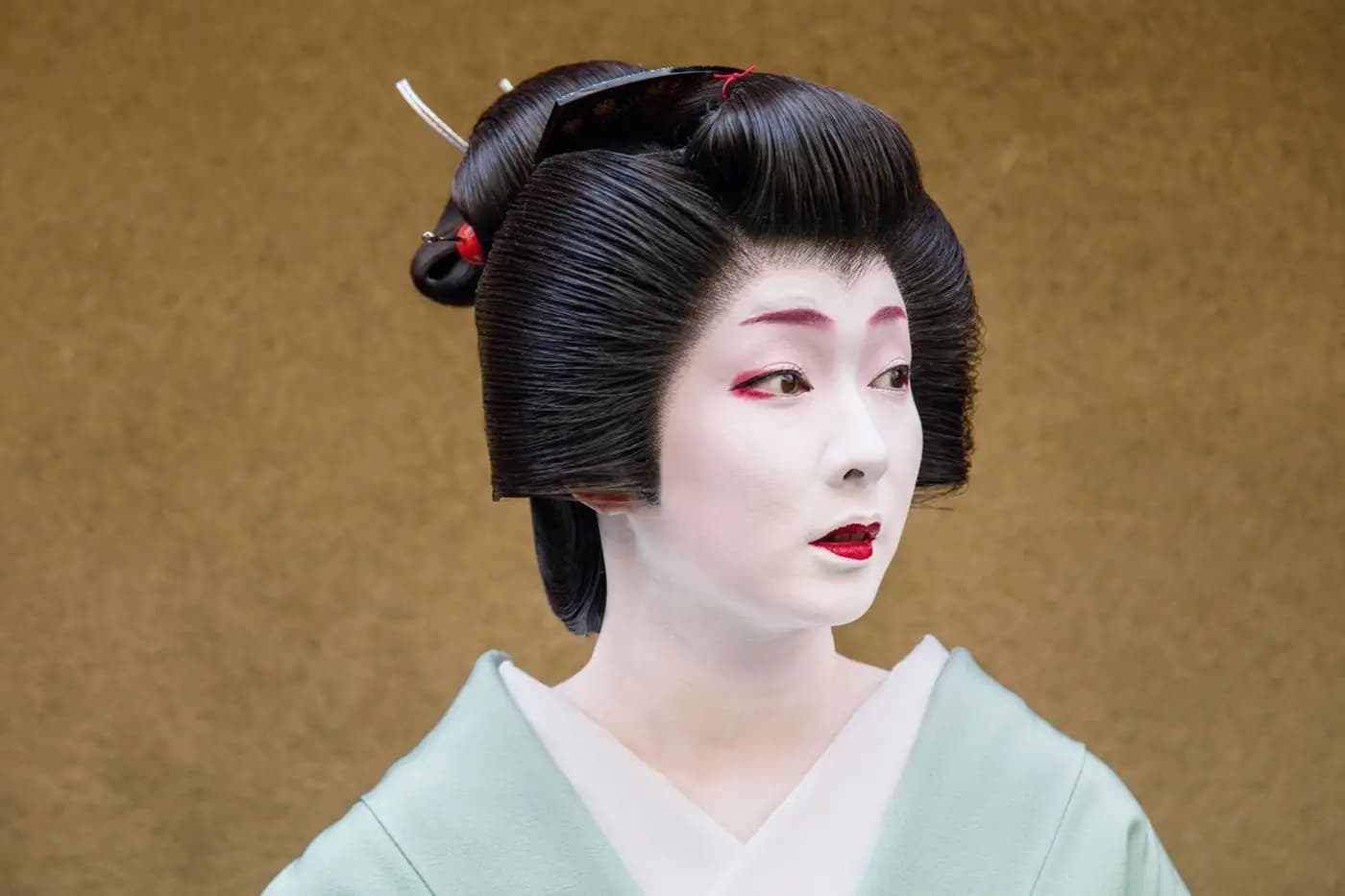
The centre also rents kimonos (¥8,800 to go out into town, returned 30 minutes before closing; ¥5,500 to stay inside) and offers maiko or geiko makeovers (¥33,000 including make-up and photo) and Heian court costume (¥48,400).
Getting there: city bus to Horikawa Imadegawa, 1–2 minutes' walk (route 9 from Kyoto Station, about 30 minutes); or the Karasuma subway line to Imadegawa, then a 10-minute walk. Coach parking on site (10 vehicles, ¥3,000).
Kyo-yuzen: how silk is painted, and where to try a dyeing workshop
Yuzen takes its name from Miyazaki Yuzensai, a fan painter active in Kyoto in the late 17th century whose designs were adapted to kimono dyeing. The principle is a resist: a fine line of paste stops colours from running into each other, which allows detailed motifs and gradations.
The main stages of hand-painted yuzen (tegaki yuzen):
- drawing the motif on the silk with a plant-based ink that washes out;
- applying the resist line (itome-nori) with a piping cone along every outline;
- colouring (sashi-yuzen) with a brush, area by area, including gradations;
- steam-fixing, then covering the motifs with paste to protect the painting;
- dyeing the background (hikizome) with a wide brush, fixing again, then washing to remove paste and ink. This washing was once done in the Kamo River, a famous Kyoto image; today it is done in workshops.
Since the Meiji era there has also been stencil yuzen (kata-yuzen), which reproduces a design using dozens, sometimes hundreds, of successive stencils. It is the technique most visitor workshops offer, since it gives a good result in an hour.
Where to try it:
- Kyoto Museum of Crafts and Design (Okazaki, see below), which runs stencil yuzen workshops and, for groups, sessions with craftsmen by reservation.
- Private workshops in central Kyoto, often in machiya townhouses: stencil-dyeing a handkerchief, furoshiki or bag in 1 to 1.5 hours, from about ¥1,600–3,000 depending on size; longer options (2 to 3 hours) for a real kimono stencil. Capacity is often around 10 people per session, so larger groups need to be split.
The dyed piece is usually handed over the same day after drying, unlike ceramics workshops.
Where to see textile artisans in Kyoto
Beyond the Nishijin Textile Center and the yuzen workshops, three options let you see artisans at work or their pieces up close.
Kyoto Museum of Crafts and Design (Kyoto Dento Sangyo Museum), in the basement of Miyako Messe in Okazaki, near Heian Shrine. It presents Kyoto's 74 traditional crafts, including Nishijin-ori and Kyo-yuzen, with craftsman demonstrations on some days. Open 10am–6pm (last entry 5:30pm), closing days shown on its calendar. Entry ¥500 (¥400 per person from 20) and free for visitors wearing kimono, which makes it a logical stop after a rental. Small drop-in workshops (painting a folding fan for ¥2,000, a round fan or candle for ¥1,000, 15 to 30 minutes, 4 people per slot) round off the visit.
Nishijin on foot: between Horikawa-dori, Imadegawa-dori and Senbon-dori, machiya streets still hold a few weaving workshops where you sometimes hear the looms clacking. The cooperative publishes a walking map. Several weaving houses open their showrooms; a former workshop turned textile museum, the Orinasukan, displays costumes and hand looms. Respect private entrances: these are lived-in homes.
Flea markets: at the Kitano Tenmangu shrine market (the 25th of each month) and the Toji market (the 21st), stalls sell old kimonos and obi, silk and brocade remnants from a few hundred yen. A good place to feel the difference between a woven obi and a printed fabric.
Finally, the Gion Matsuri (July) displays floats in the central streets decorated with tapestries, some from Nishijin and others imported from Europe centuries ago.
Renting a kimono in Kyoto: prices and etiquette
Kimono rental is one of the most popular activities in Kyoto. It goes smoothly if you know a few rules.
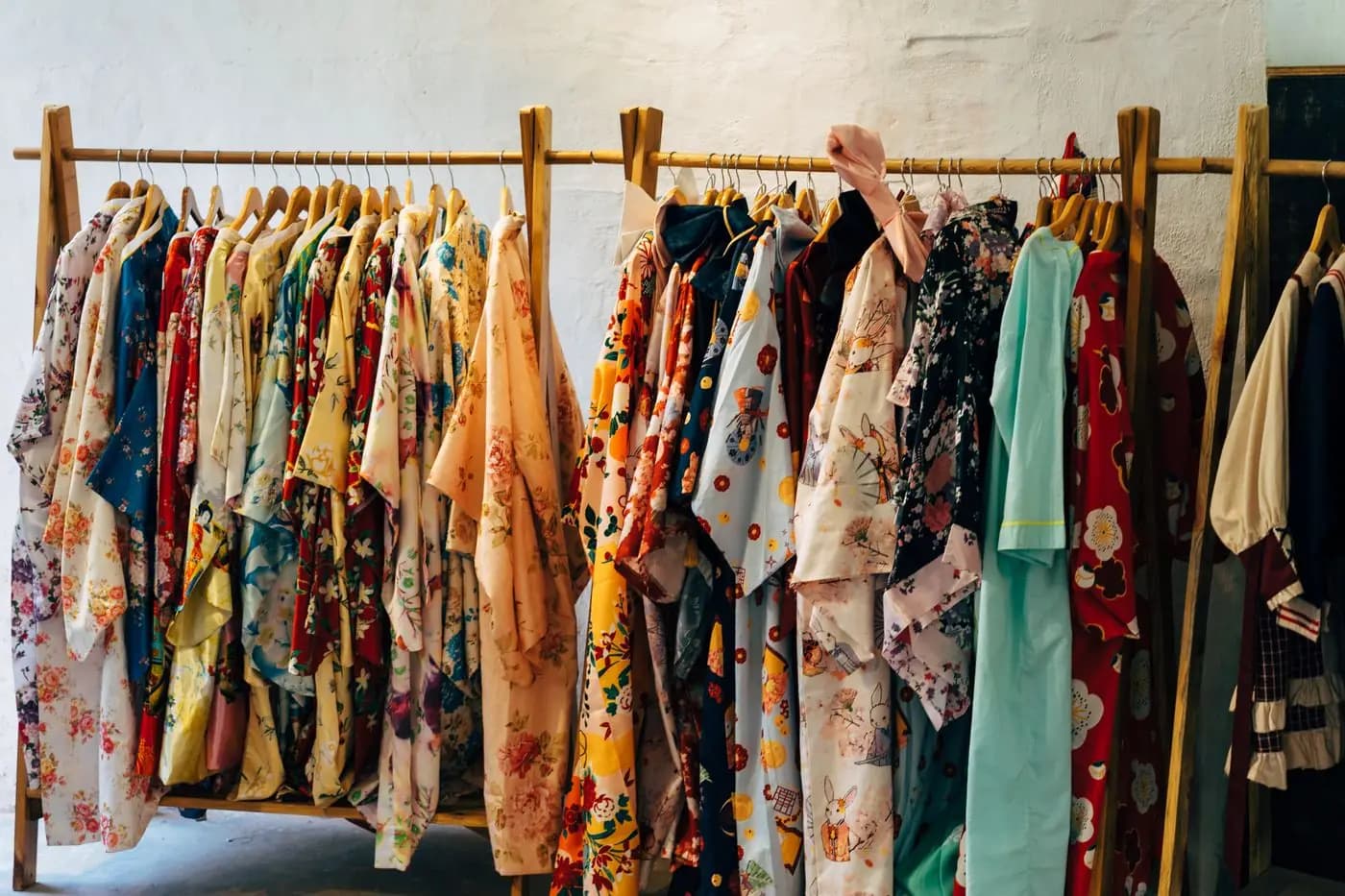
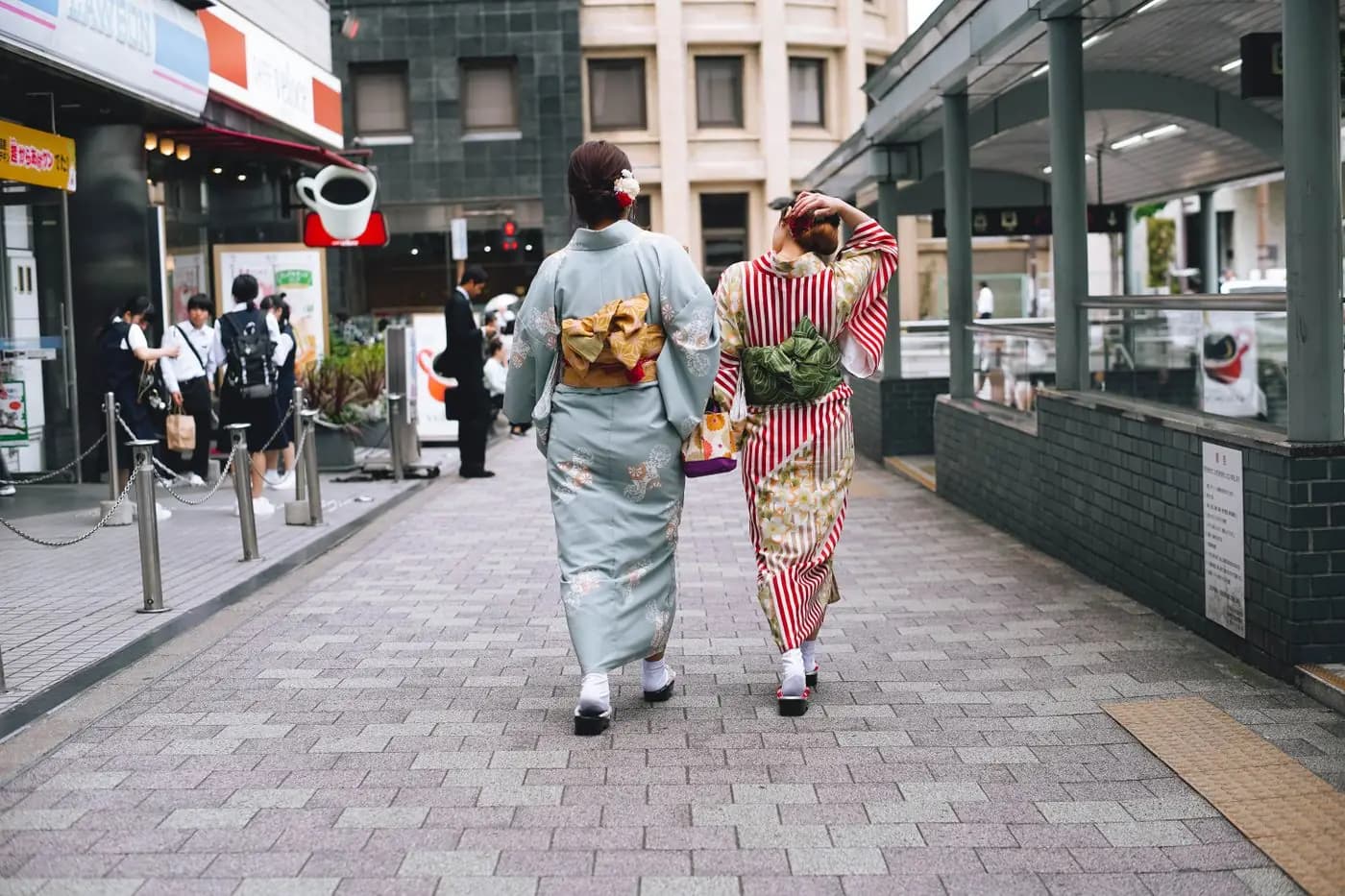
Prices and options: at specialist shops, basic packages (polyester kimono or yukata in summer, obi, bag, sandals, dressing) start at a few thousand yen, hair styling is often extra, and silk kimonos cost considerably more. At the Nishijin Textile Center, the kimono package for going out into town is ¥8,800. Allow 30 to 60 minutes for dressing, longer at peak times.
Rules to follow:
- The left panel crosses over the right; seen from the front it forms a lower-case "y". The reverse is for the dead: rental staff dress you correctly, but check if you re-dress yourself.
- Return the kimono on time: shops often close around 5 or 6pm, and late returns are charged.
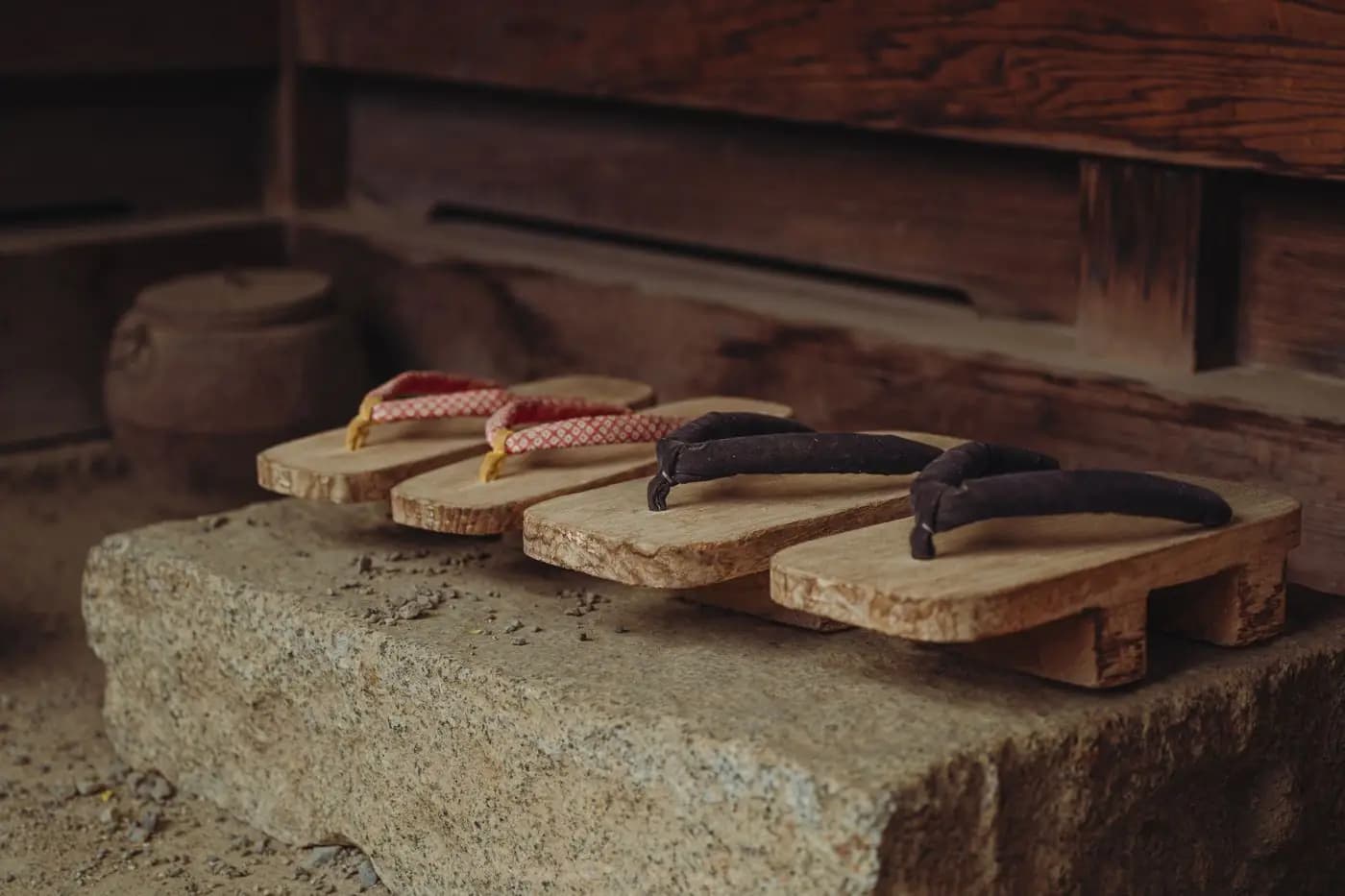
- Walk with small steps, lifting the hem slightly on temple stairs; zori sandals slow you down a lot, so plan short distances.
- Hold your sleeves when eating, washing your hands at fountains or using the toilet; avoid saucy dishes.
- Do not sit on dusty steps: deposits or cleaning fees may apply.
- Rain: most shops lend an umbrella and sandal covers; in heavy rain, better to postpone.
- Gion: the private alleys around Hanamikoji are off limits to visitors, and photographing maiko without permission is frowned upon, kimono or not.
Wearing a kimono also brings some practical perks in Kyoto, such as free entry to the Kyoto Museum of Crafts and Design.
Kyoto textiles for groups: workshops, private visits and gifts
For a corporate group, Kyoto textiles have an advantage few crafts offer: you can host many people at once, in one place.
- Weaving at the Nishijin Textile Center takes up to 50 people per session, with a group rate from 15 people and on-site parking for 10 coaches. It is the simplest solution for a group of 30 to 50.
- The Kyoto Museum of Crafts and Design recommends booking from 8 people and requires it for some services: 10 business days ahead for a group's self-guided visit, 21 business days for a one-hour guided tour by the director or a specialist guide (¥16,500 per group), 28 business days for a workshop with a craftsman. There are only 3 coach spaces, so plan a drop-off.
- Yuzen workshops in machiya are more intimate: above 10 people, split the group across two slots or two workshops, alternating with a walk in Nishijin.
- Kimono rental for a group: book the same rental shop for everyone, schedule staggered dressing (about twenty people an hour in a large shop) and a group photo somewhere it is allowed. For men, the hakama option is often the most popular.
- Private visits: some Nishijin weavers open their workshop or showroom to a small group on request, with a presentation by a family member. It is often the most memorable moment, but it takes several weeks to arrange.
For gifts, a pouch, business-card holder or furoshiki in Nishijin fabric or yuzen-dyed silk slips easily into a suitcase, and the cooperative's label guarantees the origin.
SHINOGI DMC organises these textile days in Kyoto, from booking workshops and kimono rental shops to private artisan visits and end-of-seminar gifts.
Frequently asked questions
What is the difference between Nishijin-ori and Kyo-yuzen?
Nishijin-ori is weaving: the threads are dyed first and the pattern is made on the loom. Kyo-yuzen is dyeing: the pattern is painted or stencilled onto silk that is already woven.
Does the Nishijin Textile Center still hold its kimono show?
No. The official site states that no kimono show is scheduled and offers online videos instead. The centre is still free and runs a weaving workshop at ¥2,750.
Where can you try yuzen dyeing in Kyoto?
At the Kyoto Museum of Crafts and Design in Okazaki, or in private machiya workshops in central Kyoto that offer stencil-dyeing a handkerchief or bag in 1 to 1.5 hours.
Which way should a kimono be crossed?
Left panel over right, forming a "y" when seen from the front. Crossing it the other way is reserved for the dead.
How much does kimono rental cost in Kyoto?
Basic packages start at a few thousand yen, hair styling is often extra and silk costs more. At the Nishijin Textile Center, the package for going out into town is ¥8,800.
Can a large group do a textile workshop in Kyoto?
Yes: the Nishijin Textile Center weaving workshop takes up to 50 people per session, with a group rate of ¥2,530 from 15 people. Booking is required.
Rédaction SHINOGI DMC · Updated
Sources
- Nishijin Textile Industrial Association — Nishijin Textile Center (horaires, accès, parking)
- Nishijin Textile Industrial Association — Ateliers (tissage à la main)
- Nishijin Textile Industrial Association — Voir (archives, kimono show)
- Nishijin Textile Industrial Association — Location de kimono et transformations
- Nishijin Textile Industrial Association — Qu'est-ce que le Nishijin-ori
- Kyoto Museum of Crafts and Design — Informations pratiques
- Kyoto Museum of Crafts and Design — Visites de groupe
- Kyoto Museum of Crafts and Design — Petits ateliers