What is the Kumano Kodo and why choose the Nakahechi?
The Kumano Kodo is not a single trail but a network of pilgrimage routes that cross the Kii Peninsula towards three grand shrines: Kumano Hongu Taisha, Kumano Hayatama Taisha and Kumano Nachi Taisha, known together as Kumano Sanzan. The network has been a UNESCO World Heritage Site since 2004, together with Mount Koya and Yoshino, under the name "Sacred Sites and Pilgrimage Routes in the Kii Mountain Range".
There are several routes: the Kohechi coming down from Mount Koya through the mountains, the Iseji following the coast from Ise, the seaside Ohechi. For a first visit, the Nakahechi is the obvious choice, for three practical reasons:
- it is the historic imperial route, used by retired emperors and the court travelling from Kyoto;
- it is the best waymarked, with numbered posts roughly every 500 m and signs in English;
- it is the only one where lodging, buses and luggage shuttles really let you walk light.
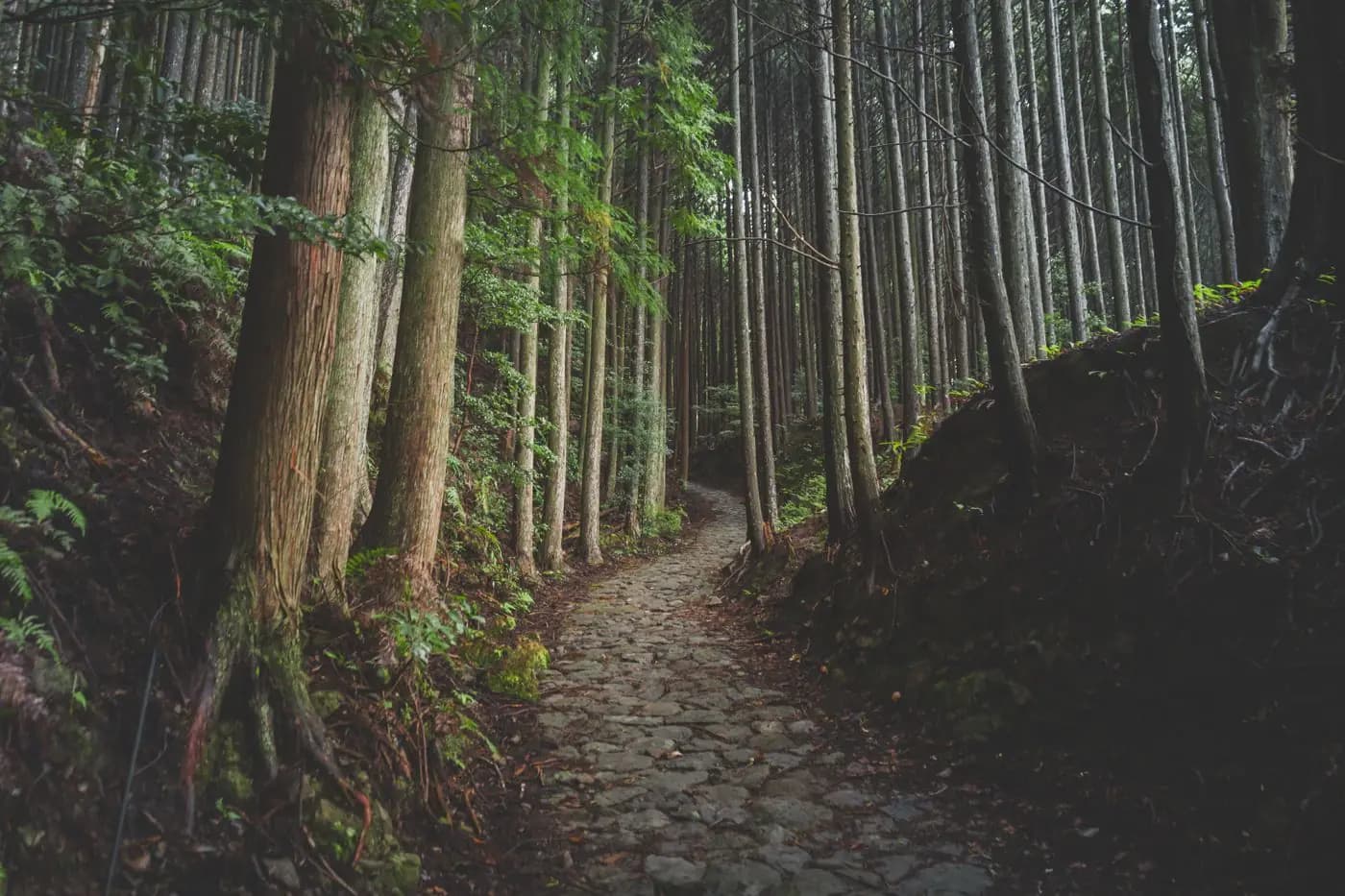
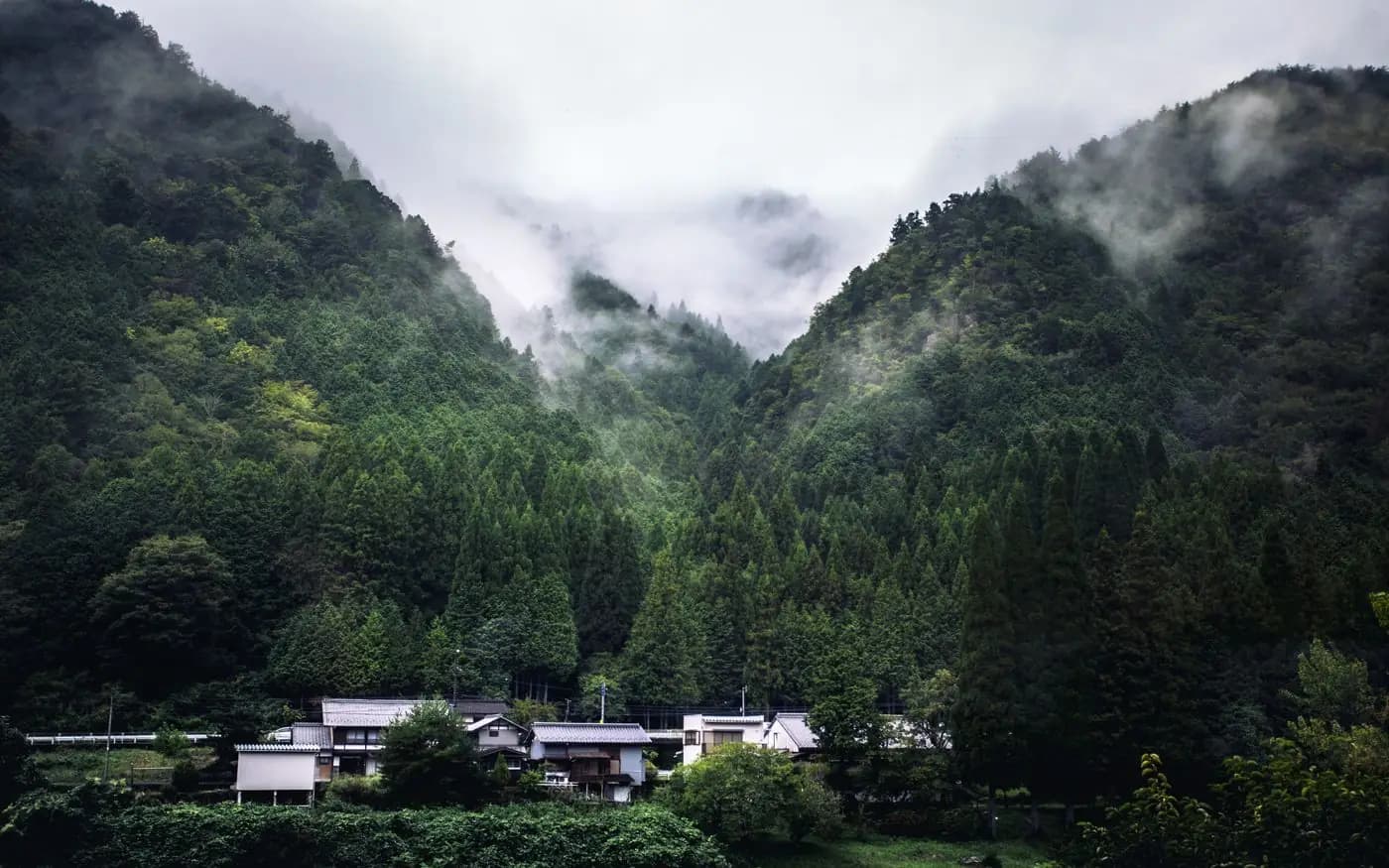
The scenery is cedar and Japanese cypress forest broken up by terraced hamlets, small shrines called oji (subsidiary shrines along the way) and passes. This is not high mountain walking: no pass on the Nakahechi reaches 900 m. But the climbs are steep, often on stone steps, and the humidity makes roots slippery.
Walkers who have already completed the Camino de Santiago can earn Dual Pilgrim status by also completing a set Kumano Kodo itinerary; stamps are collected from boxes placed along the trail.
Nakahechi stages from Takijiri-oji to Kumano Hongu Taisha
The classic starting point is Takijiri-oji, about 40 minutes by bus from Kii-Tanabe Station. The Kumano Kodo-kan, right across from the shrine, introduces the trail and is a good place to fill your water bottle. Here are the official distances published by the Tanabe tourism bureau:
- Takijiri-oji → Takahara: 4 km, 2–3 h, about 430 m of ascent. The first half-hour climbs hard through the forest, past the Tainai-kuguri rock, before you come out at the hilltop village of Takahara, one of the best viewpoints on the route.
- Takahara → Gyuba-doji-guchi: 8 km, 3–4 h. The most isolated stretch, with the Jujo-oji pass and the remains of old teahouses. Few villages, little water: carry 1.5 litres.
- Gyuba-doji-guchi → Chikatsuyu-oji: 1.3 km, 30 minutes, downhill into the Chikatsuyu valley, the usual overnight stop.
- Chikatsuyu-oji → Tsugizakura-oji: 4 km, about 1 h 15, partly on village roads.
- Tsugizakura-oji → Kumano Hongu Taisha: 21 km, 8–11 h, via the Toganoki-jaya teahouse, Hosshinmon pass and the long final descent into Hongu.
In total, Takijiri → Tsugizakura is about 17 km and 7–10 hours, and Tsugizakura → Hongu 21 km. Few walkers do this second block in one go. The most common solution is to take the bus from Chikatsuyu to Hosshinmon-oji, then walk the last 7.5 km (2–3 h, mostly downhill). It is also the best half-day for a group that only wants a taste of the Kumano Kodo.
A realistic split for a fit walker:
- Day 1: train from Osaka or Kyoto to Kii-Tanabe, bus to Takijiri, walk to Takahara. Night in Takahara.
- Day 2: Takahara → Chikatsuyu (9.3 km). Night in Chikatsuyu.
- Day 3: bus to Hosshinmon-oji, walk to Kumano Hongu Taisha, night in a hot-spring inn at Yunomine, Kawayu or Watarase.
- Day 4: Kogumotori-goe towards Nachi, or bus and a visit to Nachi.
Kumano Hongu Taisha, Yunomine and Nachi: what to see at the end of the trail
Kumano Hongu Taisha is the spiritual heart of the network. The current shrine stands on a hill at the top of 158 stone steps lined with banners. It was moved after the 1889 flood: its former site, Oyunohara, on a river sandbank, is now marked by a giant torii almost 34 m high, visible from the road. It is a 10-minute walk away. The three-legged crow Yatagarasu, messenger of the Kumano deities, is everywhere: on charms, banners, even postboxes.
The three hot-spring villages around Hongu are the real reward after the walk:
- Yunomine Onsen, one of the oldest onsen in Japan, home to Tsuboyu, a tiny stone bath that is part of the World Heritage listing. You book it on the spot for 30 minutes, alone or as a couple, often with a queue in the late afternoon.
- Kawayu Onsen, where hot water bubbles up through the riverbed: you dig your own pool on the bank. In winter, a large pool built into the river (Sennin-buro) opens for a few months.
- Watarase Onsen, with a large open-air bath, more practical for a group.
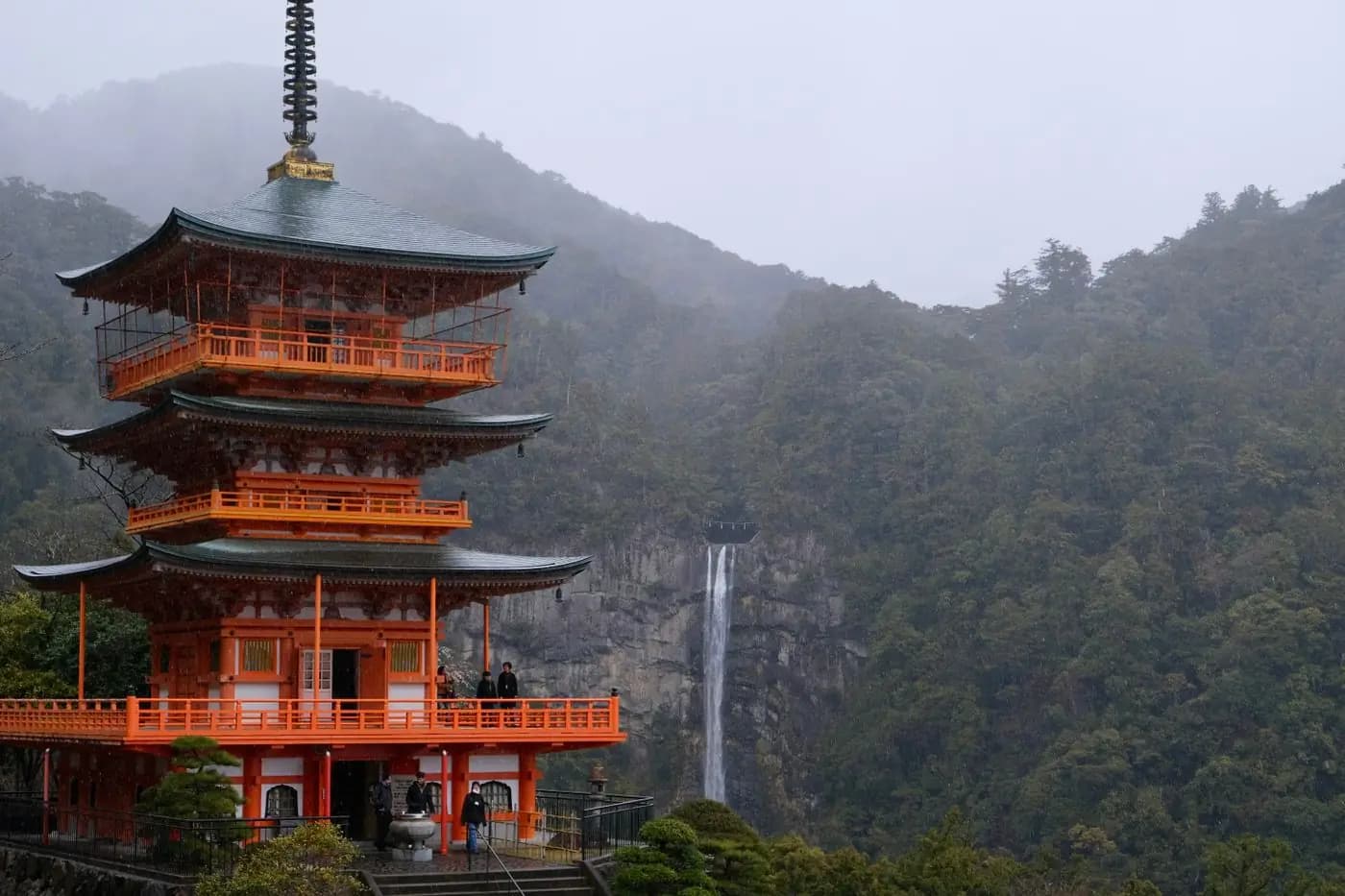
Nachi, to the east, is usually visited by bus from Kii-Katsuura. You climb Daimon-zaka, a flight of stone steps under centuries-old cedars, up to Kumano Nachi Taisha and the neighbouring Seiganto-ji temple, whose vermilion three-storey pagoda is photographed in front of the Nachi Falls, 133 m high, Japan's tallest single-drop waterfall. Allow half a day for Daimon-zaka, the shrine, the temple and the foot of the falls. The third grand shrine, Kumano Hayatama Taisha, is in Shingu, 30 minutes by bus from Nachi.
Where to stay on the Kumano Kodo: minshuku, ryokan and booking
On the Nakahechi you mostly sleep in minshuku (family-run guesthouses) or small inns, with a Japanese dinner and breakfast included. Rooms have tatami floors and futons; bathrooms are often shared; the communal bath runs at set times. Dinner is served early, often at 6pm, and you need to call ahead if you arrive after 5pm.
What to know before booking:
- Capacity is very small. In Takahara or Chikatsuyu, most places have between 3 and 8 rooms. In spring and autumn they are full several months ahead.
- The reference platform is KUMANO TRAVEL, the booking service of the Tanabe tourism bureau. It covers most Nakahechi minshuku, offers packages with buses and luggage shuttles, and works in English.
- Pay in cash. Many lodgings and most village shops do not take cards. ATMs are in Kii-Tanabe and Hongu (post office), not elsewhere along the trail.
- Lunch boxes (bento) are ordered from your minshuku the night before. Between Takahara and Chikatsuyu there is almost nowhere to buy food.
In Hongu the picture changes: the hot-spring villages of Yunomine, Kawayu and Watarase have larger ryokan with several dozen rooms, large baths, banquet rooms and coach parking. That is where a group can find rooms under one roof.
Luggage shuttles, buses and access from Osaka or Kyoto
Getting there. From Shin-Osaka or Kyoto, the JR Kuroshio limited express reaches Kii-Tanabe in just over 2 hours. Buses then run to Takijiri, Chikatsuyu and Hongu; Nanki-Shirahama Airport, about an hour's flight from Haneda, is the other gateway. Buses on the peninsula are infrequent (sometimes one every two hours), so check times the day before, especially for the Chikatsuyu → Hosshinmon-oji bus.
Luggage shuttles. Several local carriers move your bags between lodgings while you walk with a daypack. The conditions set by KUMANO TRAVEL are strict:
- the service only runs between lodgings booked through KUMANO TRAVEL;
- it must be booked at least 20 days in advance;
- no last-minute changes on site, and no refund if you end up with fewer bags than booked;
- the morning hand-over time is fixed in advance.
For arrival and departure, Japan's door-to-door delivery service (takkyubin) also lets you send your big suitcase straight from your Osaka or Kyoto hotel to your post-hike hotel. You then keep a 25–35 litre pack for the three or four walking days.
When is the best season to hike the Kumano Kodo?
The Kii Peninsula is one of the wettest regions in Japan, so the choice of season matters more than usual.
- March to May: the best period. 12 to 22°C, wild cherry trees in late March, fresh green forest in May. Golden Week (late April to early May) fills the lodgings.
- June to mid-July: rainy season. Stone paths get slippery and some sections close after heavy rain.
- Late July to September: humid heat (often over 30°C in the valleys), leeches on some sections and typhoon season, which can cut roads and buses for days.
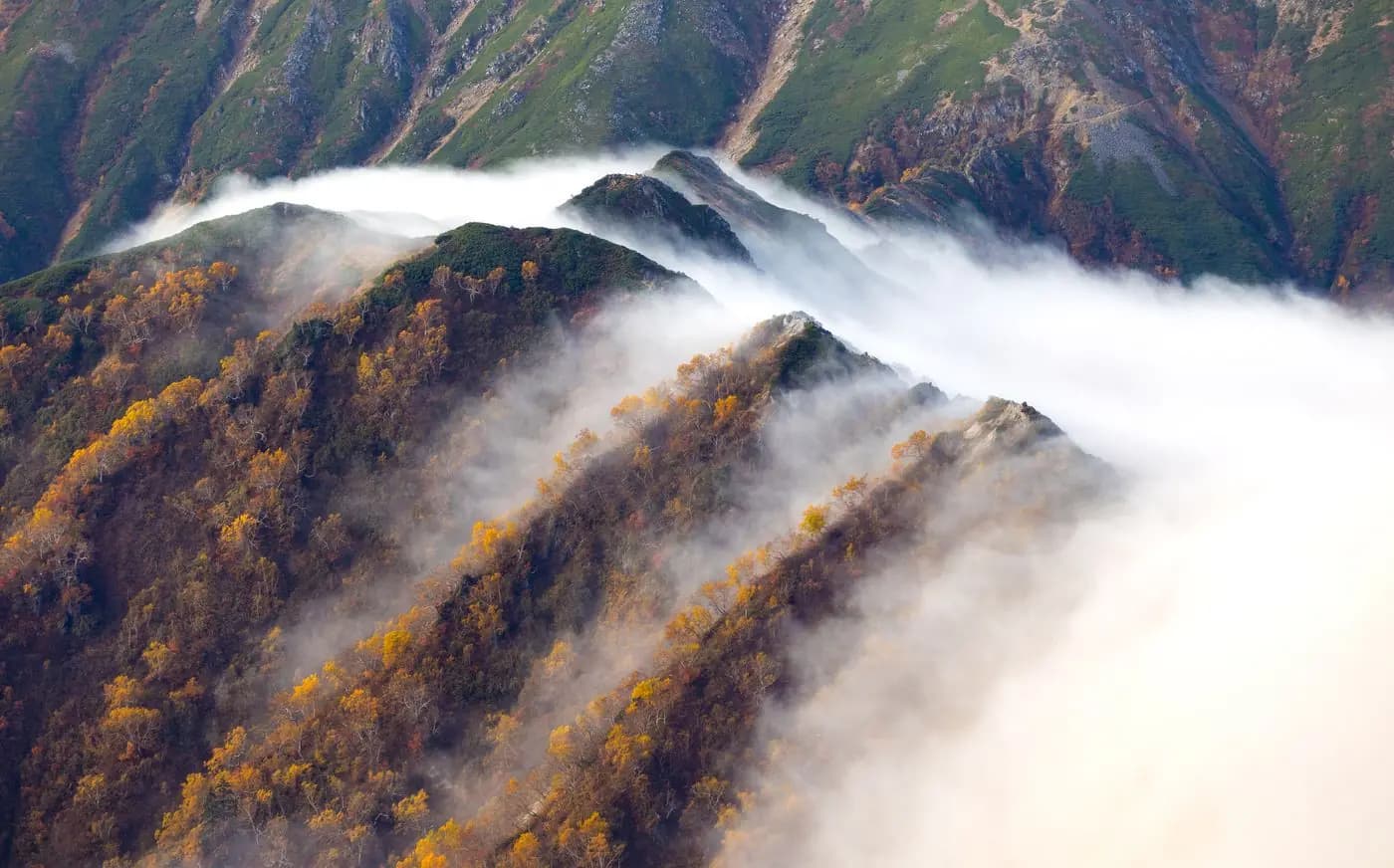
- Mid-October to late November: the other good window, with dry air, low light and leaves turning red in November.
- December to February: rarely any snow on the Nakahechi, quiet trails, but short days (dark around 5pm) and some minshuku closed. This is when the onsen make the most sense.
Whatever the season, start early (8am at the latest) to arrive before 4pm, and carry a rain jacket, a headlamp and shoes with grippy soles. Walking poles help a lot on stone-step descents.
How fit do you need to be? Difficulty and preparation
The Tanabe tourism bureau rates each section on a scale from 1 to 5. It gives a good idea of what an average walker can expect:
- 1 to 2: Gyuba-doji-guchi → Chikatsuyu (1), Chikatsuyu → Tsugizakura (1.5), Hosshinmon-oji → Hongu (2). Fine for anyone who walks regularly.
- 2.5 to 3: Takijiri → Takahara (2.5), Takahara → Gyuba-doji-guchi (3). Steep climbs and high steps, but short.
- 4: the long blocks Takijiri → Tsugizakura and Tsugizakura → Hongu done in one go.
- 5: Ogumotori-goe, 14 km between Nachi and Koguchi, 7–9 hours, about 1,260 m of ascent. A proper mountain day with no way out once you have started.
To prepare, we recommend a few 15–20 km outings with some climbing in the weeks before, carrying the pack you plan to use. The most common problem is not breath but knees on wet stone-step descents.
On the trail, water points and toilets are few and marked on the official maps. Mobile coverage reaches most of the Nakahechi, but not everywhere. Black bears live in the Kii Mountains: encounters are rare, but many walkers carry a bell.
Walking the Kumano Kodo as a group: logistics and tips
The Kumano Kodo works very well for a seminar or leadership trip looking for something other than a meeting room: a shared walk, meals on tatami, a hot bath in the evening. But the logistics are nothing like a city.
- Group size. Beyond 12 to 15 people you can no longer sleep together in Takahara or Chikatsuyu. Two options: spread the group over three or four neighbouring minshuku, or base the group for two or three nights in a ryokan in Kawayu or Yunomine and head out each day by minibus to a different section.
- Mixed fitness levels. Run two formats on the same day: a long section for experienced walkers (Takijiri → Takahara then Chikatsuyu) and Hosshinmon-oji → Hongu for the others, with a common meeting point at the shrine in the late afternoon.
- Guides. One English- or French-speaking guide per 10–12 walkers, plus a sweeper. The trails are narrow: a group of 30 walking in single file stretches over more than a kilometre.
- Transport. Scheduled buses are not enough for a group; charter minibuses or mid-size coaches, as full-size coaches cannot reach every trailhead.
- Meals and diets. Minshuku dinners are set in advance and heavy on fish; special diets (vegetarian, gluten-free, allergies) should be sent in writing several weeks ahead.
- Weather plan B. After heavy rain some sections close: keep an alternative (Nachi by bus, a workshop or shrine visit) already booked.
For a company group, the format that works best is often three days: arrive in Tanabe and do a short first walk, a Hosshinmon-oji → Hongu day with a group dinner in a ryokan, then Nachi on the last morning before heading back to Osaka. SHINOGI DMC organises this kind of trip, coordinating lodging, minibuses, guides and luggage shuttles.
Frequently asked questions
How many days do you need for the Kumano Kodo?
For the Nakahechi from Takijiri-oji to Kumano Hongu Taisha, allow 2 to 3 walking days, plus one day for Nachi. A half-day version, Hosshinmon-oji → Hongu (7.5 km), already gives a good taste.
Is the Kumano Kodo difficult?
Most Nakahechi sections are rated 1 to 3 out of 5: steep climbs and stone steps, but modest altitude. The Ogumotori-goe to Nachi (14 km, about 1,260 m of ascent) is rated 5/5.
How do you get your luggage carried on the Kumano Kodo?
Through the luggage shuttles offered by KUMANO TRAVEL: they only run between lodgings booked on that platform and must be booked at least 20 days in advance.
What is the best time of year for the Kumano Kodo?
March to May and mid-October to late November. June is the rainy season, and August–September combine humid heat and typhoons.
How do you get to Takijiri-oji from Osaka?
JR Kuroshio limited express from Shin-Osaka to Kii-Tanabe (just over 2 hours), then a bus to Takijiri (about 40 minutes).
Can a company group walk the Kumano Kodo?
Yes, with some adjustments: sub-groups of 10–12 walkers per guide, chartered minibuses and lodging in the Hongu hot-spring ryokan rather than minshuku. SHINOGI DMC can handle this organisation.
Rédaction SHINOGI DMC · Updated
Sources
- Tanabe City Kumano Tourism Bureau — Nakahechi Route
- Tanabe City Kumano Tourism Bureau — Takijiri-oji to Tsugizakura-oji (course data)
- Tanabe City Kumano Tourism Bureau — Tsugizakura-oji to Kumano Hongu Taisha (course data)
- Tanabe City Kumano Tourism Bureau — Hosshinmon-oji to Kumano Hongu Taisha
- Tanabe City Kumano Tourism Bureau — Ogumotori-goe
- Tanabe City Kumano Tourism Bureau — Difficulty rating
- Tanabe City Kumano Tourism Bureau — Luggage Shuttle & Storage
- Kanpai — Kumano Kodo (inspiration)