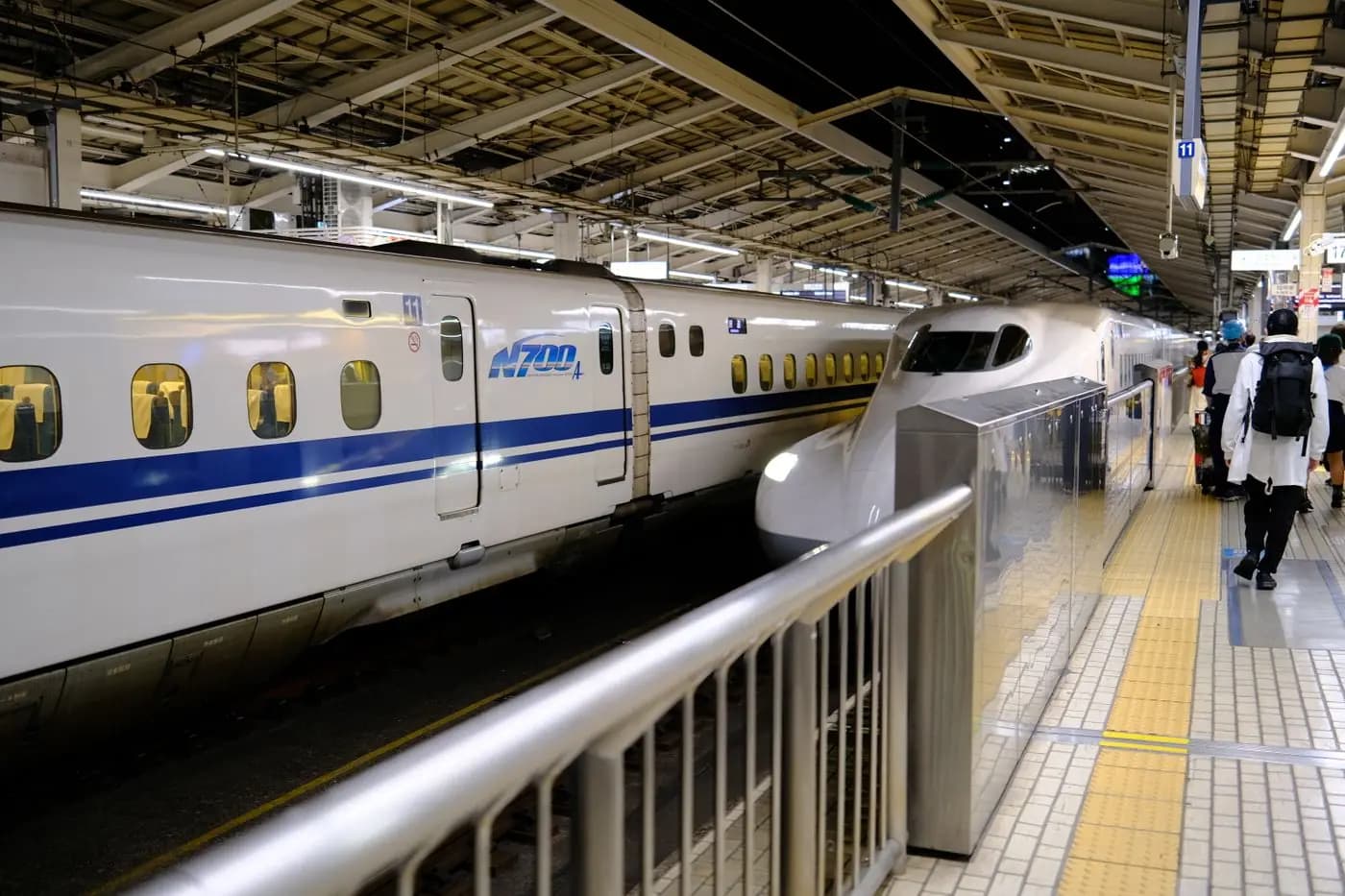
Coach, train or plane: which transport for a group in Japan?
The right mode of transport depends mainly on distance and the number of suitcases. After years of moving groups of 15 to 300 people, this is the rule we apply:
- Under 150 km, or several stops in a day: private coach. Day trips to Nikko, Hakone, Nara, Kamakura, a temple circuit in Kyoto.
- 150 to 700 km between two major cities: Shinkansen, with suitcases sent separately. Tokyo–Kyoto in about 2 h 15, Tokyo–Kanazawa in 2 h 30 to 3 h, Osaka–Hiroshima in 1 h 30.
- Beyond that, or to an island: fly. Tokyo–Fukuoka, Tokyo–Sapporo, every route to Okinawa.
Long-distance coaches have their fans, because the group stays together and the luggage follows. But Tokyo–Kyoto by expressway is about 470 km, 6 to 7 hours with mandatory breaks, against two and a quarter hours by train. We keep it for routes with stops that justify the road: the Mount Fuji area, Takayama, the Izu Peninsula.
The train has another, lesser-known advantage: punctuality. The annual average delay of a Tokaido Shinkansen is in the order of one to two minutes per train, bad weather included. A programme can therefore be written to the minute, provided the group is also on time on the platform.
A final criterion: arrival. A coach drops the group at the hotel door. A train leaves it in a station such as Kyoto or Shin-Osaka, which are huge, with another 10-minute walk and a coach or taxis to follow. Plan this last kilometre in every transfer.
Coaches in Japan: sizes, capacities and costs
Japanese charter coaches (kashikiri bus) come in three sizes. Advertised seat counts often include fold-down aisle seats, which you should never count for an adult group.
- Full-size coach (12 m): about 45 standard seats. With one suitcase each in the hold, do not exceed 40 travellers; for an airport transfer with two bags each, 30 to 35 is safer.
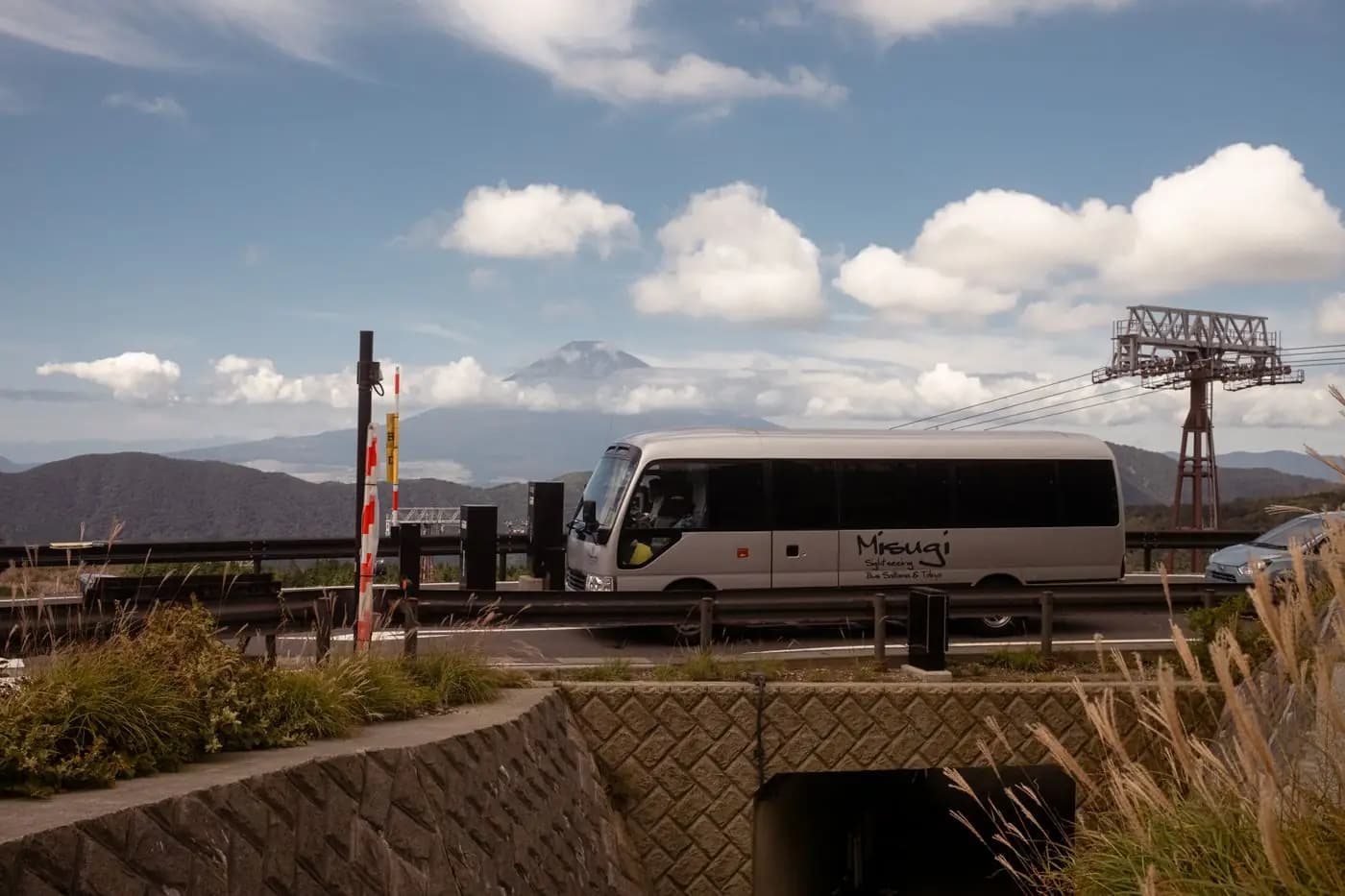
- Mid-size coach (9 m): about 25 to 27 seats and a smaller hold. The right format for 15 to 22 people with luggage.
- Minibus: 15 to 20 seats, almost no hold. For short transfers or a group without suitcases.
- Vans and cars with driver: for an executive committee of 6 to 9 people, or the VIPs of a group.
Fares are regulated by the transport ministry: a price based on both hours and kilometres, between a floor and a ceiling. Hours count from leaving the depot to returning, with one hour of preparation included. Hence a common surprise: a 4-hour outing for the group can be billed as 6 to 7 hours if the depot is far away. Always ask where the depot is.
In Tokyo and Kyoto, coaches cannot wait just anywhere. Parking near sights is scarce, often paid, and must be booked in Kyoto in peak season. The driver drops the group, leaves to park and returns at an agreed time: a group 15 minutes late can sometimes block a street. Note also that drivers rarely speak English; the guide is the link.
Driver hours: the rules to know since 2024
In April 2024, Japan tightened working rules for professional drivers. For an organiser, they concretely set the length of coach days. The main ones for coach drivers:
- Duty span (from start to end of the shift, breaks included): 13 hours a day in principle, 15 at most, and generally no more than 14 hours more than three times a week.
- Continuous driving: 4 hours maximum, followed by at least 30 minutes of breaks in total.
- Driving time: 9 hours a day on average over two days.
- Rest between shifts: 11 hours in principle, never less than 9.
On top of these come the transport ministry's distance rules: a single driver covers no more than 500 km by day (600 km with set breaks) or 400 km at night. Beyond that, a second driver is required, at extra cost.
What this means in practice:
- A day that starts at 8 a.m. at the hotel and ends with a 9 p.m. dinner and a 10:30 p.m. return already exceeds 15 hours once you count leaving the depot. For a late evening, plan a second vehicle or taxis.
- A Tokyo–Nikko–Tokyo day trip is comfortable; Tokyo–Kyoto by coach with visits along the way is at the limit.
- When the group sleeps outside the driver's home city, the driver's accommodation is added to the quote.
These rules are good news: they partly explain why tour coach accidents are rare in Japan. Be wary of any quote promising a 16-hour day with a single driver.
Taking the Shinkansen as a group: tickets, platforms and luggage
The Shinkansen is the most reliable way to link Tokyo, Nagoya, Kyoto, Osaka and Hiroshima. For groups, JR offers a collective ticket from 8 people travelling together. The discount applies to the base fare (not the express surcharge): 10% in busy periods (March to May, July–August, October, the year-end holidays) and 15% the rest of the time (mid-January to the end of February, June, September, November to December 20). From 31 travellers, one person travels free, then one more per additional 50. Requests are made between 9 months and 14 days before the date.
The real advantage of a group ticket is getting reserved seats together, often in the same car. A Shinkansen car has between 65 and 100 seats depending on its position.
On the platform, time is short. At Kyoto or Nagoya, a Nozomi stops for only one to two minutes. Car numbers are painted on the floor, with queue lines. The guide places the group at the right door ten minutes ahead and splits travellers between two doors if there are more than thirty.
For luggage, two rules:
- On the Tokaido, Sanyo and Kyushu lines, a suitcase whose three dimensions add up to more than 160 cm (up to 250 cm) requires a reserved seat with an oversized baggage area. Without one, a surcharge is collected on board and the bag must be moved.
- A large group with suitcases fills the luggage space of a whole car. The answer: send suitcases the day before by delivery service and travel with a small bag.
The Japan Rail Pass (50,000 yen for 7 days in ordinary class since October 2023) no longer pays off for a simple Tokyo–Kyoto–Osaka; it only does for long routes. Run the numbers trip by trip.
Domestic flights: when flying makes sense for a group
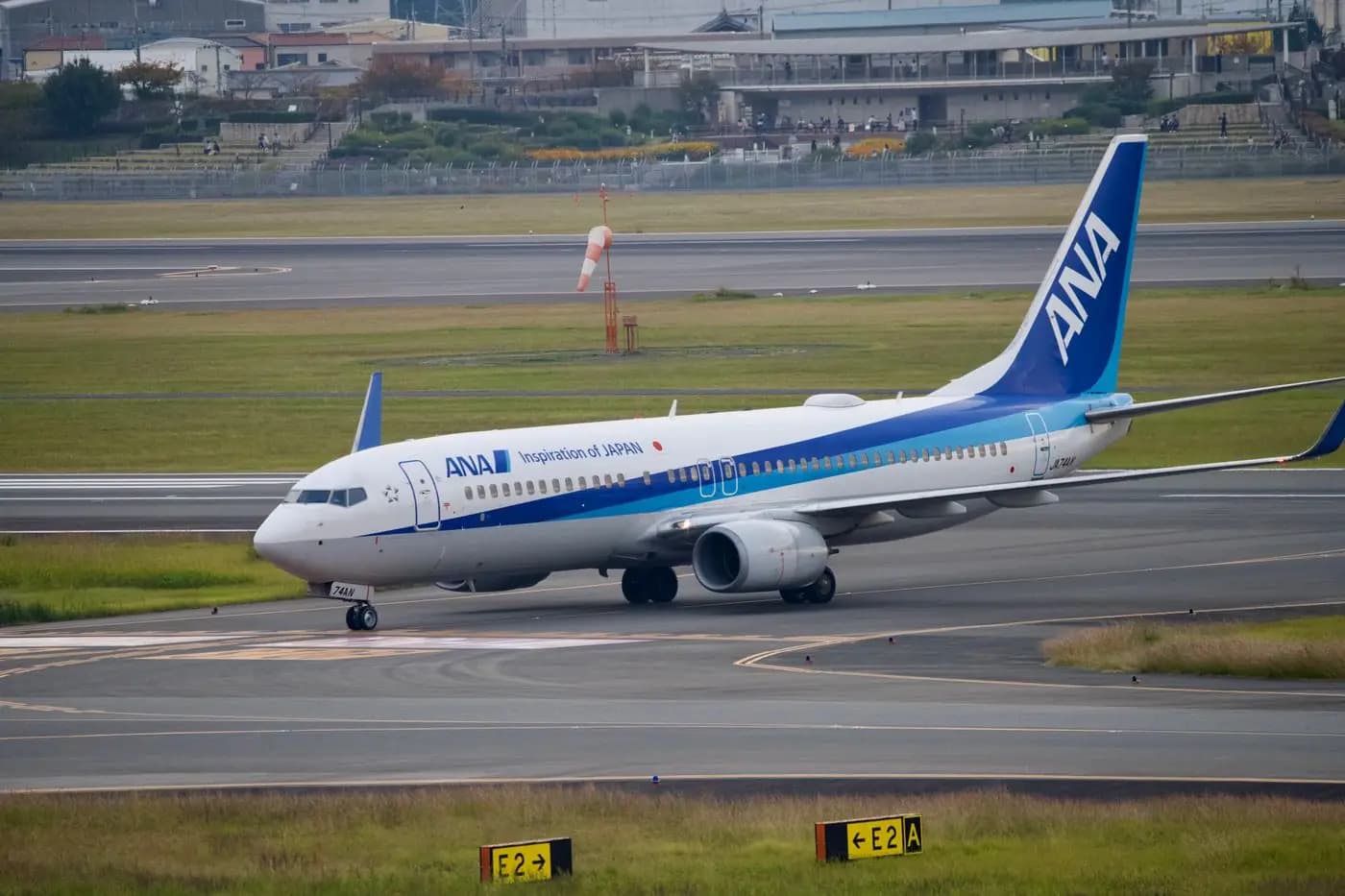
For Okinawa, Hokkaido or southern Kyushu, flying is the only sensible option. Haneda–Naha takes about 2 h 30 to 3 h, Haneda–Fukuoka 1 h 45 to 2 h, Haneda–Sapporo (New Chitose) about 1 h 30. ANA and JAL offer group fares and run frequent flights on these routes; several low-cost carriers serve the same cities, often from Narita or Kansai.
A few points to watch:
- Luggage: on ANA and JAL economy, the checked allowance on domestic flights is 20 kg per passenger, often less than on the international flight. A group arriving from Europe with 23 kg each will pay excess fees or have to send part of their luggage ahead.
- Low-cost carriers: paid checked bags, paid seats, earlier or later schedules. The headline fare quickly approaches ANA or JAL for a group with suitcases.
- Airport arrival time: allow 1 h 15 to 1 h 30 before departure for a group, even if check-in closes 20 minutes before for an individual passenger.
- Typhoons: from July to October, flights to Okinawa are the first to be cancelled. One night's margin before the international return flight is not a luxury.
For Tokyo–Osaka or Tokyo–Hiroshima, on the other hand, flying rarely saves a group any time once airport transfers are counted: the Shinkansen leaves from and arrives in the city centre.
Airport transfers: Narita, Haneda and Kansai for a group
For a group with luggage, a private coach remains the simplest option on arrival: the guide waits in the arrivals hall with a sign, the group walks to the coach park, bags are loaded and off you go. Express trains are excellent for a solo traveller, much less so for 40 people and 60 suitcases.
Narita is about 70 km from central Tokyo. By coach, allow 60 to 90 minutes to hotels in Ginza or Shinjuku, 2 hours in Friday-evening traffic. The Narita Express reaches Tokyo Station in about an hour and the Skyliner reaches Nippori in just over half an hour, but you still have to get to the hotel.
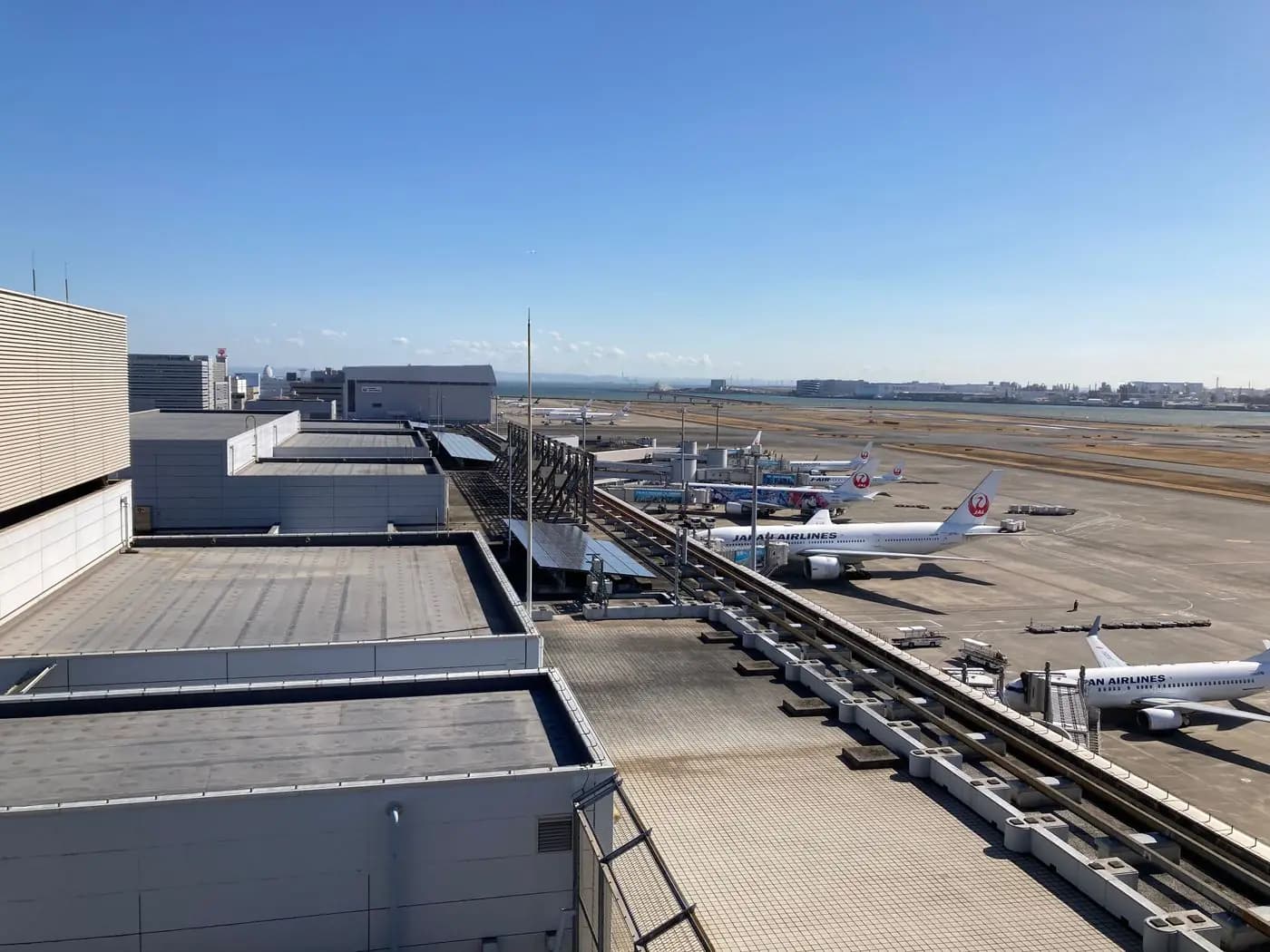
Haneda is 15 km from the centre. By coach, 30 to 50 minutes. For a small group without suitcases, the monorail or the Keikyu line reach Hamamatsucho or Shinagawa in 15 to 20 minutes.
Kansai (KIX) sits on an artificial island, 50 km from Osaka and 100 km from Kyoto. By coach: 50 to 70 minutes to central Osaka, 1 h 30 to 1 h 45 to Kyoto. The Haruka train reaches Kyoto in about 75 to 80 minutes, and Nankai's Rapi:t reaches Namba in 35 to 40 minutes.
Our habits for a group arrival:
- track the flight in real time and warn the coach company of any delay, as waiting time is billed;
- allow 45 to 60 minutes between landing and leaving the arrivals hall on a long-haul flight (immigration, baggage, customs);
- if the group arrives on several flights, use shuttles or taxis rather than making the first subgroup wait three hours;
- for departure, be at the terminal 3 hours before an international flight.
Luggage: sending suitcases separately from the group
This is the best logistics tip we can give for a group trip to Japan: don't make suitcases travel with the travellers. Japan's delivery service, takkyubin, carries a suitcase from one hotel to another, usually for 2,000 to 4,000 yen depending on size and distance. Between Tokyo and Kyoto or Osaka, a suitcase handed to reception before mid-afternoon arrives the next day; between Tokyo and Fukuoka or to a mountain area, it often takes two days.
The method that works:
- notify both hotels and have reception fill in the forms the evening before;
- give everyone a small overnight bag (toiletries, clothes, medication, chargers);
- tag every suitcase with the group name and number the forms, for a quick check on arrival;
- send suitcases two days ahead if a night in a ryokan falls between two hotels.
At the airport, delivery counters operate at Narita, Haneda and Kansai: the group can hand over its suitcases on arrival and go straight to a visit. Some services deliver the same day in central Tokyo, Osaka or Kyoto if bags are dropped in the morning.
For a seminar or incentive of 50 to 300 people, luggage coordination becomes a job in itself: tags, counting, loading a dedicated truck, delivery to rooms. It is exactly the kind of task SHINOGI DMC handles, along with coaches, train tickets and transfers, so the group never sees a suitcase between the airport and their room.
Frequently asked questions
How many people fit in a coach in Japan?
A full-size coach has about 45 standard seats, plus fold-down seats that should not be used for adults. With suitcases in the hold, plan 40 people at most, 30 to 35 for an airport transfer with two bags each.
Can you book a whole Shinkansen car for a group?
For a large enough group, JR often allocates seats together in the same car through the group ticket, requested up to 9 months ahead. A car has 65 to 100 seats depending on position; chartering an entire train is a separate request.
What is the easiest way to get a group from Narita to Tokyo?
A private coach booked in advance: the guide waits in the arrivals hall, suitcases go in the hold, and you reach central hotels in 60 to 90 minutes. The train is faster on paper but involves changes with luggage.
How long can a coach driver work per day in Japan?
Since April 2024, the duty span is 13 hours a day in principle and 15 at most, with no more than 4 hours of continuous driving before a 30-minute break and at least 9 hours' rest between shifts.
How do you send suitcases from one hotel to another in Japan?
By takkyubin, arranged at hotel reception the day before. Allow 2,000 to 4,000 yen per suitcase; next-day delivery between Tokyo and Kyoto or Osaka, often two days to Fukuoka or the mountains.
Is the Japan Rail Pass worth it for a group?
Rarely since the October 2023 increase (50,000 yen for 7 days). For a Tokyo–Kyoto–Osaka route, JR group tickets with 10 to 15% off usually work out cheaper.
Rédaction SHINOGI DMC · Updated
Sources
- Ministry of Health, Labour and Welfare — 自動車運転者の労働時間等の改善のための基準 (driver working-hour standards)
- MLIT — 貸切バス 交替運転者の配置基準 (charter coach second-driver standards)
- JR Group — 団体割引乗車券のご案内 (group discount tickets)
- JR Central — Oversized baggage on the Tokaido Shinkansen
- Japan Rail Pass — Official website
- ANA — Checked baggage on domestic flights
- Narita International Airport — Access
- Kansai International Airport — Access
- JNTO — Préparer son voyage au Japon