Koyasan: why spend a night there
Koyasan (Mount Koya) is not a single mountain but a plateau at about 800 metres, ringed by eight peaks, in Wakayama Prefecture. The monk Kukai, known after his death as Kobo Daishi, founded the centre of esoteric Shingon Buddhism here in 816. Today a small town of about 3,000 inhabitants has grown up around more than a hundred temples, and the site has been on the UNESCO World Heritage list since 2004, together with the pilgrimage routes of the Kii mountains.
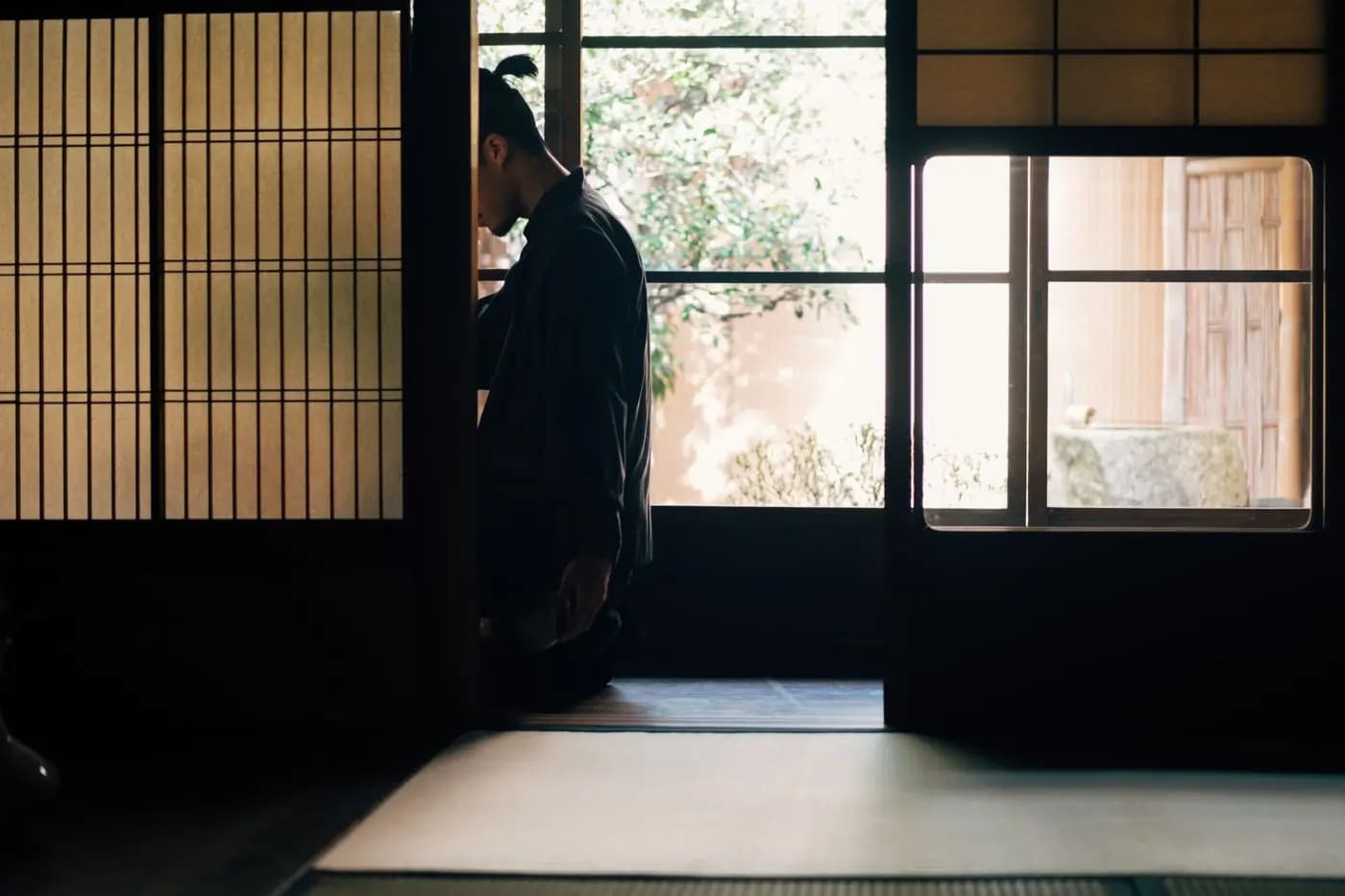
About fifty of these temples take in overnight visitors: these are the shukubo, originally intended for pilgrims. You sleep on futons in a tatami room, dine on Buddhist vegetarian cuisine, and can attend the monks' service the next morning. It is one of the rare chances in Japan to experience the rhythm of a temple from the inside, not just visit it.
Why not do Koyasan as a day trip? It is possible from Osaka, but the experience is very different. You miss the essentials: the Okunoin forest at nightfall, when the lanterns come on and the day groups have left, and the early-morning silence, with prayers, incense and cold air. Two hours of travel each way for four hours on site is a lot of train for little atmosphere.
The right format: arrive in the early afternoon, visit the Garan and Kongobu-ji, check in at the temple around 4pm, have dinner, walk through Okunoin in the evening, attend the morning service, then continue sightseeing (Okunoin by day, Daimon gate) before heading down around 1pm. Two nights let you add a section of the pilgrimage trail or a longer meditation, but one night is enough for most visitors.
One thing to know before booking: Koyasan is a mountain town. It is 5 to 8°C cooler than Osaka. In winter, snow and well-below-freezing temperatures are common, and some temple rooms stay chilly despite heating.
Getting to Koyasan by Nankai train from Osaka or Kyoto
Access is almost always via the Nankai Koya Line from Namba Station in Osaka. The journey has three stages:
- Nankai train from Namba to Gokurakubashi. The Koya limited express, with reserved seats, takes about 80 minutes; ordinary expresses take about 1 hour 40, often with a change at Hashimoto. The last stretch, winding up the valley, is beautiful: sit by the window.
- Cable car from Gokurakubashi to Koyasan Station in 5 minutes, up an impressive slope. Connections are timed with the trains.
- Nankai Rinkan bus from Koyasan Station to the centre (Senjuin-bashi stop, about 10 minutes) or to Okunoin (about 20 minutes). Note: the road between the station and the town is closed to pedestrians, so you must take the bus or a taxi.
Allow about 2 hours from Namba to the temple. From Kyoto, add 45 minutes to an hour to reach Namba, about 3 hours in all.
Tickets: Nankai sells a two-day pass for foreign visitors, the Koyasan World Heritage Ticket (digital version), covering the round-trip train from Namba, the cable car and the buses on the mountain, with discounts at some temples. The Koya limited express supplement is extra. Check the current price on Nankai's website; for a simple round trip with two or three bus rides, it usually pays off.
Practical tips:
- Book the Koya limited express a few days ahead for weekends and in autumn; it is often full.
- Travel light: there is walking between the bus stop and the temple, and plenty of steps. Osaka's big stations have lockers, and luggage forwarding services can send your suitcase on to your next hotel.
- By car, Koyasan is about 2 hours from Osaka on mountain roads; there are plenty of car parks, but the road is winding and sometimes snowy in winter.
There is also a seasonal direct bus from Kyoto, useful to avoid changes; its operating days vary from year to year.
How to choose and book a shukubo on Koyasan
Koyasan's shukubo range from very simple family-run temples to almost hotel-like places with listed gardens, rooms with bathrooms and onsen. Before booking, four criteria matter:
- Bathrooms: in most temples, toilets and washbasins are shared down the corridor, and the bath is communal, with set hours (often 4pm to 9pm). Rooms with private bathrooms exist but are rare, more expensive and go quickly.
- Location: temples near Okunoin (to the east) make the evening and morning walks easier; those in the centre, near Kongobu-ji and the Garan, are handier for buses and restaurants.
- Activities: in addition to the morning service, some temples offer a fire ceremony (goma), ajikan meditation, sutra copying (shakyo) or a monk-guided night tour of Okunoin. If an activity interests you, check it runs on your dates and whether it costs extra.
- Language: a few temples have English-speaking monks used to foreign visitors; others operate only in Japanese, which is part of the experience too.
Prices: expect ¥12,000 to ¥30,000 per person per night, dinner and breakfast included, sharing a room for two. The best-known temples, rooms with bathrooms and autumn dates (maples, late October to mid-November) sit at the top of the range or beyond. Solo travellers often pay more per night.
Booking: via the Koyasan shukubo association website (run with the tourist office), directly with temples that have their own sites, or through the major booking platforms, where some temples are listed. For autumn and May weekends, book two to three months ahead.
Good to know:
- Check-in is usually between 3 and 5pm; let them know if you will be late, as dinner is served at a fixed time.
- Some temples take cash only, and ATMs are scarce on the mountain: withdraw before going up.
- Walls are thin: keep voices low in the evening.
Shojin ryori dinner and morning service: how a night at the temple unfolds
Dinner (around 5:30 or 6pm) is shojin ryori, the cuisine of Buddhist monks: no meat, no fish and traditionally no garlic or onion. Served on lacquered trays, in your room or in a shared hall, it includes about ten small dishes, with two mountain specialities:
- goma-dofu, a creamy "tofu" made from sesame and starch, served with a little wasabi and soy sauce;
- koya-dofu, freeze-dried tofu rehydrated in broth, with a spongy texture.
You will also find vegetable tempura, mountain vegetables, pickles, miso soup and rice. The stock is usually made from kombu seaweed and mushrooms, suitable for vegetarians and often for vegans; still, mention any allergy when booking (sesame, soy and wheat are everywhere). Many temples sell beer and sake. The meal is generous but light, and people go to bed early.
The evening: communal bath, then a walk through Okunoin if you booked the night tour. Some temples lock their gates around 9 or 10pm: ask before going out.
Morning service (around 6am): a monk sometimes strikes a gong to wake guests. Dress warmly (yukata and jacket provided, socks recommended) and go to the main hall. For 30 to 45 minutes, the monks chant sutras before the altar, in the half-light and the scent of incense. Guests sit at the back, on tatami or on chairs for those who cannot kneel. You may be invited to offer incense at the end; just follow the monks.
At some temples, the service is followed or replaced by a fire ceremony (goma): a monk burns wooden tablets bearing wishes in a large ritual fire, to the rhythm of drums and chanting. It is one of the most powerful moments of the stay.
Breakfast (around 7am) is also vegetarian: rice, miso soup, tofu, vegetables, pickles, seaweed. Check-out is generally before 10am.
Basic rules:
- Take off your shoes at the entrance and use the slippers provided (and the separate pair for the toilets).
- During the service, no photos unless explicitly allowed, and phones on silent.
- Temples are not hotels: staff are few, monks have their own duties, and schedules are kept.
Okunoin by night and day: the cemetery and Kobo Daishi's mausoleum
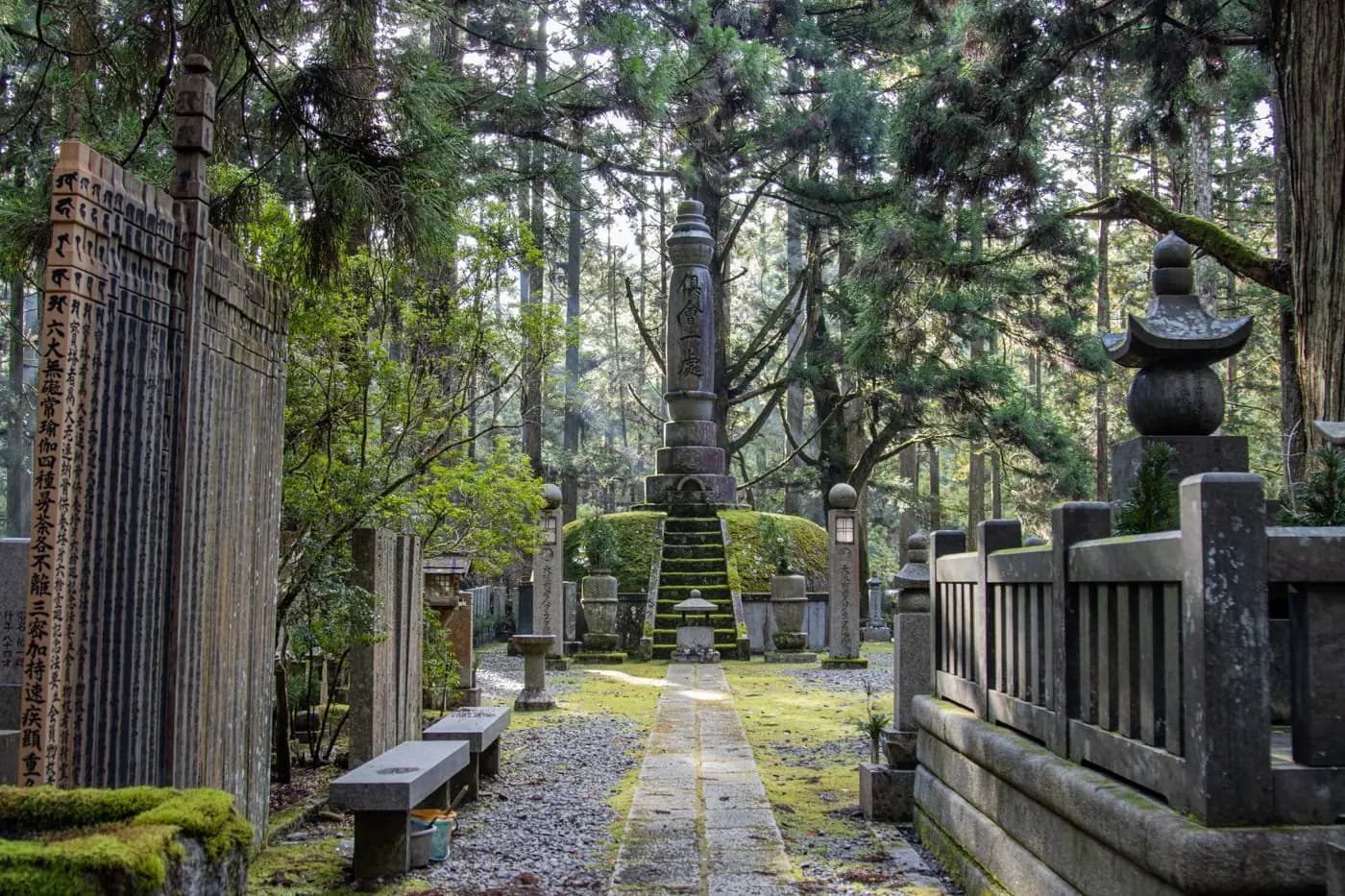
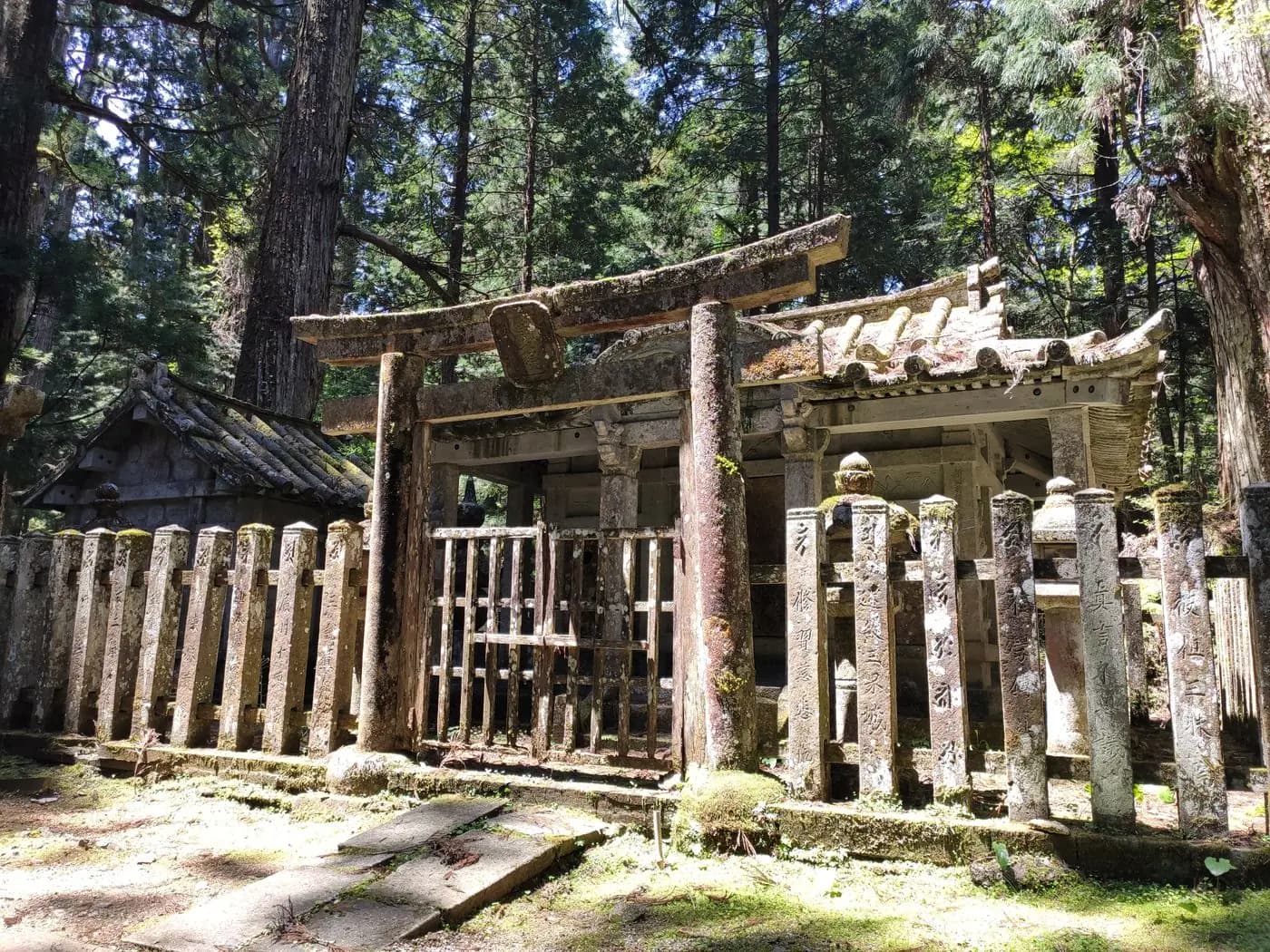
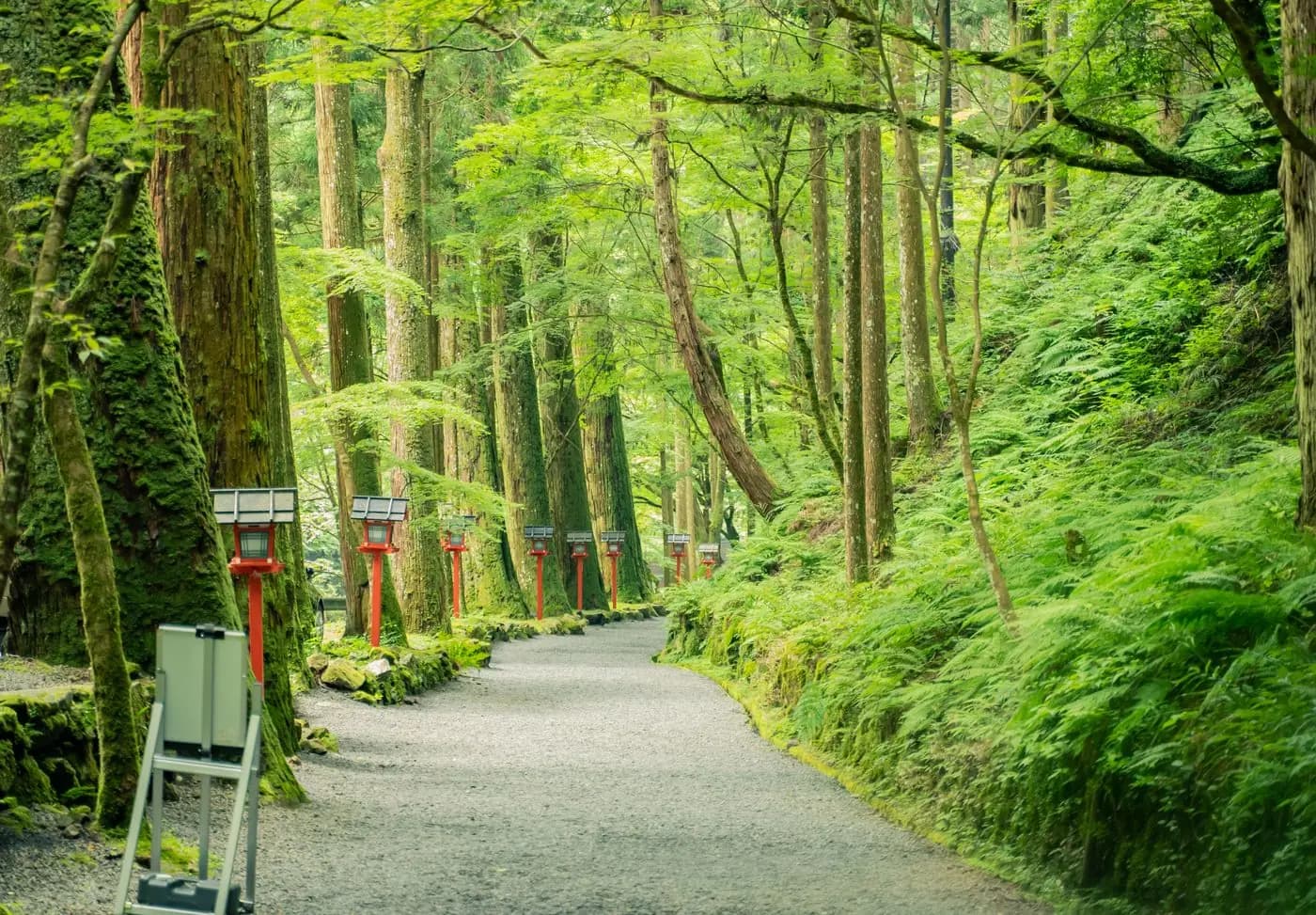
Okunoin is Koyasan's most sacred place and Japan's largest cemetery. From Ichi-no-hashi bridge, a path about 2 kilometres long crosses a forest of centuries-old cedars, among more than 200,000 graves, steles and monuments. Here lie famous warlords (Oda Nobunaga, Takeda Shingen, the Toyotomi family), thousands of ordinary people, and memorials of Japanese companies, some unexpected: a giant coffee cup, a rocket, and the monument erected by a pest control company in memory of termites.
At the end of the path, beyond Gobyo-bashi bridge, stand the Torodo, the lantern hall, where thousands of lamps offered by worshippers burn, and behind it Kobo Daishi's mausoleum. According to Shingon tradition, Kukai did not die in 835: he entered eternal meditation. Twice a day, around 6am and 10:30am, monks carry a meal to him in procession.
Rules beyond Gobyo-bashi bridge:
- no photos or video;
- no food or drink;
- bow before crossing the bridge, as a sign of respect;
- speak softly.
The night visit: walking through Okunoin after dark, when the stone lanterns light up along the path, is what stays with people most. Several temples, including Eko-in, run a monk-guided night tour of about 1.5 hours, explaining the graves, rituals and history of the place. It is paid, booking is advised, and some tours are open to people staying at other temples. You can also go on your own: the path is lit and safe, but it is very dark between lanterns. A headlamp or phone torch is useful, as are closed shoes.
The day visit: returning the next morning between 7 and 9am lets you see the details of the graves and the moss in daylight, before the groups. You can enter from the Okunoin-mae bus stop along a shorter, more modern path, but the historic entrance via Ichi-no-hashi is far more beautiful.
Every year on August 13, the candle festival (Rosoku Matsuri) lights the path with tens of thousands of candles.
What else to see on Koyasan: the Garan, Kongobu-ji and Daimon
The afternoon of arrival is enough for the main sites in the centre, all within walking distance:
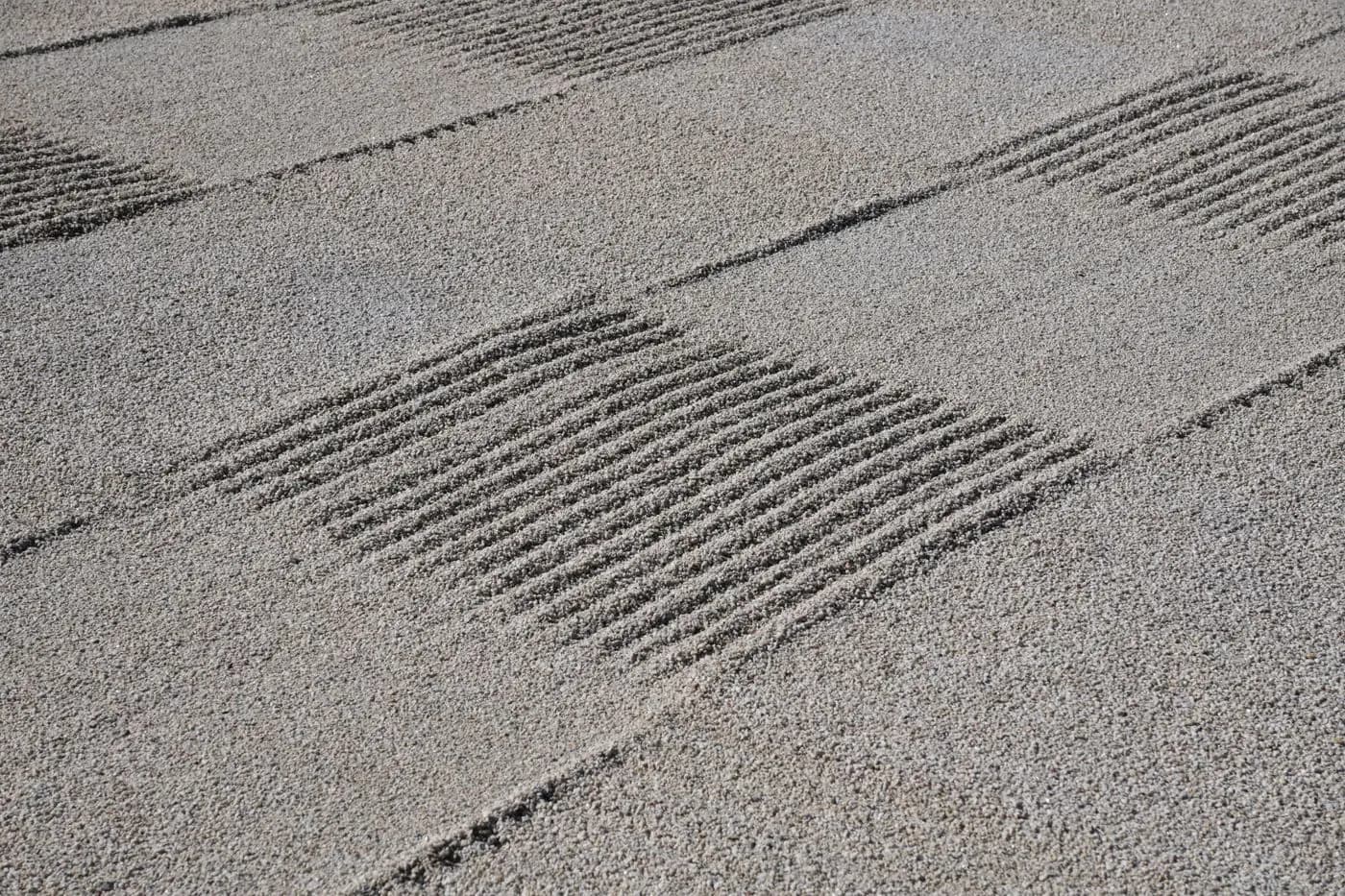
- Kongobu-ji: the head temple of the Shingon school and Koyasan's administrative seat. You walk through a series of rooms with painted sliding doors and the Banryutei, Japan's largest rock garden, where granite stones depict two dragons in a sea of clouds. A room offers visitors tea and a small sweet. Admission: ¥1,000. Allow 45 minutes.
- Danjo Garan: the sacred complex founded by Kukai himself. The Konpon Daito, a vermilion pagoda almost 50 metres tall rebuilt in 1937, houses a three-dimensional mandala (Buddha statues and painted pillars); it is paid, like the Kondo (main hall). The grounds themselves are free. Allow 45 minutes to an hour.
- Reihokan: Koyasan's treasure museum, with first-rate Buddhist sculpture and painting. Works rotate with exhibitions.
- Daimon: the great gate at the western end of the plateau, 20 minutes' walk from the Garan. At sunset, the view over the Wakayama mountains from its steps is superb, and there are few people.
A combined ticket sold at Kongobu-ji covers several of these sites (Kongobu-ji, Kondo, Konpon Daito, Tokugawa mausoleum and Daishi-kyokai hall) for about ¥2,500, worthwhile if you plan to see everything.
Lunch: a few restaurants serve shojin ryori at lunchtime, or soba. The café on the main street and shops selling fresh goma-dofu (to eat the same day) make a pleasant break. Most restaurants close early, around 5pm; that is no problem, since dinner is served at the temple.
For walkers: the Choishi-michi, a historic pilgrimage path, climbs from the Kudoyama valley to the Daimon over about 24 km, marked with stone posts every 109 metres. You can do just the last few hours, from Kamikosawa Station, arriving on foot at the Daimon.
Koyasan with a group: shukubo for seminars and corporate trips
A night at a temple works remarkably well as the highlight of a seminar or incentive trip: it breaks the urban rhythm, creates a shared experience and lends itself to a moment of collective reflection. But it means accepting certain constraints.
- Capacity: several large temples have many rooms and vast tatami halls and can host a group of 40 to 100 people, sometimes more, on the same night. Beyond that, split the group between two neighbouring temples, with a joint dinner in the larger one.
- Rooms: the norm for groups is shared rooms of two to four people, with communal bathrooms. For an executive committee or participants who need privacy, book the few rooms with bathrooms first, very early.
- Meals: shojin ryori is served to everyone at once in a large hall, which suits a group well. Special diets are handled in advance (sesame, soy, gluten allergies). For a more festive dinner, some temples agree to serve beer and sake in quantity.
- Activities: ajikan meditation, sutra copying, the fire ceremony or the Okunoin night tour can be booked exclusively for the group, with an English-speaking monk or an interpreter. A temple hall can also host a short working session before dinner.
- Transport: by private coach from Osaka, about 2 hours on mountain roads; large coaches can make the climb, but the road is narrow in places. By train, reserve whole cars on the Koya limited express and plan the buses accordingly, as the cable car and buses have limited capacity.
- Season: autumn is beautiful but saturated; May, June and September are easier to book. Winter requires participants who are warned about the cold.
Always brief participants before arrival: fixed times, silence, no photos during the service or at the mausoleum, shoes off. Well prepared, this night often becomes the main memory of the trip. SHINOGI DMC organises Koyasan stays for groups, coordinating temples, monks, transport from Osaka or Kyoto and interpreters.
Frequently asked questions
How much does a night in a Koyasan shukubo cost?
About ¥12,000 to ¥30,000 per person per night, shojin ryori dinner and breakfast included, sharing a room for two. Rooms with bathrooms, renowned temples and autumn cost more.
How do I get to Koyasan from Osaka?
Nankai train from Namba to Gokurakubashi (about 80 minutes by Koya limited express), a 5-minute cable car to Koyasan Station, then a bus to the centre or Okunoin. Allow about 2 hours.
Can you visit Okunoin at night?
Yes. The path is lit by lanterns and accessible at night. Several temples run a monk-guided night tour of about 1.5 hours, on reservation. Photography is still forbidden beyond Gobyo-bashi bridge.
Do you need to be Buddhist to stay in a Koyasan temple?
No. Shukubo welcome all visitors. You are only asked to respect the schedule, silence and temple rules; attending the morning service is optional but highly recommended.
Is shojin ryori suitable for vegetarians?
Yes: it contains no meat or fish, and the stock is usually made from kombu and mushrooms, often suitable for vegans too. Sesame, soy and wheat are everywhere: mention any allergy when booking.
Can a corporate group stay in a shukubo?
Yes. Several large temples host 40 to 100 people in shared rooms, with a joint dinner and private activities (meditation, fire ceremony, night tour). SHINOGI DMC organises these stays from Osaka or Kyoto.
Rédaction SHINOGI DMC · Updated
Sources
- Koyasan Shukubo Association — Accès, réservation de shukubo
- Koyasan Shukubo Association — Access to Koyasan
- Kongobu-ji — site officiel (Koyasan Shingon)
- Nankai Electric Railway — Koyasan, gare de Gokurakubashi et funiculaire
- Nankai Electric Railway — site anglais (Koyasan World Heritage Ticket)
- Wakayama Tourism — Koyasan
- UNESCO — Sacred Sites and Pilgrimage Routes in the Kii Mountain Range
- JNTO — Mt. Koya (Koyasan)
- Terres Japonaises (inspiration)