Yakatabune in Tokyo: what is it and how much does it cost?
A yakatabune is a roofed traditional boat fitted out as a banquet room. It cruises for about 2 hours 30 minutes between Tokyo Bay and the Sumida River while a Japanese dinner with free-flow drinks is served on board. In 2026, budget ¥13,000 to ¥28,000 per person, all inclusive (boat, meal and drinks), whether you join a shared boat as a couple or charter a whole boat from 20 guests.
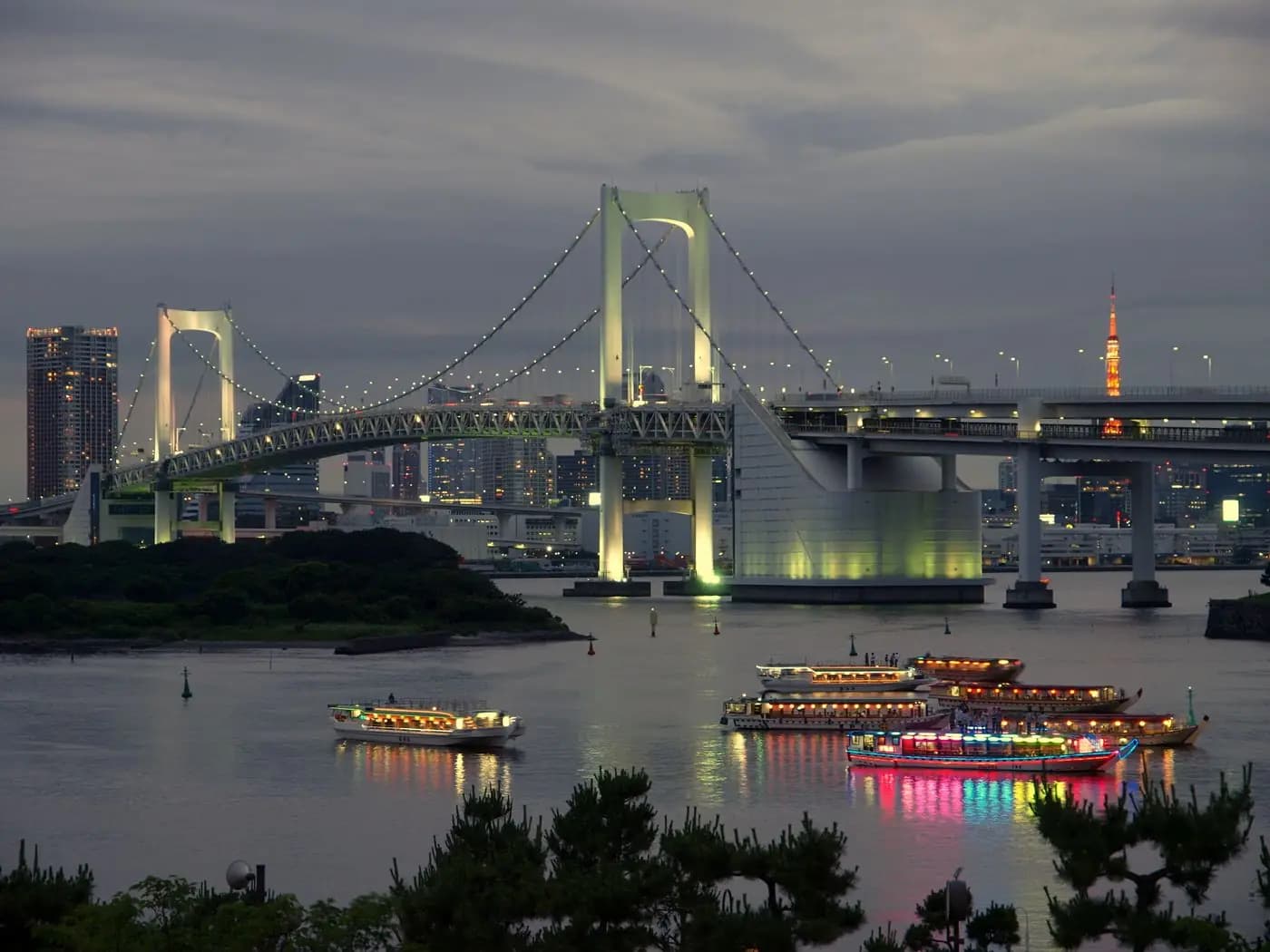
The custom dates back to the Edo period, when city merchants hired boats to dine and cool off on the Sumida. Today many Tokyo operators keep it alive, with boats seating from 30 to more than 100. There is a single cabin: low tables on tatami with a sunken leg well (horigotatsu) or tables with chairs, plus an open upper deck you climb onto while the boat is anchored to photograph the Rainbow Bridge.
What to know before comparing offers:
- Prices are almost always per person, even for a charter. There is no separate boat hire fee: a "whole boat" is paid for through a minimum number of guests.
- Free-flow drinks (nomihodai) are included: beer, sake, shochu, whisky and soft drinks.
- The standard cruise lasts 2 hours 30 minutes, with extensions available (¥1,650 per person per half hour at Harumiya in 2026).
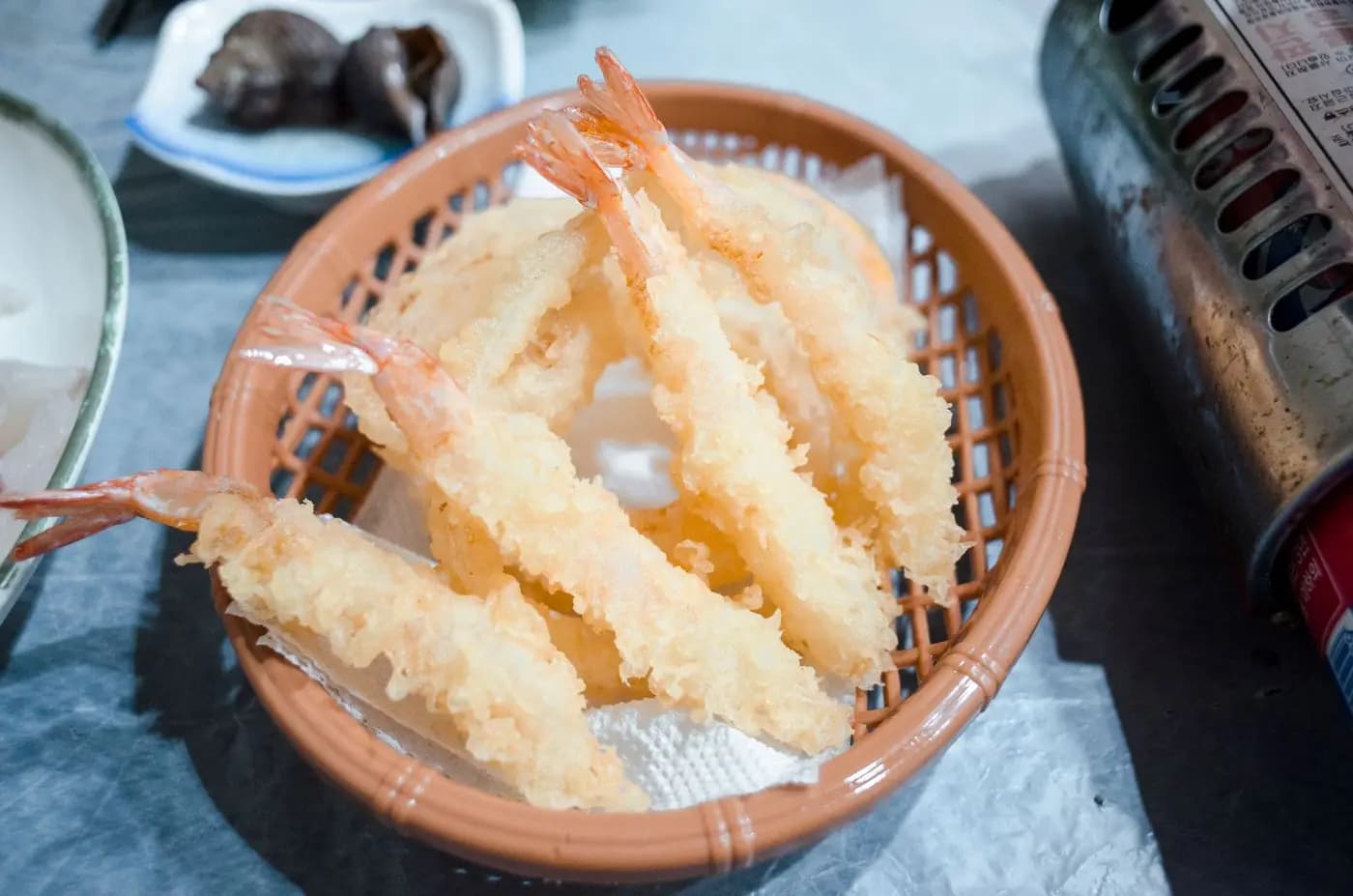
- The menu centres on sashimi and tempura fried on board, with simmered dishes, sushi or beef depending on the course.
To see where a yakatabune fits among Tokyo's other evening options, our Tokyo by night article compares group formats; this guide goes into the boat itself.
How does a yakatabune dinner cruise work?
The format hardly changes from one operator to the next. Here is a typical evening from Shinagawa, based on the route Funasei publishes.
- Arrive at the pier 15 to 20 minutes before departure. On tatami boats, shoes come off at the entrance, so wear clean socks without holes.
- Departure and first drink. The boat leaves the canal and reaches Odaiba in about 20 minutes. The cold dishes (sashimi, starters) are already on the table.
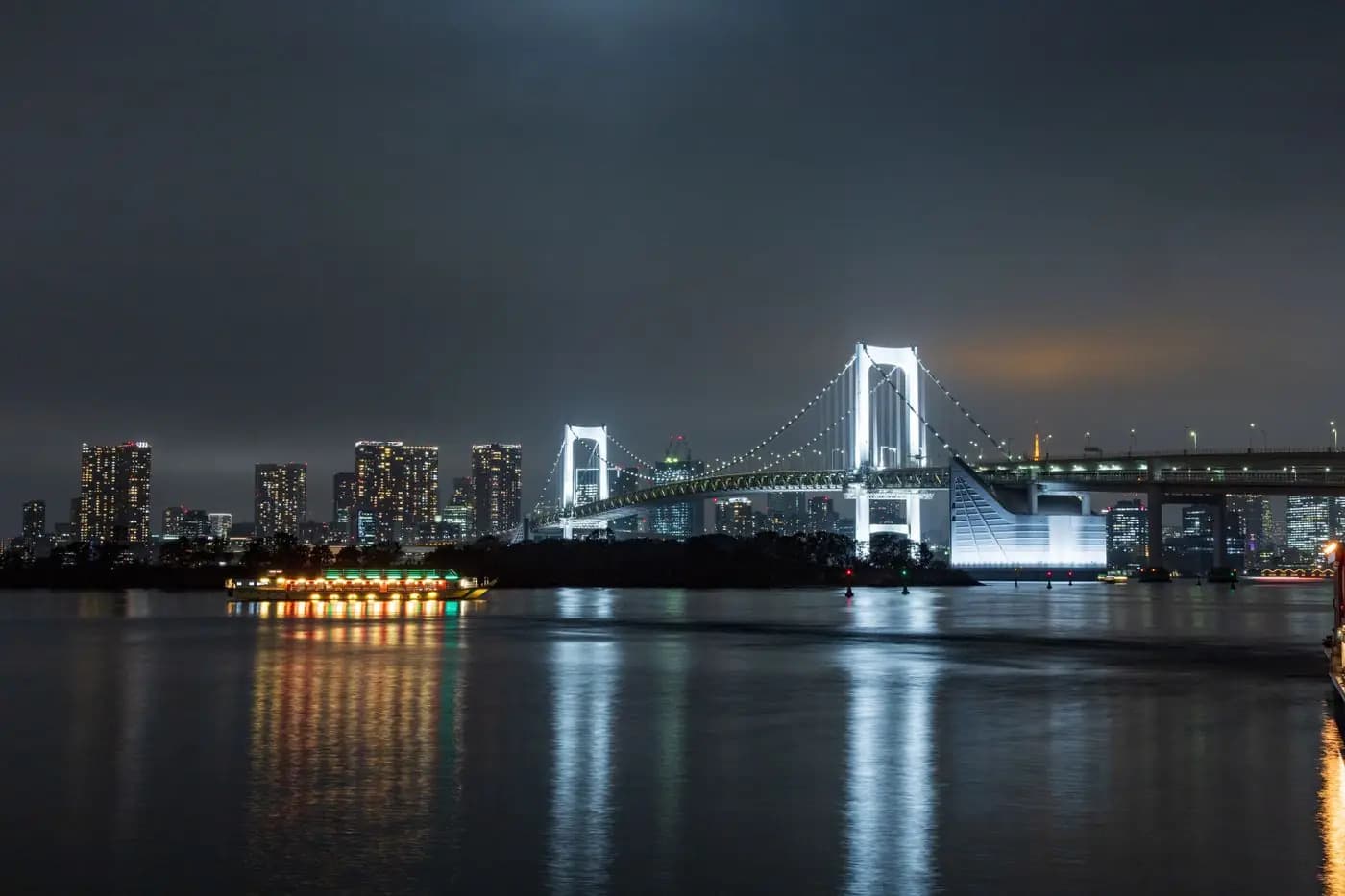
- Anchored off Odaiba for about 55 minutes. This is the heart of the evening: tempura arrives in batches, piping hot from the boat's kitchen. Guests climb onto the deck for the view of the Rainbow Bridge and Tokyo Tower.
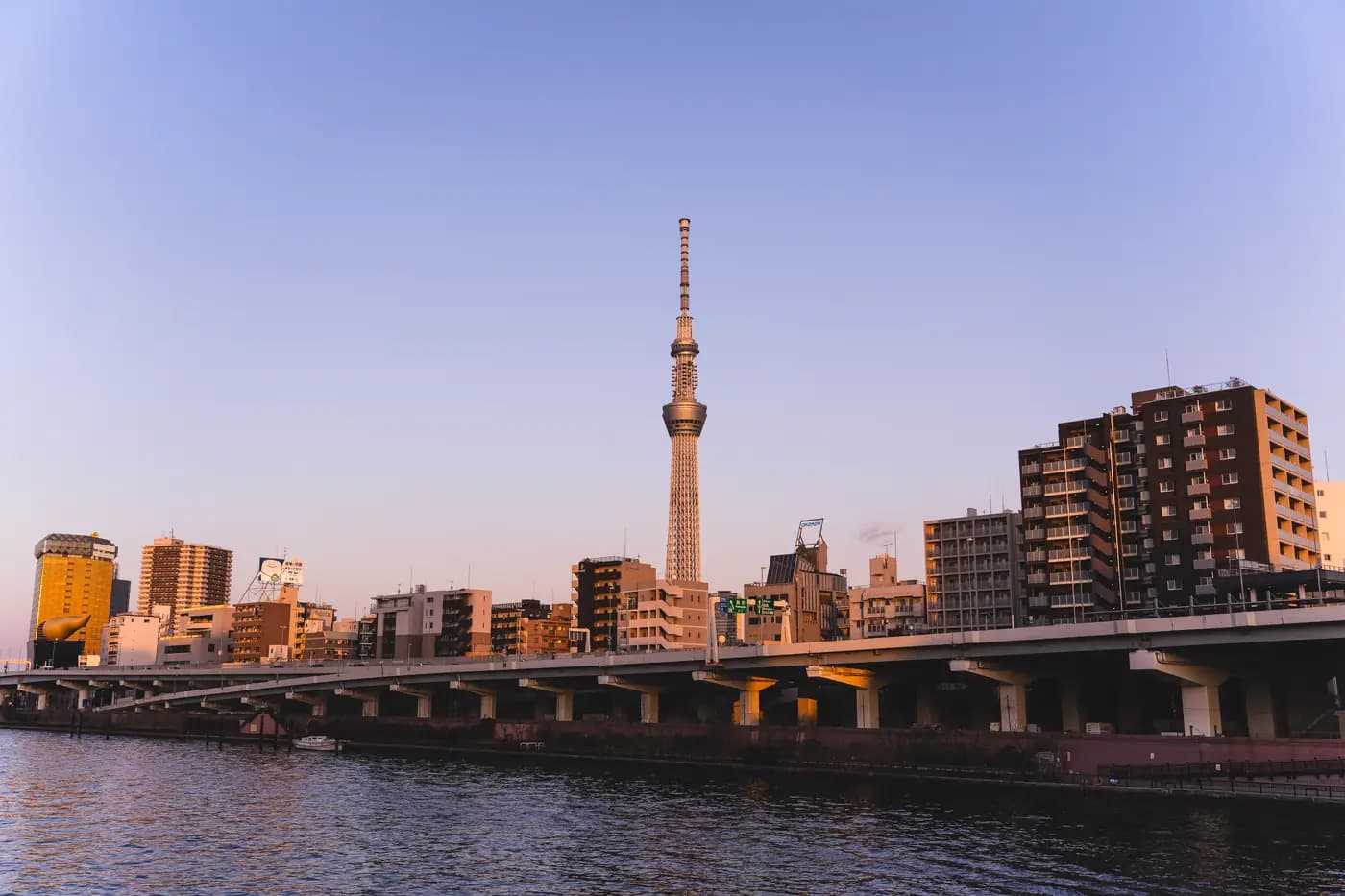
- Up the Sumida River to Eitai Bridge, then a view of the Skytree, and back to the pier. Total: about 2 hours 30 minutes.
On the plate, entry-level courses (around ¥13,000) bring sashimi, shrimp, fish and vegetable tempura, a few cold dishes, rice and miso soup. Higher courses (¥20,000 to ¥28,000) add more raw fish, sushi, a beef or shellfish dish. It is not fine dining in the kaiseki sense: quality follows the price you choose, and the tempura served straight from the fryer remains the highlight.
A few details that matter:
- Toilets: every boat has them, Western style, usually two to four depending on size.
- Smoking: outside only, at the stern or on deck.
- Seasickness: the boats sail in sheltered water and spend a long time at anchor; operators say they rarely hear complaints. Sensitive guests should sit in the middle of the cabin.
- Headroom: under 1.9 m on most boats. Very tall guests will duck when moving around.
Yakatabune Tokyo prices: shared boat or private charter?
There are two formats, and the difference is less about price per person than about flexibility.
The shared boat (noriai-bune) can be booked from 2 people on fixed dates published in a calendar. You share the cabin with other tables, often Japanese friends or families. Examples of 2026 rates, all inclusive:
- Harumiya (piers at Harumi, Ryogoku, Etchujima, Asakusa-Azumabashi and elsewhere): from ¥13,200, 2 hours 30 minutes.
- Funasei (Kita-Shinagawa): courses at ¥14,000, ¥16,800, ¥20,800 and ¥23,900.
The private charter (kashikiri-bune) is priced on a minimum number of guests. You choose the departure time, the menu and sometimes the route. 2026 examples:
- Harumiya: courses from ¥13,200 to ¥27,500 per person, from 20 adults on weekdays and 25 adults on Fridays, Saturdays, Sundays, public holidays and the eve of holidays. Under-20s pay 80% of the adult price.
- Funasei: courses from ¥13,000 to ¥22,900 per person, a fleet of seven boats seating 32 to 120. The minimum depends on the boat: 20 guests for the smallest, 30 to 40 for mid-size boats, 50 to 60 for the two largest.
The sum that matters to a planner: minimum guests × course price = floor budget. A Harumiya boat on a Saturday with the cheapest course therefore costs at least 25 × ¥13,200 = ¥330,000, even if only 18 of you come. Conversely, listed capacity is not real comfort: Funasei recommends 50 to 60 guests on a 72-seat boat. For a dinner where people move around and talk, aim for two-thirds of capacity.
Both operators revised their rates in spring 2026. The prices above are those shown on their websites in October 2026; they can change, and fireworks or cherry blossom dates are often sold on special terms.
Which route: Tokyo Bay, Odaiba, the Sumida or the Skytree?
The route mainly depends on the pier. Operators in Shinagawa and Harumi favour the bay; those in Asakusa and Ryogoku favour the river. Three main routes come up:
- Bay and Odaiba: the classic. A long stop off Odaiba island, with views of the illuminated Rainbow Bridge, Tokyo Tower and the Shiodome towers. The most photogenic, and the calmest on board, since the boat barely moves during the meal.
- Sumida and Skytree: up the river under a series of lit bridges towards Asakusa, with the Skytree as the focal point. More urban and lively; the boat spends more time moving.
- Combined: Odaiba, then the Sumida up to Eitai Bridge or beyond. This is Funasei's standard route and the best compromise for a first yakatabune.
Harumiya also runs routes towards Maihama, on the Tokyo Disney Resort side, and Funasei a "Skytree" route for shared boats only (about 2 hours 45 minutes).
The pier also shapes group logistics. Funasei's pier in Kita-Shinagawa is a 13-minute walk from Shinagawa Station and has no parking: a coach drops the group nearby. Harumiya uses several piers, some served by the city's water buses, so you can pick the one closest to the hotel. For a group staying in Shinagawa or Takanawa, the bay from Shinagawa is simplest; for a hotel in Asakusa or Ryogoku, starting on the Sumida saves a transfer.
Our article on day trips from Tokyo has more ideas for the daytime part of a stay.
Cherry blossoms, fireworks, year-end: when to book a yakatabune?
Yakatabune run all year: the cabin is air-conditioned and heated, and you dine under cover even in the rain. But four periods change the picture entirely.
- Cherry blossoms (late March to early April). Operators run special routes on the Sumida, which is lined with cherry trees. At Funasei, the hanami cruise lasts about 2 hours 45 minutes with a 30-minute stop near Sakura Bridge in Asakusa. Dates depend on the bloom, known only a few weeks ahead: book a window and accept the risk. Our cherry blossom article has the timing city by city.
- The Sumida River fireworks, traditionally held on the last Saturday of July (25 July in 2026, around 20,000 shells). Boats with a spot on the river sell out months ahead, at specific rates.
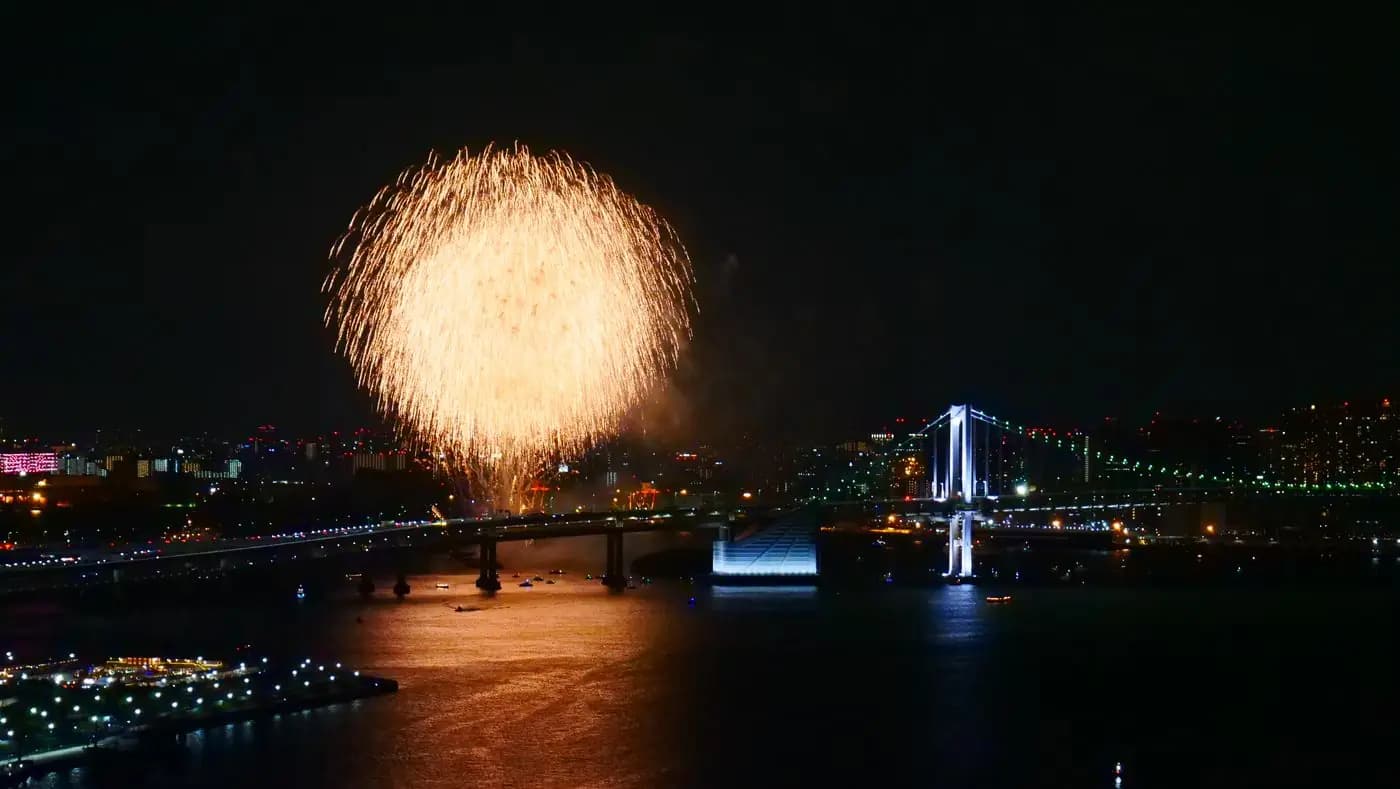
- The Tokyo Bay Grand Fireworks Festival (Tokyo-wan Daihanabi-sai), back on Saturday 24 October 2026 after an eleven-year break, organised by Chuo and Minato wards. It is cancelled in bad weather, with no postponement. Funasei's cruises for that night are fully booked. For 2027, the organisers have not announced a date yet.
- Bonenkai season (December). Japanese companies' year-end dinners fill private boats, especially on Fridays. It is also when a Saturday moves to a 25-guest minimum at some operators.
Recommended lead times for a private boat: 2 to 3 months for an ordinary spring or autumn date, 4 to 6 months for December, cherry blossom season or a fireworks night. A shared boat on a Tuesday in June can be booked a few days ahead.
As for weather, the operator alone decides to cancel or postpone in strong wind, a typhoon or an official warning, and calls to let you know. In typhoon months (mainly August and September), keep a plan B for an important closing dinner.
Practical tips: dress, dietary needs, language and tipping
A few points people often discover too late:
- Dress: no dress code, but on tatami boats you sit on the floor. A short skirt or very tight trousers quickly become uncomfortable over 2 hours 30. Bring a warm layer for the deck, even in May: the wind on the bay is surprisingly cold.
- Shoes: they come off at the entrance of tatami boats. Boats with chairs (Atsuhime, Benkei or Shizuka-gozen at Funasei, for example) avoid the issue, which matters for older guests or those with reduced mobility.
- Dietary needs: menus are prepared in advance for the whole boat. Vegetarian, shellfish or fish allergies, alcohol-free: flag them in Japanese when booking, with the exact number of guests concerned. A fully fish-free menu is rarely possible on the day. Our article on dietary needs and allergies in Japan gives useful wording.
- Language: bookings are made in Japanese. Harumiya says it can put foreign-language staff on board on request; Funasei handles overseas bookings through a partner. For a speech or a host, plan your own interpreter.
- Payment: advance bank transfer at Harumiya for private boats; the organiser settles in a single payment.
- Tipping: no. Service is included, and leaving cash on the table embarrasses the crew.
- Karaoke: most private boats have karaoke (DAM at Funasei, with two wireless microphones). Not everyone loves it: with a corporate group, offer it after dessert rather than make it the programme.
Chartering a yakatabune for a group or a company
For a seminar or incentive in Tokyo, a yakatabune offers something rare: the whole group dines in one room, with no splitting between restaurants, and a backdrop that changes through the evening. It suits groups of 20 to around 100; beyond that, you charter two boats that sail together, or switch to a modern restaurant boat.
What makes the difference in planning:
- Choose the boat for actual numbers, not capacity. For 40 guests, a 60-seat boat recommended for 45 leaves room; a 48-seat boat would be full.
- Keep a margin on the guaranteed minimum. If numbers may drop, pick a boat whose minimum is well below your registrations.
- Plan the transfer: a return coach from the hotel with a drop-off close to the pier. Getting 40 people home by taxi from a pier with no taxi rank is not realistic.
- Time the speech well: during the stop at anchor, when the boat is steady and before karaoke starts. Microphones, projectors and screens are available on some boats, sometimes at extra cost.
- Set the departure time: with a charter, you choose your slot. Leaving around 6:30 pm in October or November lets you watch night fall over the bay; in June, 7 pm is better.
- Give the group a single menu and handle dietary needs separately, with table cards if needed.
SHINOGI DMC arranges this kind of evening as part of seminars and incentives in Tokyo: choice of operator and boat, booking and menus in Japanese, transfers, interpreter and on-site coordination.
Frequently asked questions
How much does a yakatabune cost in Tokyo?
In 2026, about ¥13,000 to ¥28,000 per person, all inclusive (2.5-hour cruise, dinner and free-flow drinks). Harumiya starts at ¥13,200; Funasei at ¥13,000 for charters and ¥14,000 on shared boats.
Can two people take a yakatabune?
Yes, on shared boats (noriai-bune), bookable from 2 people on set dates. Chartering a whole boat requires at least 20 guests, or 25 at weekends at Harumiya.
How long does a yakatabune cruise last?
About 2 hours 30 minutes, including nearly an hour at anchor off Odaiba on the classic route. Cherry blossom cruises last about 2 hours 45 minutes, and charters can be extended by the half hour.
Are drinks included on a yakatabune?
Yes, courses generally include free-flow drinks: beer, sake, shochu, whisky and soft drinks. Minors get soft drinks only.
Does the yakatabune sail if it rains?
Yes, the cabin is covered and air-conditioned. In strong wind, a typhoon or an official warning, however, the operator can cancel or postpone and will call the customer.
When should a group book a yakatabune?
Two to three months ahead for an ordinary date, four to six months for December (bonenkai season), cherry blossoms or a fireworks night. Funasei's sailings on 24 October 2026, the night of the Tokyo Bay fireworks, were already full by mid-October.
Rédaction SHINOGI DMC · Updated
Sources
- Harumiya — Tarifs des bateaux partagés et privatisés (屋形船 料金)
- Harumiya — Privatisation (貸切屋形船), minimums de groupe
- Harumiya — FAQ (météo, toilettes, karaoké, paiement)
- Funasei — Site officiel, formules et tarifs 2026
- Funasei — Bateaux privatisés, capacités et minimums
- Funasei — Parcours et durées
- Funasei — Accès (Kita-Shinagawa)
- Arrondissement de Chuo — Tokyo Bay Grand Fireworks Festival 2026 (東京湾大華火祭)
- Arrondissement de Minato — Communiqué sur le retour du Tokyo Bay Grand Fireworks Festival