Large suitcases on the Shinkansen: the 160 cm rule
Since May 2020, a rule has applied on the Tokaido, Sanyo and Kyushu Shinkansen, and later the Nishi-Kyushu: luggage whose length + width + height exceeds 160 cm must be reserved. In practice, a 28- to 32-inch checked suitcase often exceeds this threshold; a medium 24- to 26-inch case usually stays below.
The three categories according to JR Central:
- Up to 160 cm: no formalities. The case goes on the rack above the seats or in front of your legs.
- From 160 to 250 cm: "oversized" luggage. You must book a "seat with oversized baggage area", usually the last row of certain cars, behind which the case is stored. The booking costs nothing beyond the reserved seat, but places are limited.
- Over 250 cm: not allowed on board.
Without a reservation, staff charge ¥1,000 and ask you to move the case to a place they designate. Sports equipment (skis, golf bags, bagged bicycles), musical instruments, strollers and wheelchairs are not affected.
You book these seats along with your ticket: at the counter, at ticket machines, on smartEX or with a JR Pass bought online. On JR East lines (Tohoku, Hokkaido, Joetsu, Hokuriku, Yamagata, Akita), there are no such bookable seats: use the luggage spaces at the end of the car when there is room, or keep the case with you.
Our advice: if you travel with a large suitcase, book the luggage seat as soon as sales open, one month ahead, especially during holiday periods. Or better still, send it ahead.
Luggage lockers and storage in Japan: prices and tips
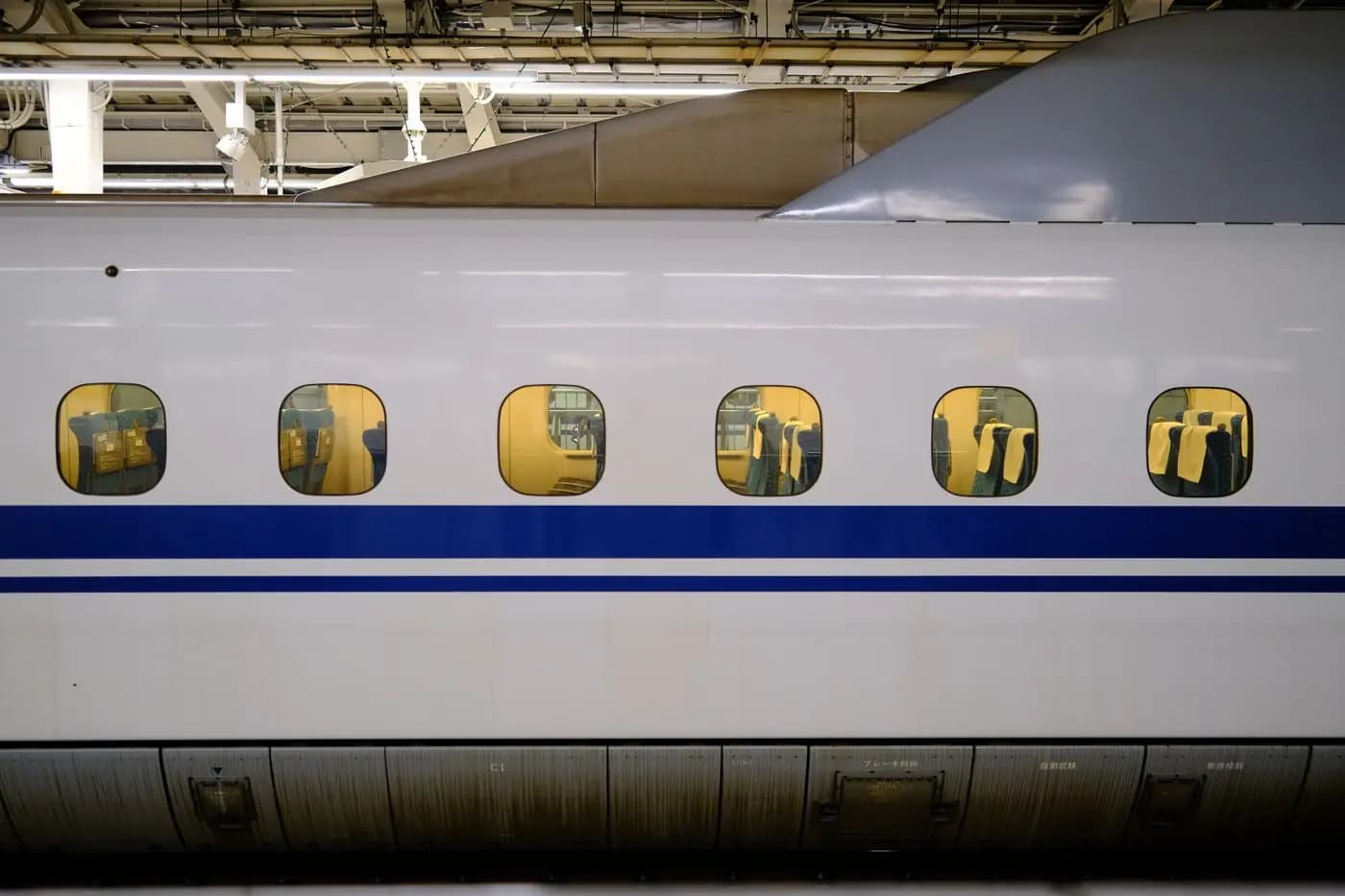
Luggage lockers (coin lockers) are everywhere: stations, subway stops, shopping centers, some tourist sites. They let you explore a city between hotel check-out and the evening train.
Price benchmarks, per day (or per period until midnight, depending on the model):
- Small locker (backpack, cabin bag): ¥400 to ¥500.
- Medium locker (carry-on suitcase): ¥500 to ¥700.
- Large locker (checked suitcase): ¥700 to ¥1,000.
Newer lockers are paid with an IC card (Suica, ICOCA), which also acts as the key; older ones only take ¥100 coins. Beyond three days in most cases, contents are removed and stored by the operator for a fee.
The problem is availability. In Kyoto, Tokyo or Shin-Osaka, large lockers are full by 10 a.m., especially at weekends. A few solutions:
- Staffed baggage rooms in major stations (Kyoto, Tokyo, Shin-Osaka, Hakata), often ¥800 to ¥1,000 per bag per day. They take large suitcases, with no hunting for a free locker.
- Luggage storage booking apps (ecbo cloak and similar), giving access to space in shops, cafés and hotels, around ¥500 to ¥800 per bag per day for a small item, a little more for a suitcase.
- Same-day delivery services from some stations or storage counters to your hotel, handy in Kyoto.
- Your hotel, quite simply: most keep luggage free of charge before check-in and after check-out, even at 7 a.m.
Avoid relying on a locker for a large suitcase on a busy day: it is the surest way to lose an hour wandering around a station.
Takkyubin: sending your suitcase hotel to hotel in Japan
Takkyubin (door-to-door parcel delivery) is one of Japan's most useful services for travelers. You leave your suitcase at the hotel front desk in the morning, travel hands-free, and find it at the next hotel, usually the following day. Japanese people have used it for decades for ski, golf and holiday luggage.
Three main carriers: Yamato Transport (the black cat, "Kuroneko"), the most common in hotels, Sagawa Express and Japan Post (Yu-Pack).
How it works with Yamato:
- Ask at the front desk the evening before or the morning you leave. The hotel provides the waybill, often helps fill it in and calls the carrier.
- Give the address of the next hotel, its phone number, your name as on the booking and your arrival date. Let the destination hotel know that luggage will arrive before you: this is standard and they will hold it.
- Pay in cash, by card or with an IC card depending on the hotel.
The price depends on size (sum of the three dimensions) and distance. According to Yamato's 2026 rates (cash payment), a suitcase sent from the Tokyo area to the Kyoto and Osaka area costs:
- Size 140 (up to 140 cm, 20 kg): ¥2,780.
- Size 160 (up to 160 cm, 25 kg): ¥3,160.
- Size 180 or 200 (large 32-inch cases): ¥4,480 to ¥5,410.
Delivery times: next day between the major cities of Honshu (Tokyo, Nagoya, Kyoto, Osaka), one to two days to Fukuoka, two days or more to Hokkaido and Okinawa. So keep what you need for the first night in a small bag.
The carrier's liability is capped (¥300,000 per parcel at Yamato). Keep valuables, laptops and medication with you.
Sending luggage to or from the airport
Takkyubin also works with airports, in both directions.
From the airport to the hotel. At carrier counters in the arrival halls of Narita, Haneda, Kansai, Chubu or Fukuoka, you hand over your suitcase on landing and head into town by train, luggage-free. Delivery is usually the next day. At Haneda and Narita, Yamato also offers same-day delivery to Tokyo hotels if you drop the case early enough in the morning (around 11 a.m. at Haneda), at a higher price. Since summer 2025, Yamato charges a ¥660 counter fee at Narita, Haneda and Kansai airports.
From the hotel to the airport. The "Airport TA-Q-BIN" service delivers your suitcase to the carrier's counter in the departure terminal, where you collect it before check-in. Yamato adds a ¥660 storage and handover fee. Golden rule: send the case at least two days before your flight from the big cities, three from a remote region, and check the cut-off time given by the hotel.
A combination we often recommend: on arrival, send the large suitcase from the airport straight to the second hotel (Kyoto, for instance) and spend the first days in Tokyo with a carry-on. On the way home, send the case to the airport from the second-to-last hotel.
Watch out for banned or regulated items: lithium power banks, lighters, aerosols, and now tax-free purchases subject to the customs check on departure. Keep the latter in your hand luggage, in a bag that is easy to open.
Traveling light in Japan: which suitcase and what to pack?
In Japan, traveling light is not a fad: it is what makes the trip enjoyable. Some station exits have stairs without escalators, commuter trains are packed at rush hour, Kyoto's sidewalks are narrow, and rolling a 30 kg suitcase through the lanes of Gion is no fun for anyone, you or the residents.
What works well, according to our travelers:
- One carry-on or medium suitcase (up to 24–26 inches) per person, under 160 cm, to stay free on the Shinkansen.
- A daypack for sightseeing, big enough for a rain jacket, a water bottle and the day's shopping.
- A foldable bag for purchases and for the "buffer night" when the suitcase travels by takkyubin.
- Easy-wash clothes: most business hotels have coin laundries (¥300 to ¥500 per wash, the same for the dryer), so you can pack one week of clothes for two.
- Shoes that come off easily: temples, ryokans, some restaurants and fitting rooms ask you to remove them.
Conversely, leave at home the hair dryer (provided everywhere and not suited to 100 V), bath towels and a full toiletry kit: even the simplest hotels provide shampoo, toothbrushes and pajamas.
Finally, keep some space for the return trip. Ceramics, knives, tea, sake and stationery fill a suitcase quickly. You can also send a box to Europe by Japan Post (EMS or airmail parcel) before you leave.
Forwarding luggage for 50 people between two hotels
For a group, the luggage question is settled before departure, not on the platform. Fifty suitcases on a Shinkansen means fifty luggage seats to book, blocked aisles and a real risk of delay when getting off, as the train only stops for one to two minutes. So we almost always send the suitcases separately.
Two methods, depending on group size and itinerary:
- Grouped takkyubin (up to about 30 to 40 cases): waybills pre-filled by the organizer with each participant's name, pick-up at the hotel the evening before, delivery to the next hotel the following day. Simple, but each case is a separate parcel.
- Chartered truck (over 40 cases, or for legs with tight timing): one truck loads all the cases at once and delivers them together, with someone overseeing the loading. For 50 people it is often barely more expensive than takkyubin, and much safer.
The process we use for 50 participants:
- Colored tags with the participant's name and departure and arrival hotels, handed out on arrival in Japan.
- Suitcases dropped the evening before (around 8 p.m.) in a room set aside by the hotel, checked against a list.
- A small overnight bag for everyone: toiletries, medication, next day's clothes, charger.
- Delivery before 3 p.m. to the arrival hotel, notified in advance, which takes the cases up to the rooms or lines them up by room number.
- Insurance checked beyond the standard cap for valuable luggage.
If the group travels by coach, the luggage holds are often enough: a 45-seat coach takes one suitcase per person. The issue really only arises with trains and domestic flights.
This is exactly the kind of logistics SHINOGI DMC organizes for seminars and incentive trips in Japan: participants board the Shinkansen with a light bag and find their suitcase in their room on arrival.
Frequently asked questions
Can you take a large suitcase on the Shinkansen?
Yes. Up to 160 cm (sum of the three dimensions), no formalities. From 160 to 250 cm, you must book a seat with a baggage area on the Tokaido, Sanyo, Kyushu and Nishi-Kyushu lines, at no extra cost; otherwise there is a ¥1,000 penalty.
How much does it cost to send a suitcase from Tokyo to Kyoto?
With Yamato in 2026, about ¥2,780 for a size 140 and ¥3,160 for a size 160 (cash payment), usually delivered the next day. Large cases (180–200) cost ¥4,480 to ¥5,410.
How long before the flight should you send your suitcase to the airport?
At least two days ahead from Tokyo, Kyoto or Osaka, three from a remote region. You collect the case at the carrier's counter in the terminal before check-in, with a ¥660 fee at Yamato.
How much is a luggage locker in Japan?
Generally ¥400 to ¥500 for a small locker, ¥500 to ¥700 for a medium one and ¥700 to ¥1,000 for a large one, per day. Large lockers go fast: staffed baggage rooms in major stations are a good alternative.
Does takkyubin work on Sundays?
Yes. Yamato, Sagawa and Japan Post collect and deliver every day, including weekends and public holidays, with delivery times sometimes longer during New Year, Golden Week and Obon.
How do you handle luggage for a group of 50 in Japan?
Forward the suitcases the day before, by grouped takkyubin or chartered truck, with name tags and delivery before 3 p.m. to the next hotel. Each participant keeps a small overnight bag and travels light on the Shinkansen.
Rédaction SHINOGI DMC · Updated
Sources
- JR Central — Oversized baggage on the Tokaido, Sanyo, Kyushu and Nishi-Kyushu Shinkansen
- JR West — Bringing oversized baggage on the Shinkansen (新幹線への特大荷物の持ち込み)
- JAPAN RAIL PASS (official) — Oversized baggage rules (PDF)
- Yamato Transport — TA-Q-BIN rate table (cash payment)
- Yamato Transport — What is the Airport TA-Q-BIN service?
- Yamato Transport — Airport handling and counter fees
- Yamato Transport — Same-day delivery service from airports
- JNTO — Préparer son voyage au Japon