Geiko, maiko, geisha: who are they really?
The word geisha literally means “person of the arts”. It is the term used in Tokyo and the rest of Japan. In Kyoto, people say geiko, “child of the arts”, and the city also has maiko, “dancing children”, the apprentices.
A geiko is a professional artist. Her job is to entertain at private banquets (ozashiki) through classical dance (kyōmai), song, shamisen, parlour games and the art of conversation. She is neither a hostess nor a courtesan: that confusion, partly born in the post-war years, is what irritates Gion residents the most.
The typical path in Kyoto:
- joining a house (okiya), often straight after junior high school, at 15 or 16;
- a shikomi period of about a year: communal life, learning the Kyoto dialect, customs and first lessons;
- official debut as a maiko (misedashi), followed by four to five years of daily training in dance, music and teahouse customs;
- around 20, the erikae, “turning of the collar”, which marks the move to geiko status.
Geiko and maiko do not work independently. They belong to an okiya and perform in ochaya, the teahouses that host banquets, within a specific district, the hanamachi. Their total number in Kyoto is only a few hundred, which explains both how rare encounters are and the cost of an evening.
How to recognise a maiko, a geiko… and a tourist in costume
The difference is quick to spot once you know where to look.
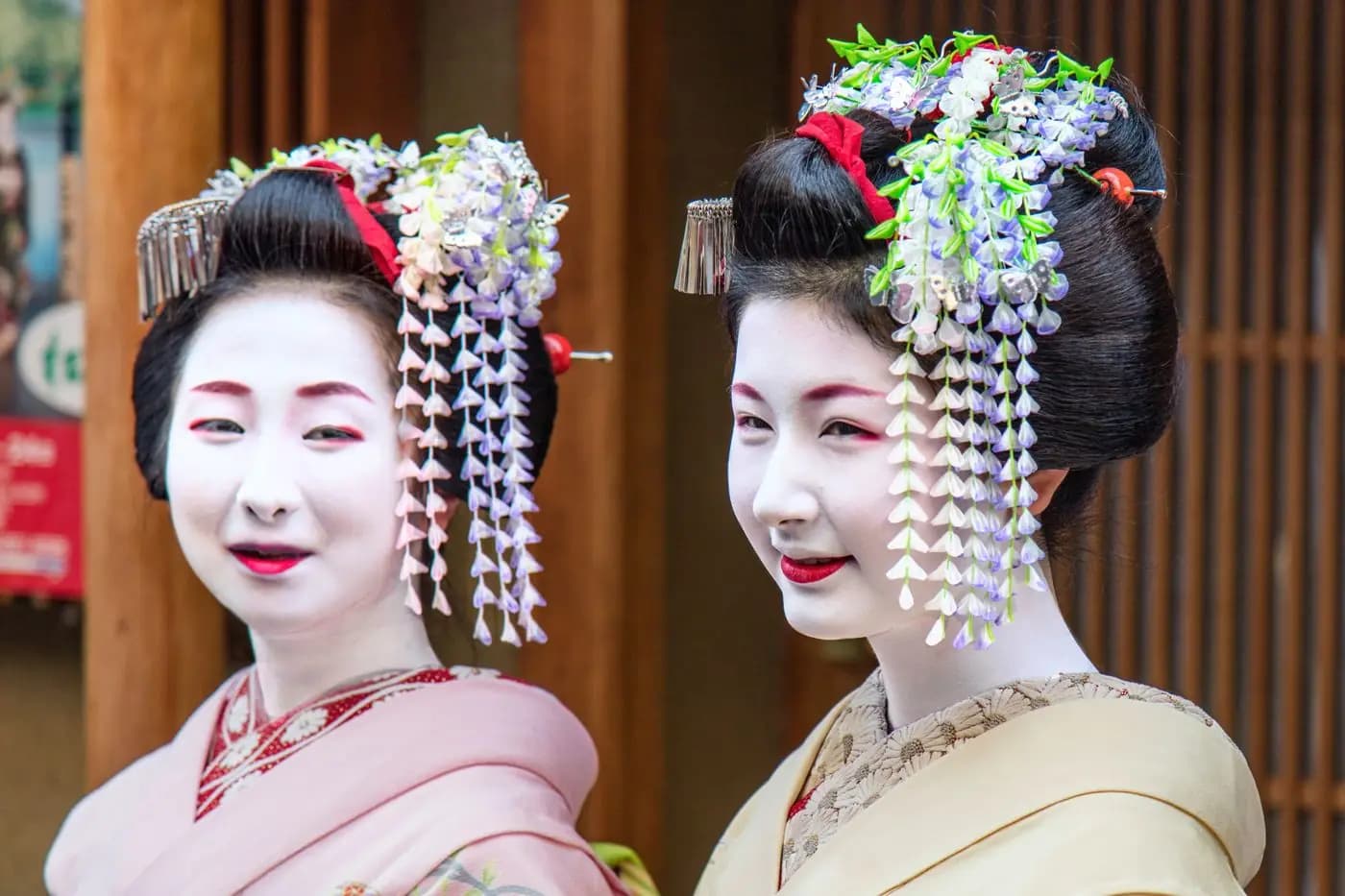
A maiko wears:
- a brightly coloured kimono with long flowing sleeves (furisode);
- a darari no obi sash that hangs almost to her ankles at the back;
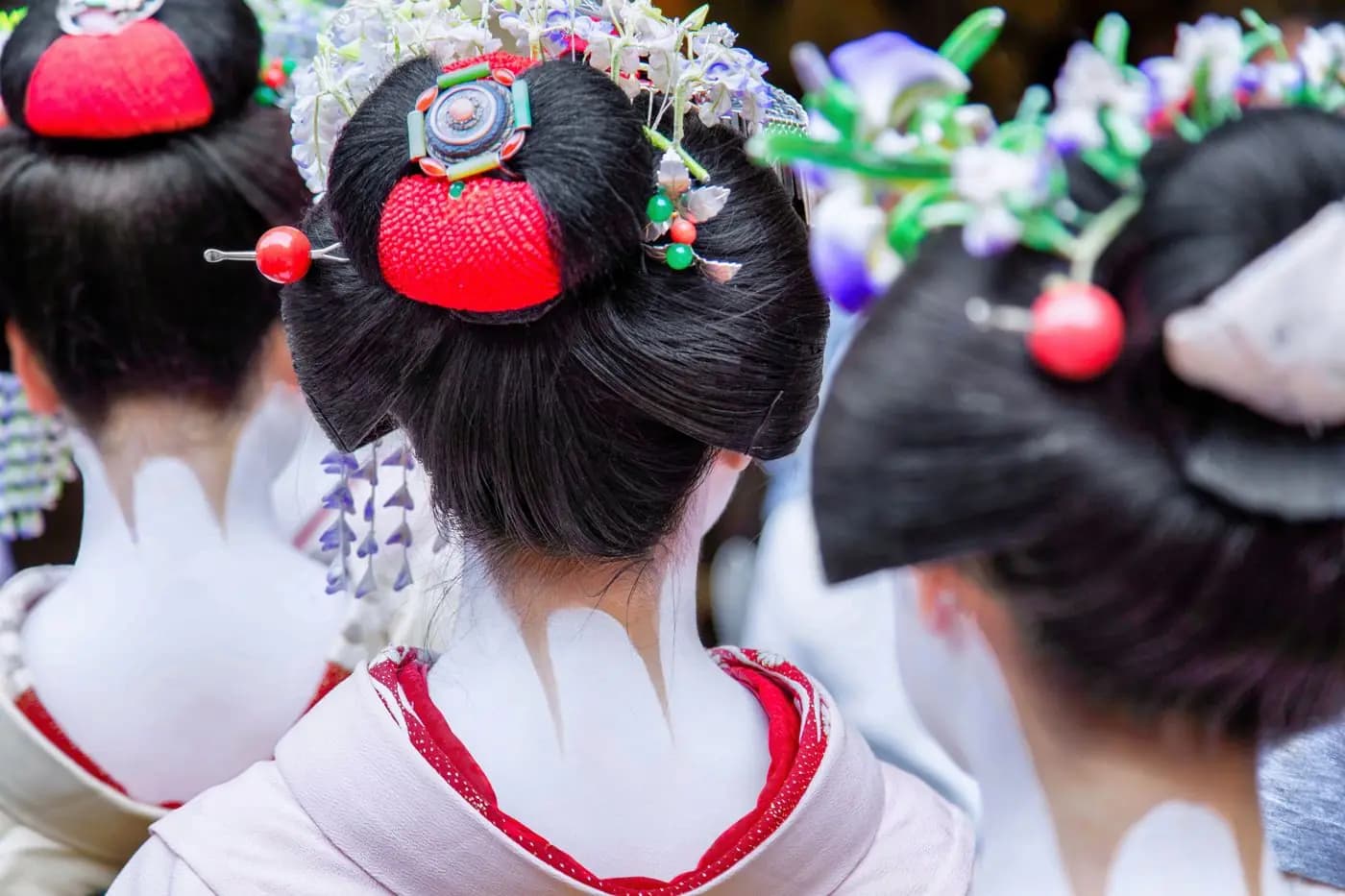
- a red embroidered collar, which gradually turns white over the years of training;
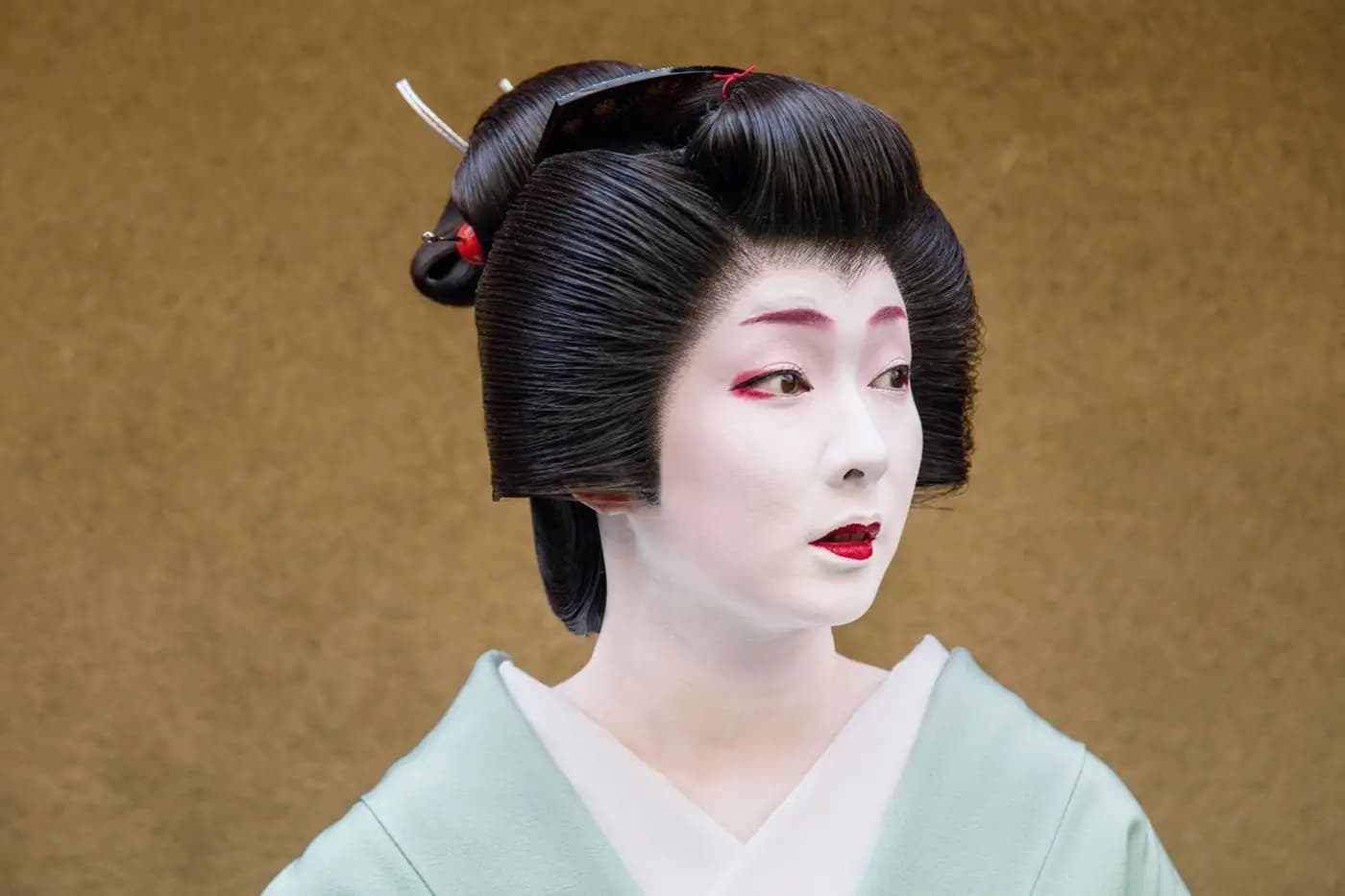
- her own hair, styled in an elaborate chignon and decorated with floral kanzashi that change every month;
- tall wooden sandals, the okobo.
A geiko wears a more understated kimono with short sleeves, a sash tied in a drum knot (taiko), a white collar, a more discreet wig and low sandals (zōri). Her white make-up is often reserved for banquets and the stage.
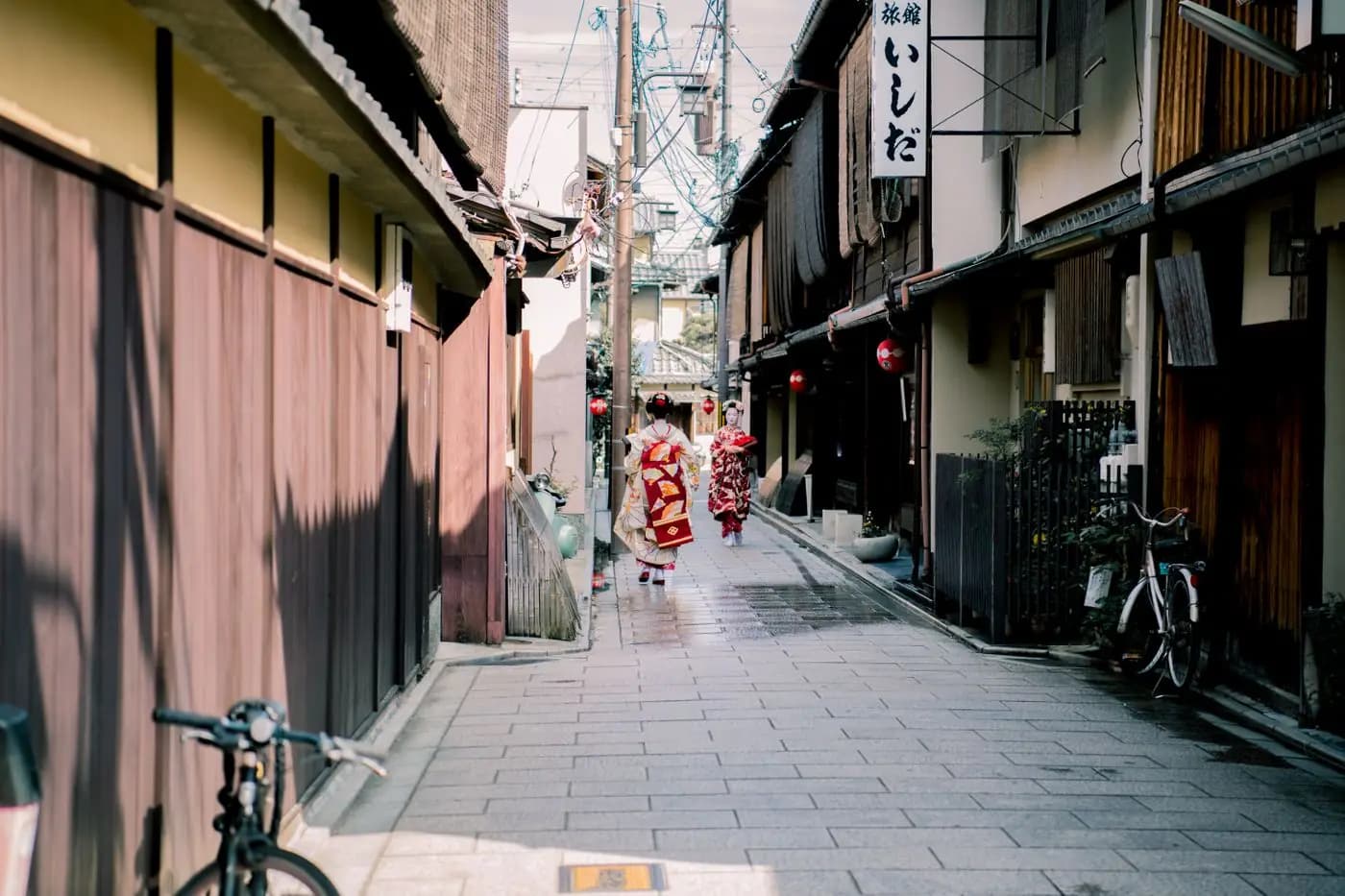
There is a third category, by far the most common in the streets of Higashiyama during the day: visitors in rental costumes (henshin). Several clues give them away: strolling in mid-afternoon around Kiyomizu-dera, posing for photos, smartphone in hand, an uncertain gait on the okobo. A real maiko walks fast, head down, usually in late afternoon or early evening, because she is on her way to an appointment.
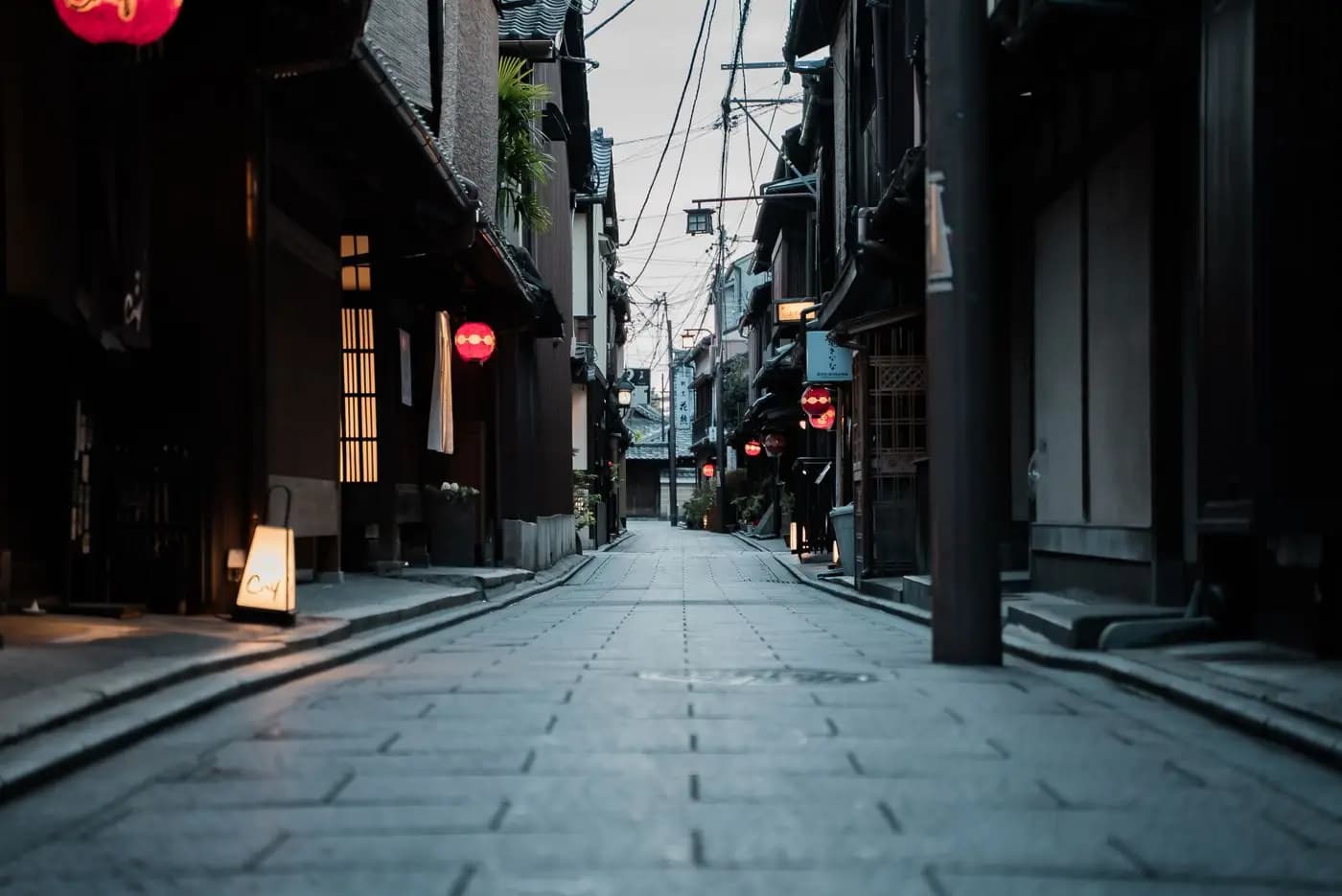
This distinction matters in practice: the hurried maiko walking along Hanamikoji at 5:45pm is not there to be photographed. She is working.
Kyoto's five hanamachi: Gion Kobu, Pontocho, Miyagawacho and the others
Hanamachi (“flower towns”, or kagai) are the districts where geiko and maiko live and work. Kyoto has five, each with its own dance style, houses and performance season.
- Gion Kobu: the largest and best known, around Hanamikoji-dori, south of Shijō-dōri. Its dance follows the Inoue school. It stages the Miyako Odori in spring and the Onshūkai in autumn.
- Gion Higashi: a small hanamachi north of Shijō, east of Hanamikoji. It presents the Gion Odori in early November, one of the few autumn dances.
- Pontocho: a narrow 500 m lane between the Kamo River and Kiyamachi, lined with restaurants whose summer terraces (yuka) overlook the water. Kamogawa Odori in May, Suimeikai in October (15–20 October in 2026).
- Miyagawacho: south of Gion along the Kamo, more residential and quiet in the evening. Kyo Odori in April.
- Kamishichiken: the oldest, in the north-west near Kitano Tenmangū Shrine. Kitano Odori in late March and early April, and a summer beer garden where guests are served by geiko and maiko.
For visitors, Kamishichiken and Miyagawacho offer a more authentic and less crowded atmosphere than Gion Kobu. Pontocho is best discovered by booking a table at one of its restaurants, a chance to see a maiko on her way to a nearby ochaya.
In Tokyo, the tradition also lives on in districts such as Asakusa, Kagurazaka, Shinbashi and Akasaka, with geisha and apprentices called hangyoku.
Gion: the rules to follow with geiko and maiko (photos, private lanes)
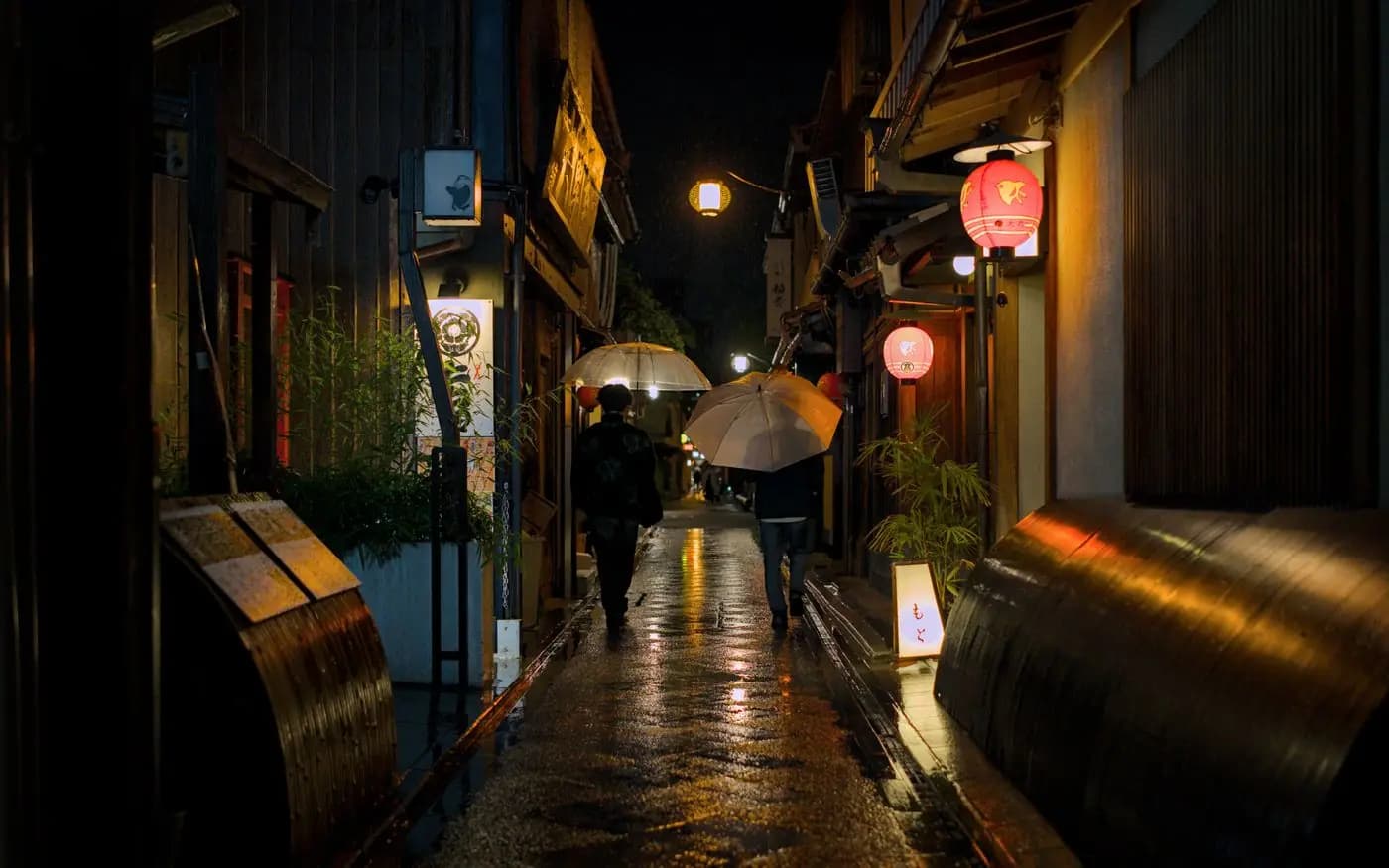
Some visitors' behaviour has led Gion to take a firmer line. Since April 2024, the private lanes branching off Hanamikoji-dori in the southern part of Gion Kobu have been closed to visitors; multilingual signs say so and mention a ¥10,000 fine. The main Hanamikoji street remains a public road, but photos on private property there are also forbidden.
The rules to explain before any walk in Gion:
- never touch a maiko or geiko, or her kimono;
- do not follow her, block her way or wait for her outside an ochaya;
- no photos without consent; they are working and often running late, so it is better to refrain;
- do not enter lanes marked as private, even for “just one photo”;
- do not sit on steps or in front of house doors;
- keep your voice down in the evening: these are residential streets too.
Several incidents have been reported in recent years: kimono sleeves pulled, kanzashi torn off, maiko chased to the door of a teahouse. Gion's associations regularly ask agencies to brief their clients.
The best way to enjoy Gion is still a morning or early-evening walk with a guide who knows the district, followed by a legitimate encounter with geiko and maiko, on stage or at a banquet.
Seeing the dances: Miyako Odori, Kamogawa Odori and seasonal performances
Each hanamachi stages a major annual dance, open to everyone with a simple ticket. It is the most accessible, and least expensive, way to see geiko and maiko on stage.
Miyako Odori (Gion Kobu) is the most famous. Created in 1872, it runs throughout April at the Gion Kobu Kaburenjo, renovated and reopened in 2023. Official information for 2027:
- 1–30 April 2027;
- three performances a day at 12:30, 2:30 and 4:30pm, each about an hour;
- ¥8,000 first class with tea ceremony (served by a geiko, with a wagashi), ¥7,000 first class, ¥5,000 second class;
- tickets on sale from 6 January 2027 at 10am, online or by phone; some performances are private bookings.
The show moves through scenes of the four seasons without lowering the curtain, with music played live by geiko.
The other spring and autumn dances:
- Kitano Odori (Kamishichiken), late March to early April;
- Kyo Odori (Miyagawacho), in April;
- Kamogawa Odori (Pontocho), in May, at the Pontocho Kaburenjo;
- Gion Odori (Gion Higashi), early November;
- the autumn recitals (Onshūkai, Suimeikai, Kotobukikai, Mizuekai), more low-key.
Out of season, the Gion Corner theatre, the small hall of the Gion Kobu Kaburenjo, presents an hour-long introduction to traditional arts almost every day, including a maiko dance. And the foundation of the five hanamachi (Ookini Zaidan) runs dinner or lunch formats with performances in some years, open on reservation.
Ozashiki: how to dine with maiko and geiko the legitimate way
An ozashiki is the private banquet at which geiko and maiko dance, pour sake, play games and talk with guests. Traditionally it takes place in an ochaya, which coordinates the meal (prepared by a caterer), the performers and the bill.
The basic rule is “ichigen-san okotowari”: no first-time customers without an introduction. An ochaya does not take bookings from strangers, because it extends credit, knows its regulars' tastes and puts its performers' reputation on the line. Legitimate routes for a foreign visitor:
- through a ryokan or large hotel in Kyoto with connections to an ochaya or ryotei;
- through an agency or DMC that works directly with the houses;
- through the hanamachi foundation, which arranges for geiko and maiko to attend receptions;
- through scheduled maiko dinners, organised by some restaurants or hotels on set dates and open to individual booking.
What you experience: one or two dances accompanied on shamisen, conversation (often with an interpreter), parlour games such as konpira fune fune or tora tora, which guests almost always lose, and a moment of exchange where you can ask about the profession.
Budget-wise, a private ozashiki remains a luxury. The price depends on the number of performers (usually one maiko and one geiko, plus a jikata musician), the duration (about two hours) and the kaiseki meal: for a small group, expect several hundred thousand yen. A scheduled maiko dinner costs far less per person.
On the other hand, avoid cheap “dinner with geisha” offers sold online with no house or district named: they often feature people in costume, not maiko.
Organising a maiko and geiko evening for a group
For a seminar or incentive trip, meeting maiko and geiko is often the most anticipated moment of the Kyoto stay. It does, however, require careful preparation.
The format depends on group size:
- up to 20 people: a dinner in an ochaya or small ryotei, the experience closest to tradition;
- 20 to 80 people: a private ryotei room or hotel banquet room, with several maiko and geiko moving from table to table;
- beyond that: a gala evening with a dance on stage, followed by a supervised time for conversation and photos.
Timing. The best dates go fast, especially in spring and autumn. Allow two to three months' notice, more for April (the hanamachi are busy with their dances) or November. Geiko and maiko have days off and district obligations: the date is set around their availability, not the other way round.
The details that matter:
- an interpreter familiar with hanamachi vocabulary, without whom conversation falls flat;
- a participant briefing on the rules (no physical contact, photos only when offered, no inappropriate questions);
- an organised photo moment, usually accepted at the end of the evening;
- parlour games planned to involve the guests;
- a kaiseki meal adapted to dietary requirements announced in advance.
SHINOGI DMC organises these evenings with houses in Gion and Miyagawacho, from an intimate dinner for an executive committee to a gala for several dozen guests.
Frequently asked questions
What is the difference between a geisha and a maiko?
A maiko is an apprentice, usually aged 15 to 20, recognisable by her long hanging sash, red collar and hairstyle made with her own hair. A geiko (Kyoto's word for geisha) is the fully qualified artist, with a plainer kimono and white collar.
Can you photograph geisha in Gion?
Not without their consent, and it is best not to in the street: they are working. Since April 2024, Gion Kobu's private lanes have been closed to visitors, with a posted fine of ¥10,000.
How much are Miyako Odori tickets?
In 2027: ¥5,000 second class, ¥7,000 first class and ¥8,000 first class with tea ceremony. Tickets go on sale on 6 January 2027.
How do you book a dinner with a maiko in Kyoto?
Through a ryokan, hotel, agency or DMC that works with ochaya, since teahouses do not accept customers without an introduction. Some restaurants and hotels also hold maiko dinners on set dates, open to individual booking.
Where can you see geisha in Kyoto?
On stage during the annual dances (Kitano Odori, Miyako Odori, Kyo Odori, Kamogawa Odori, Gion Odori), at the Gion Corner theatre, or at an ozashiki dinner. Spotting a maiko in the street is a matter of luck, in late afternoon.
Rédaction SHINOGI DMC · Updated
Sources
- Gion Kobu Kabukai — Miyako Odori 2027 (dates, horaires, tarifs)
- Ookini Zaidan (Kyoto Traditional Musical Art Foundation) — Les cinq hanamachi
- Gion Corner — Spectacle d'initiation aux arts traditionnels
- Pontocho Kabukai — Kamogawa Odori et Suimeikai
- Kyoto City Official Travel Guide
- Kanpai — Visites au Japon (inspiration)