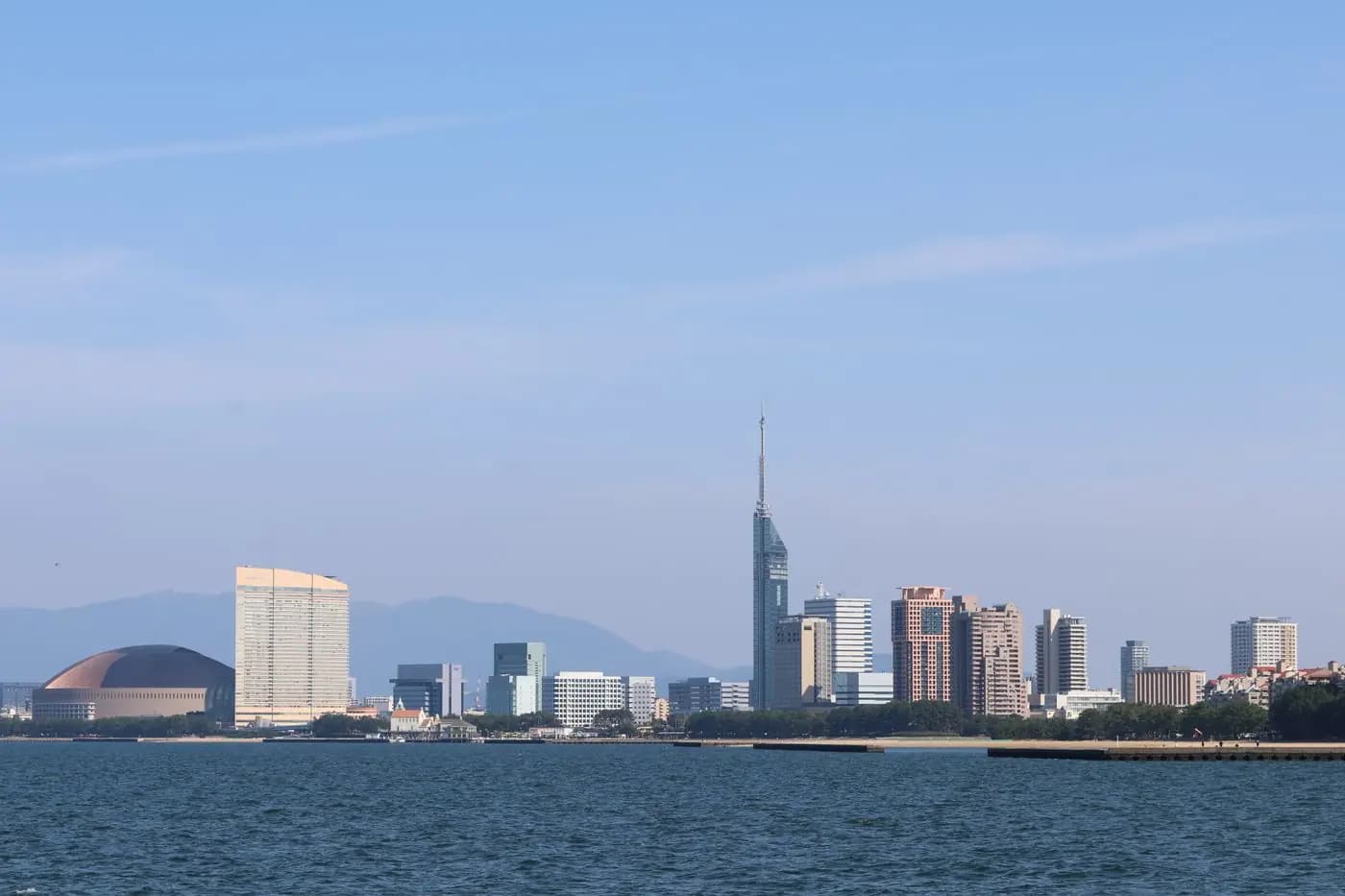
What to see in Fukuoka in 2 or 3 days: how to organise it
Fukuoka is Kyushu's largest city, but easy to get around: the airport is in town, 5 minutes by subway from Hakata Station and about ten minutes from Tenjin. You can land at 10am and be eating a bowl of ramen by 11.
The city has two hubs:
- Hakata, east of the Naka River, around the station: the old merchant quarter, its temples, Canal City and the big business hotels;
- Tenjin, to the west: the shopping centre and department stores, and further on Ohori Park and the castle ruins.
In between lies Nakasu, the island of bars and riverside yatai. All of it fits within 2 to 3 km: you walk a lot and the subway (Kuko, Hakozaki and Nanakuma lines) does the rest. Fares run from about ¥210 to ¥380 depending on distance; IC cards (Suica, ICOCA, SUGOCA) work everywhere.
A split that works well:
- Day 1: Hakata in the morning (temples, Kushida Shrine), Canal City, ramen; Ohori Park and the castle in the afternoon; yatai in the evening.
- Day 2: Dazaifu in the morning, back via Tenjin; Momochi seaside and Fukuoka Tower at sunset.
- Day 3: Nokonoshima, or a day trip (Itoshima, Yanagawa, Karatsu).
When to go? Spring (late March-April) and autumn (October-November) are the most pleasant. Summer is hot and humid, with the rainy season in June-July and typhoon risk from August to September. In early July, the Hakata Gion Yamakasa festival sends floats weighing close to a tonne racing through the streets at dawn on the 15th: spectacular, but hotels are full.
Fukuoka's yatai: where to go and how to behave
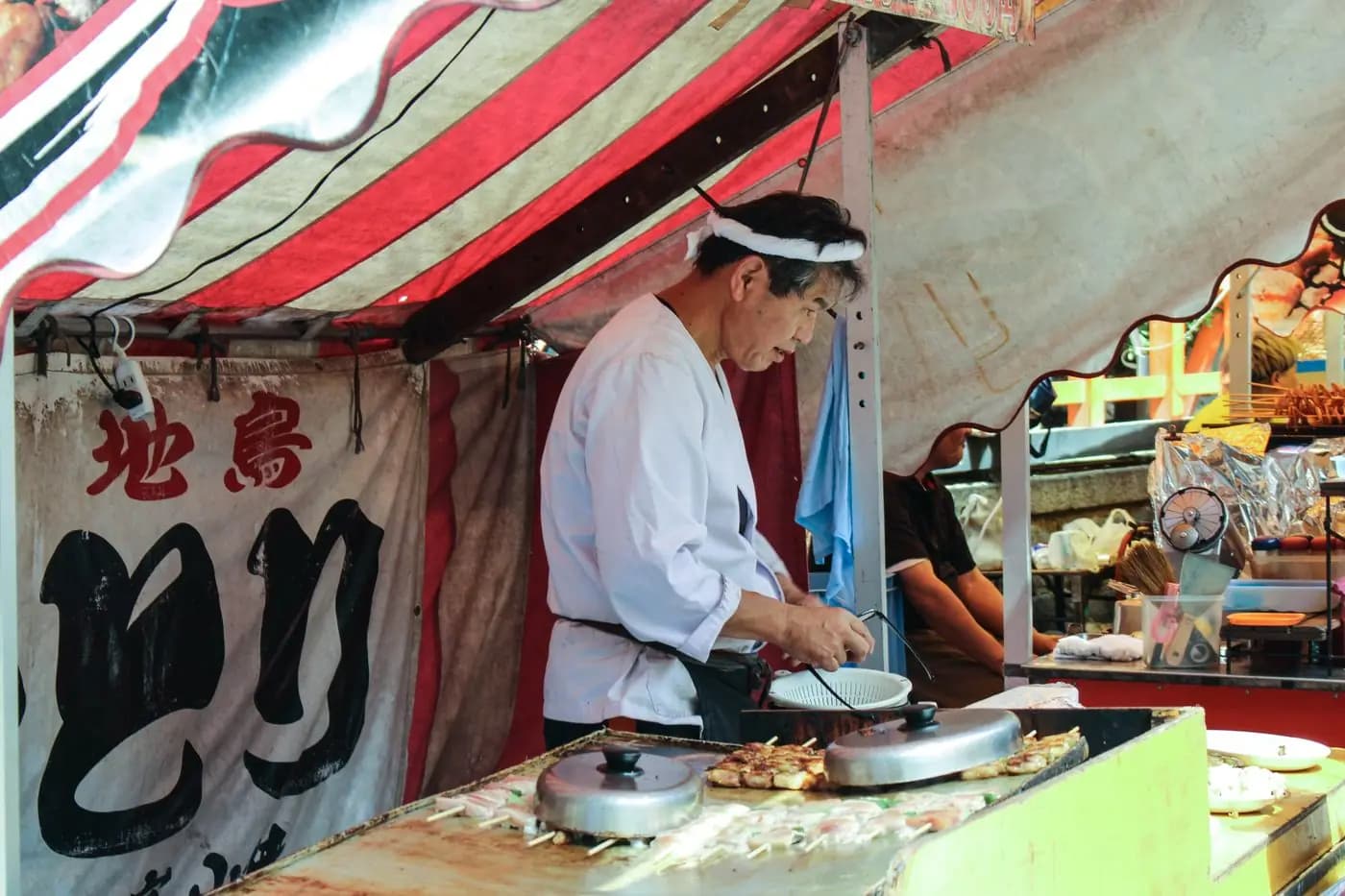
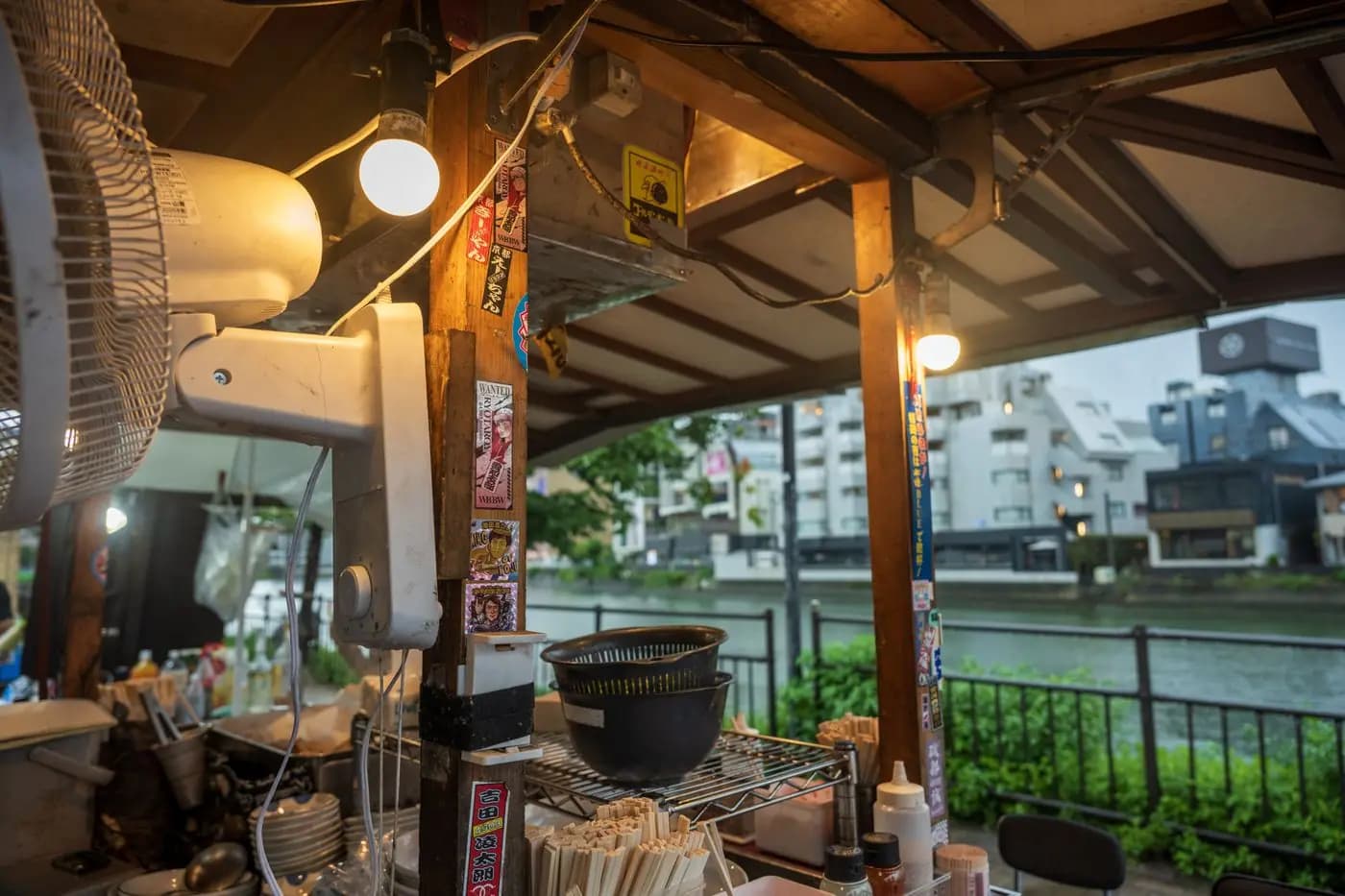
Yatai are mobile street stalls, set up each evening on the pavement and packed away before dawn. Fukuoka is the only major Japanese city where they are still common: the city counted 98 in March 2025 (around a hundred with newly licensed stalls), compared with more than 400 in the 1960s. Licences are regulated by the city, which allows setting up from 5pm and dismantling until 4am.
Three main areas:
- Nakasu, on the bank of the Naka River: some twenty stalls lined up facing the neon, the most photogenic setting and also the most touristy;
- Tenjin, around the department stores and Watanabe-dori: some twenty stalls with more local office workers;
- Nagahama, near the fishing port, birthplace of Nagahama ramen.
You eat tonkotsu ramen, yakitori skewers, gyoza, oden and grilled mentaiko, and some stalls serve less expected dishes (French food, tempura, mentaiko omelette). Budget ¥2,000 to ¥4,000 per person with a drink.
A few etiquette rules:
- a stall seats 8 to 10: come in twos, threes or fours, rarely more;
- everyone orders at least one drink and one dish; don't settle in for an hour over a single glass;
- give up your seat when the queue grows;
- many stalls have no toilet or washbasin: plan ahead;
- cards and mobile payment are spreading, but carry cash;
- some stalls display prices, others don't: ask before ordering to avoid surprises.
Yatai usually open around 6pm and close around 1 or 2am. They don't set up in heavy rain or wind, and many close one day a week. Best time: 6-7pm, before the rush, or after 10pm.
Ohori Park and the Fukuoka Castle ruins
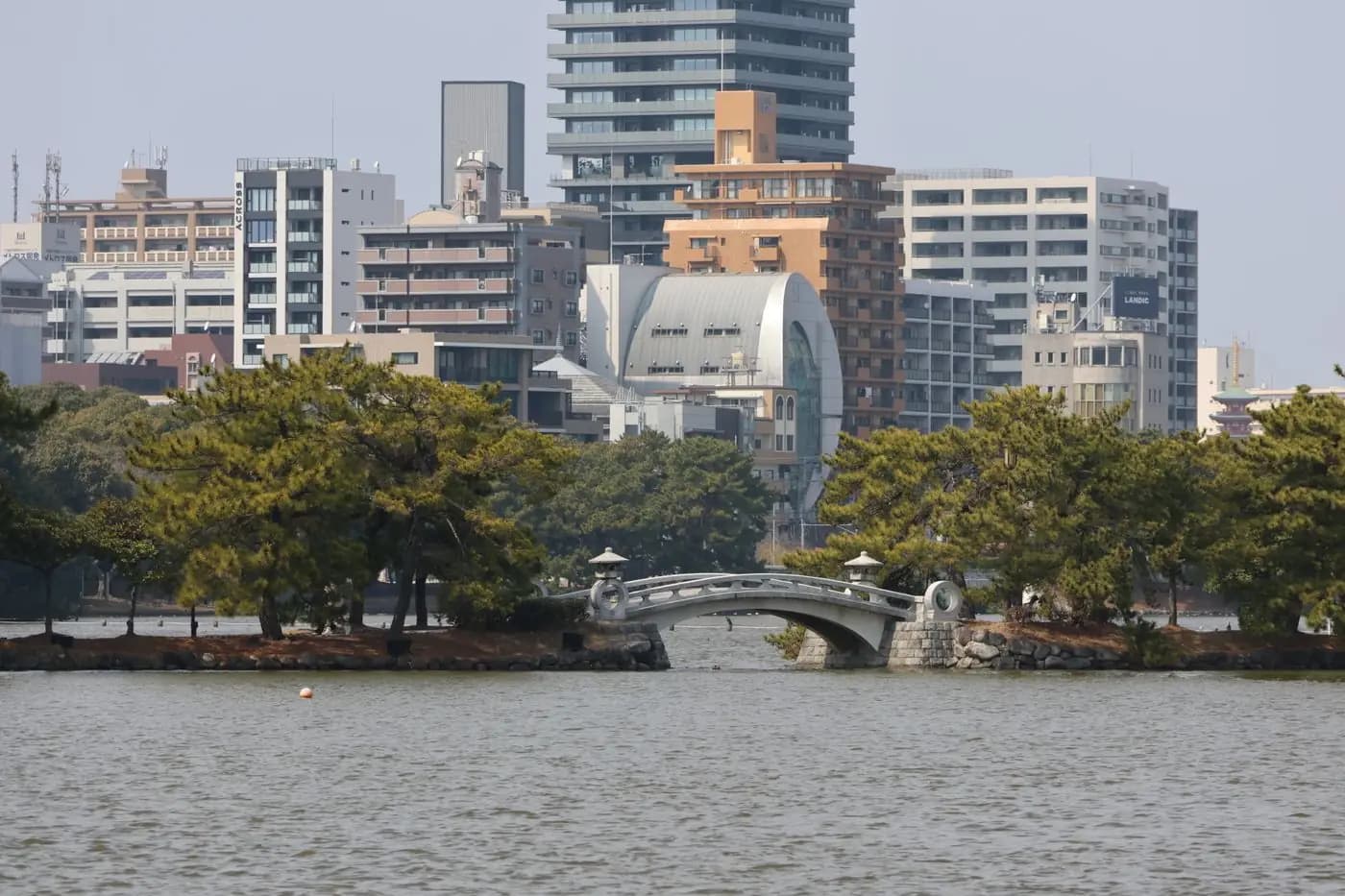
Ohori Park is where locals go for a walk. It surrounds a large lake, once the castle moat, crossed by a chain of islets and bridges. The full loop is about 2 km: joggers in the morning, families in the afternoon, couples at sunset. Free access, 24 hours a day. Subway station: Ohorikoen (Kuko Line), 10 minutes from Tenjin.
In and around the park:
- the Ohori Park Japanese Garden, at the south corner, with a pond, dry waterfall and teahouse: ¥250 for adults, often nearly empty on weekdays;
- the Fukuoka Art Museum, renovated in 2019, with a collection ranging from Buddhist art to Dalí and Warhol, and a glass-walled café over the lake;
- swan-shaped pedal boats, a local classic.
Next door, Maizuru Park holds the Fukuoka Castle ruins, built in the early 17th century by the lord Kuroda Nagamasa. No keep remains, but the stone ramparts are impressive and a few turrets survive. A 10-minute climb brings you to the keep platform (tenshudai), with views over Tenjin and the sea. Free entry. At its foot, the remains of the Korokan, a guesthouse for foreign envoys more than 1,000 years old, recall that Fukuoka has always been Japan's gateway to Korea and China.
In late March and early April, Maizuru Park's cherry trees are lit up at night (some areas charge admission). It is one of Kyushu's best hanami spots, and one of the busiest.
Allow 2 to 3 hours for the park, garden and castle at an easy pace.
Hakata, Canal City and tonkotsu ramen
The Hakata district holds the history of the merchant city. A morning on foot:
- Kushida Shrine, Hakata's guardian shrine, where a decorated float from the Yamakasa festival is on display all year;
- Shofuku-ji, regarded as Japan's first Zen temple (late 12th century), quiet behind its walls;
- Tocho-ji, with a seated wooden Buddha more than 10 metres tall;
- the small Kawabata street, an old-style covered shopping arcade.
Ten minutes' walk away, Canal City Hakata is a large shopping complex built around an artificial canal, with fountain shows every half hour and a floor devoted to ramen (Ramen Stadium). Not the most authentic place in town, but handy on a rainy day.
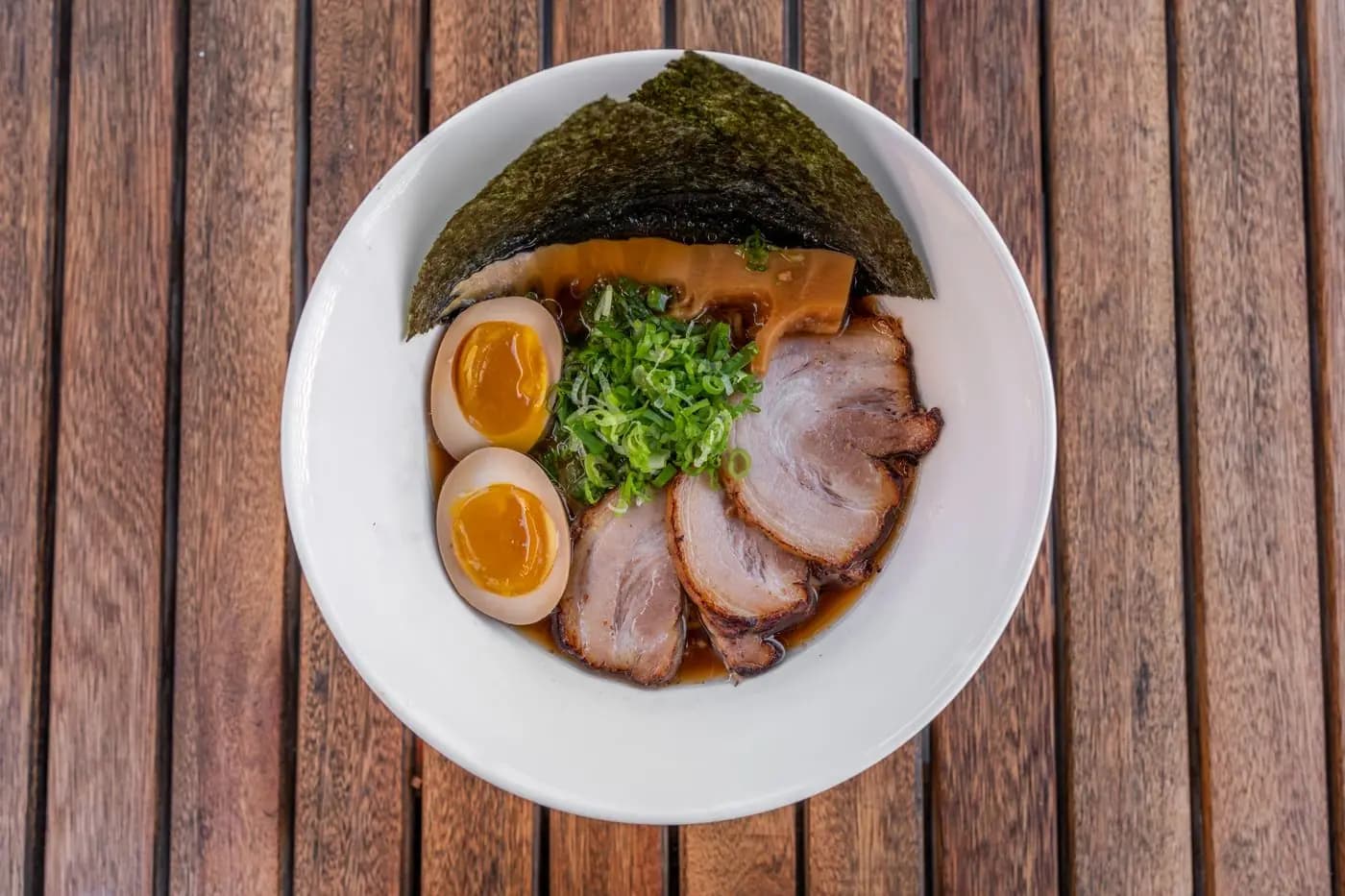
Hakata ramen is a milky pork-bone (tonkotsu) broth simmered for hours, served with very thin straight noodles. A few codes:
- choose your noodle firmness: barikata (very firm), katamen (firm), futsu (normal);
- when the noodles are gone, order kaedama (an extra portion of noodles, ¥100 to ¥200) to drop into the remaining broth;
- season with crushed garlic, sesame seeds and takana (pickled mustard greens) from the counter.
A bowl usually costs ¥800 to ¥1,200. The big chains born here (Ichiran, Ippudo, Shin-Shin) are everywhere, but small neighbourhood shops are often worth seeking out.
Other specialities to try: motsunabe (beef offal hotpot with cabbage and chives), mizutaki (chicken simmered in a clear broth) and mentaiko, spicy pollock roe, a classic gift to take home.
Dazaifu Tenmangu: the shrine of learning
Dazaifu Tenmangu is the classic trip from Fukuoka, and the easiest. The shrine is dedicated to Sugawara no Michizane, a 9th-century scholar and statesman exiled to Dazaifu who became, after his death, the deity of learning. Students from all over Japan come to pray before exams; the site receives more than ten million visitors a year.
Access: Nishitetsu train from Tenjin (Nishitetsu Fukuoka Station), changing at Futsukaichi, about 30 to 40 minutes in total. Direct trains run on some days. From Dazaifu Station, 5 minutes' walk along the shopping street (Sando).
On site:
- entry to the shrine is free;
- the main hall, dating from the late 16th century, has been restored for the first time in 124 years between 2023 and 2026, ahead of the 1,125th anniversary of Michizane's death in 2027; the temporary hall with a planted roof designed by architect Sou Fujimoto, used during the works, is being dismantled over summer 2026;
- the shrine's roughly 6,000 plum trees bloom from late January to early March; the most famous, the Tobiume, is said to have flown from Kyoto to join Michizane in exile;
- umegae mochi, grilled rice cakes filled with red bean paste, sold all along the approach (around ¥150 each).
Five minutes away through a lit escalator tunnel, the Kyushu National Museum tells the story of exchanges between Japan and Asia. Quieter, Komyozen-ji has a dry garden of moss and stones, superb in autumn.
Avoid arriving around 11am at weekends, when tour coaches follow one another. Aim for opening time (the shrine opens early) and head back to Fukuoka for lunch. Allow half a day.
Nokonoshima, Momochi and Fukuoka Tower: the seaside
Fukuoka is a seaside city, which is easy to forget downtown. Two outings make it obvious.
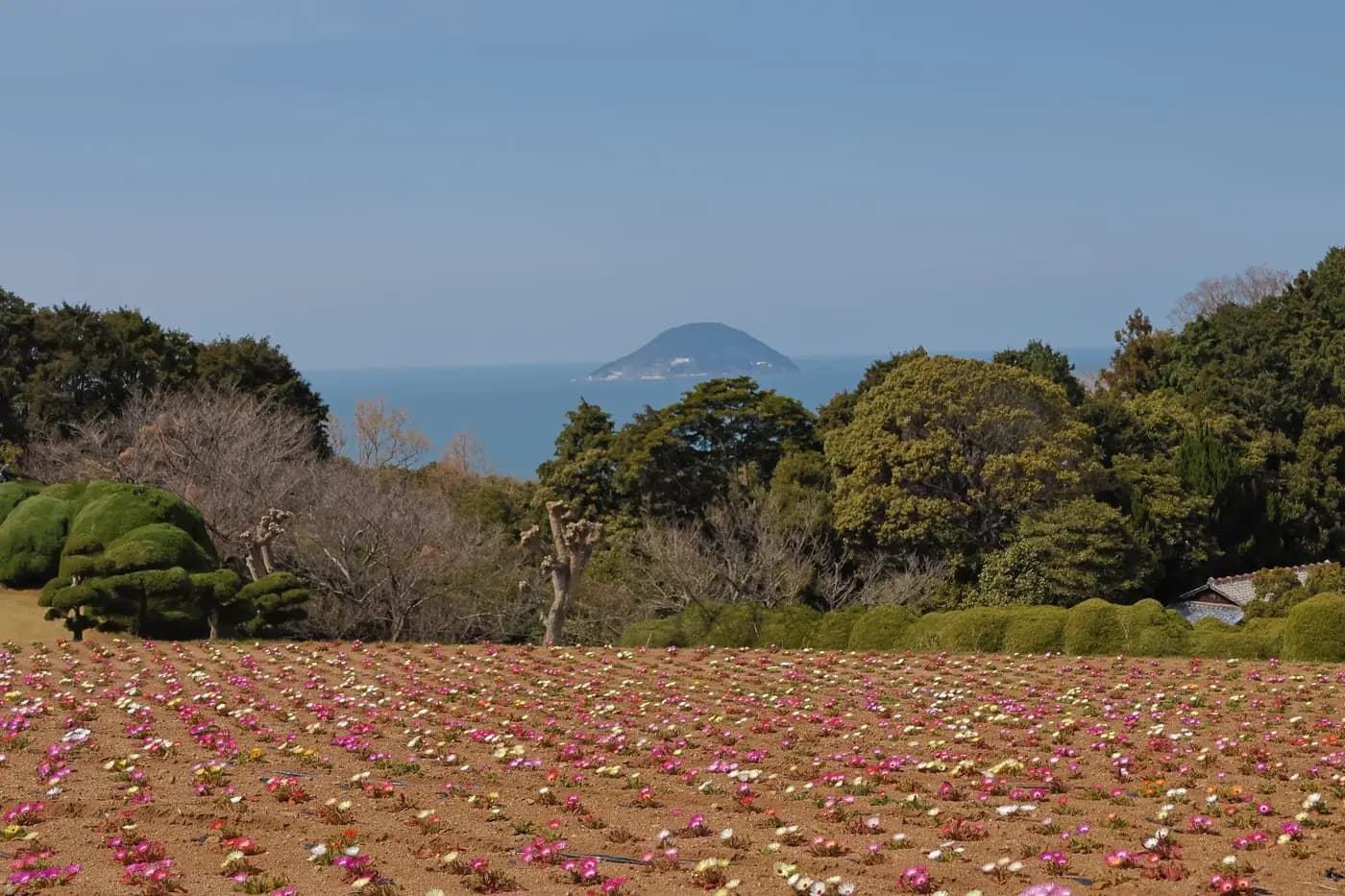
Nokonoshima is a small island in Hakata Bay, 10 minutes by ferry from the Meinohama terminal (¥230 one way for adults, roughly one departure per hour, more in peak season). From the island terminal, a bus climbs in 15 minutes to Nokonoshima Island Park, a flower park on a slope above the sea: rapeseed and cherry blossom in spring, sunflowers in summer, cosmos in autumn (late September to late October is the best time). Adult admission: ¥1,500. There is also a recreated Meiji-era street with workshops and a small restaurant. To reach the Meinohama terminal: subway to Meinohama (about 15 minutes from Tenjin), then bus or a 15-minute walk. Allow half a day; keen walkers can circle the island on foot.
The Momochi district, to the west, is a waterfront reclaimed from the bay in the late 1980s: a sandy beach, a promenade and Marizon, a small island of restaurants on stilts. Fukuoka Tower, 234 metres tall, overlooks it all; the observation deck is at 123 metres. Adult admission: ¥1,000 (discount with a foreign passport). Sunset over the bay is the best time, and the tower lights up afterwards.
Nearby, the Fukuoka City Museum traces the city's history and holds the gold seal of the King of Na, given by a Chinese emperor in 57 AD: a tiny object, a national treasure, that always surprises.
For Momochi, the bus from Tenjin or Hakata is more direct than the subway.
Day trips from Fukuoka
Fukuoka is a good base for northern Kyushu. A few ideas, from nearest to furthest:
- Itoshima (40 minutes to 1 hour by car or JR train): a coast of beaches and cafés, the wedded rocks of Sakurai Futamigaura joined by a sacred rope, sea salt workshops. Better by car.
- Yanagawa (about 50 minutes by Nishitetsu train from Tenjin): a punted boat ride along the canals (about 1 hour), then steamed grilled eel, the local speciality. A combined train and boat ticket exists. Combines well with Dazaifu, on the same line.
- Karatsu (about 1h20 by through subway and JR trains): a seaside castle, Karatsu pottery, the Niji-no-Matsubara pine grove.
- Kumamoto (about 35 minutes by shinkansen): the castle, restored after the 2016 earthquake, and Suizenji garden.
- Yufuin and Beppu (about 2 hours by limited express or coach): hot spring towns, Beppu's "hells" and Yufuin's shopping street below Mount Yufu. Better with a night there.
- Nagasaki (about 1h30 by train and shinkansen): the history of exchanges with Europe, Dejima, Peace Park. Doable in a long day, more comfortable in two.
The JR Kyushu Rail Pass covers the island's JR trains (northern or all-Kyushu versions); it pays off once you string together two or three longer trips. Nishitetsu lines (Dazaifu, Yanagawa) are not included.
A common trap: trying to do Yufuin and Nagasaki as return trips from Fukuoka in the same week. Days get long and you spend more time sitting than sightseeing.
Visiting Fukuoka with a group: practical tips
Fukuoka is one of the easiest Japanese cities for a group: an airport 5 minutes from the centre, hotels of every size, short distances, and direct flights from Seoul, Taipei or Bangkok for regional programmes.
- Yatai with 20, 40 or 80 people. An 8-seat stall cannot take a group. Two solutions: split participants into teams of 6 to 8 across several stalls booked ahead (some accept early-evening reservations), or privatise a yatai for the evening, or even set one up in a hotel or event venue. A stall-to-stall treasure hunt works very well as team building.
- Dazaifu. Coaches park in paid car parks near the shrine. Arrive before 9:30am, visit in two sub-groups with a guide each, and pre-order umegae mochi for everyone.
- Nokonoshima. The public ferry is fine for 30 people; beyond that, avoid flower-season weekends or charter a boat.
- Meals. Motsunabe and mizutaki restaurants often have private tatami rooms. A seafood dinner in Nagahama or a hotel banquet with recreated yatai stalls are safe bets.
- Calendar. Avoid Golden Week (late April-early May), Hakata Dontaku (3-4 May) and Yamakasa (1-15 July) unless they are the theme of the trip, and keep a plan B for typhoon season.
- Combined programmes. Fukuoka pairs well with a ryokan night in Yufuin or Beppu, or with Nagasaki.
SHINOGI DMC organises this kind of trip in Fukuoka and across Kyushu, with French- and English-speaking guides, transport and privatised yatai evenings.
Frequently asked questions
How many days do you need in Fukuoka?
Two days are enough for Hakata, Tenjin, Ohori Park, the yatai and Dazaifu. A third day lets you add Nokonoshima or a trip to Itoshima, Yanagawa or Karatsu.
Where are the yatai in Fukuoka?
Mainly in Nakasu along the Naka River, in Tenjin around Watanabe-dori and the department stores, and in Nagahama near the port. They usually open around 6pm.
How do you get to Dazaifu from Fukuoka?
By Nishitetsu train from Tenjin (Nishitetsu Fukuoka Station), changing at Futsukaichi: 30 to 40 minutes. The shrine is then a 5-minute walk.
Can you visit Fukuoka Castle?
It no longer has a keep, but the ramparts, a few turrets and the keep platform can be visited for free in Maizuru Park, next to Ohori Park.
How do you get to Nokonoshima?
Ferry from the Meinohama terminal, a 10-minute crossing for ¥230 one way, then a bus to Nokonoshima Island Park (¥1,500 admission).
What is kaedama with Hakata ramen?
It is an extra portion of noodles, ordered once you have finished the first, added to the remaining broth. It usually costs ¥100 to ¥200.
Rédaction SHINOGI DMC · Updated
Sources
- Fukuoka City — Ouverture de nouveaux yatai (nombre de stands, mars 2025)
- Fukuoka City Official Travel Guide — Yatai Guide
- Dazaifu Tenmangu — site officiel
- Nokonoshima Island Park — accès et ferry
- Fukuoka Tower — site officiel
- Crossroad Fukuoka — Japanese gardens of Fukuoka (Ohori Park Japanese Garden)
- JR Kyushu — JR Kyushu Rail Pass
- Kanpai — Visites au Japon (inspiration)