- Duration
- About 3 hours, early morning, meal included
- Group size
- 4–30 pax
- Cities
- Tokyo
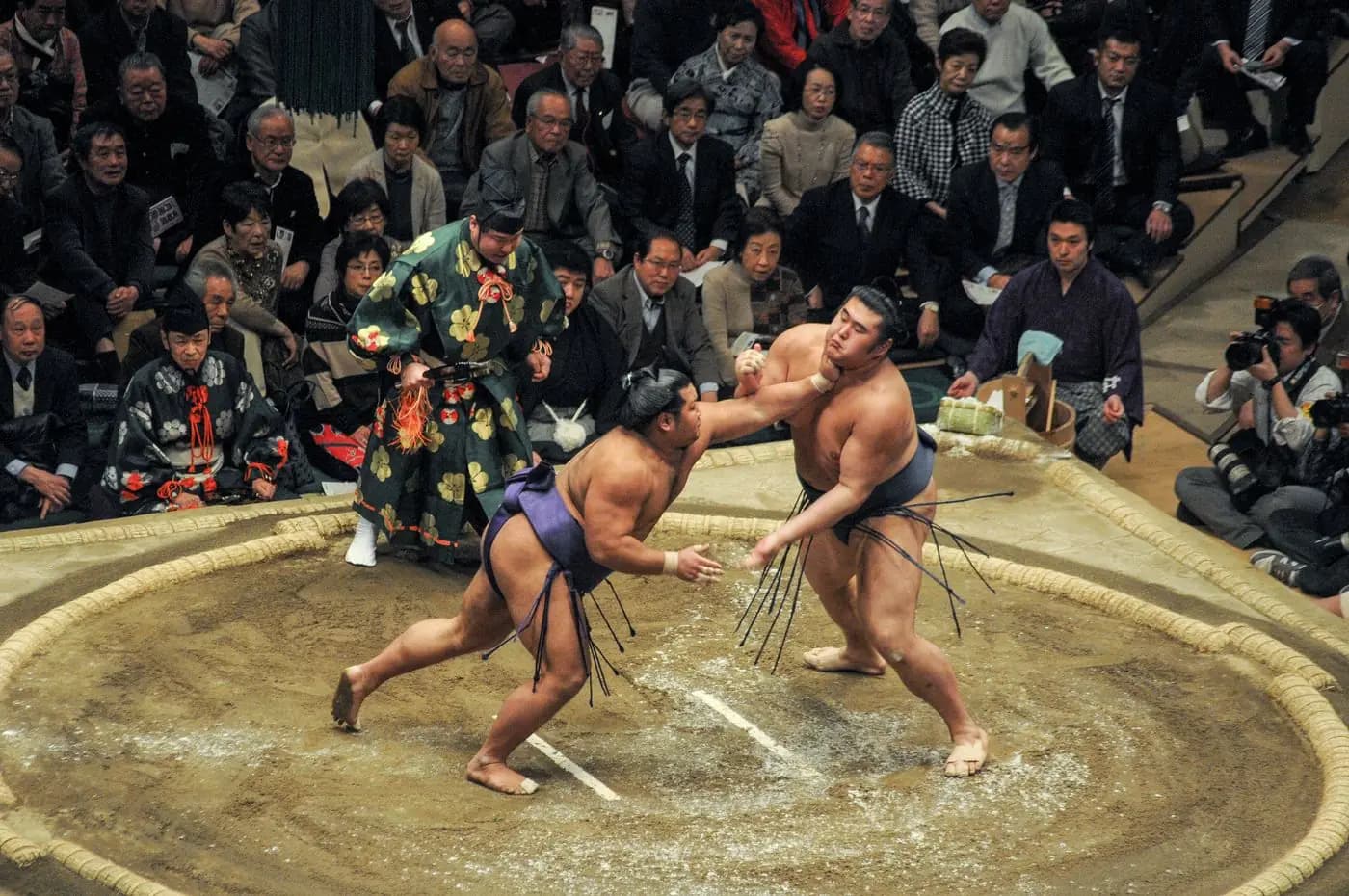
Stables (heya) are where professional wrestlers live and train, most of them in Tokyo's Ryogoku and Sumida area. Morning practice starts early and takes place in focused silence: warm-ups, shiko leg stomps and repeated bouts between wrestlers of different ranks, under the eye of the oyakata, the stable master. Visitors sit at the edge of the training ring and watch without interfering.
Access to stables is not a tourist service. It is arranged through our partners, who have a relationship of trust with the stables, and depends on their agreement, schedule and how many visitors they accept. During official tournaments (honbasho) and regional tours, open practices are rare or suspended; Tokyo tournaments are held in January, May and September, and wrestlers travel for the Osaka, Nagoya and Fukuoka tournaments. Depending on the dates, chanko nabe is shared at the stable or served at a chanko restaurant in the neighborhood.
For an executive committee or incentive group, the experience offers a unique view of hierarchy, discipline and mentoring in Japan. Every wrestler holds a precise rank, junior wrestlers serve their seniors, and progress depends on relentless daily training. An interpreter explains what is happening, before and after, without ever disturbing the session.
Objectives
- Observe Japanese hierarchy and discipline up close
- Understand mentoring between master and apprentices
- Live a rare and exclusive cultural experience
- Reflect on effort and progression
How it works
- 1Request to our partners as soon as dates are set, confirmed subject to the stable's agreement.
- 2Etiquette briefing the day before: silence, dress, photography, seated posture.
- 3Early transfer from the hotel to Ryogoku, arriving before practice begins.
- 4Silent observation of practice (about 1.5 to 2 hours).
- 5Possible short exchange with the oyakata or a wrestler, depending on availability.
- 6Chanko nabe at the stable or a nearby chanko restaurant, with interpreter.
Good to know
- Strict etiquette: complete silence during practice, no food or drink, phones off, no flash, never point your feet toward the ring.
- Photos are often allowed without flash or sound, but always according to the stable's rules; no video without permission.
- Wear modest clothing; you will sit on the floor or a low bench for almost two hours.
- Availability depends on the tournament calendar (January, March, May, July, September, November) and regional tours; some periods are not possible.
- Groups are limited, often to about twenty per stable; larger groups are split across stables or offered another format (private sumo demonstration).
Indicative budget
Indicative: from ~€180 per person (access through partner, interpreter, chanko nabe, early transfers), varying with group size and stable. Price confirmed only once the stable agrees.
Frequently asked questions
Is a sumo stable visit guaranteed?
No. It depends on the stable's agreement, its schedule and the time of year. We confirm as early as possible and offer an alternative, such as a private sumo demonstration or a chanko dinner with a former wrestler.
What time do we leave the hotel?
Practice starts early; depending on the stable and your hotel's location, departure is usually between 6:30 and 7:30 am. We give the exact time the day before.
Can a group attend a sumo tournament?
Yes, during the Tokyo tournaments (January, May, September at the Ryogoku Kokugikan) or those in Osaka, Nagoya and Fukuoka. Group tickets are limited and sell quickly, so plan from the day sales open.