- Duration
- About 1.5 hours
- Group size
- 4–40 pax
- Cities
- Tokyo
- Indicative budget
- From ¥43,000 per person
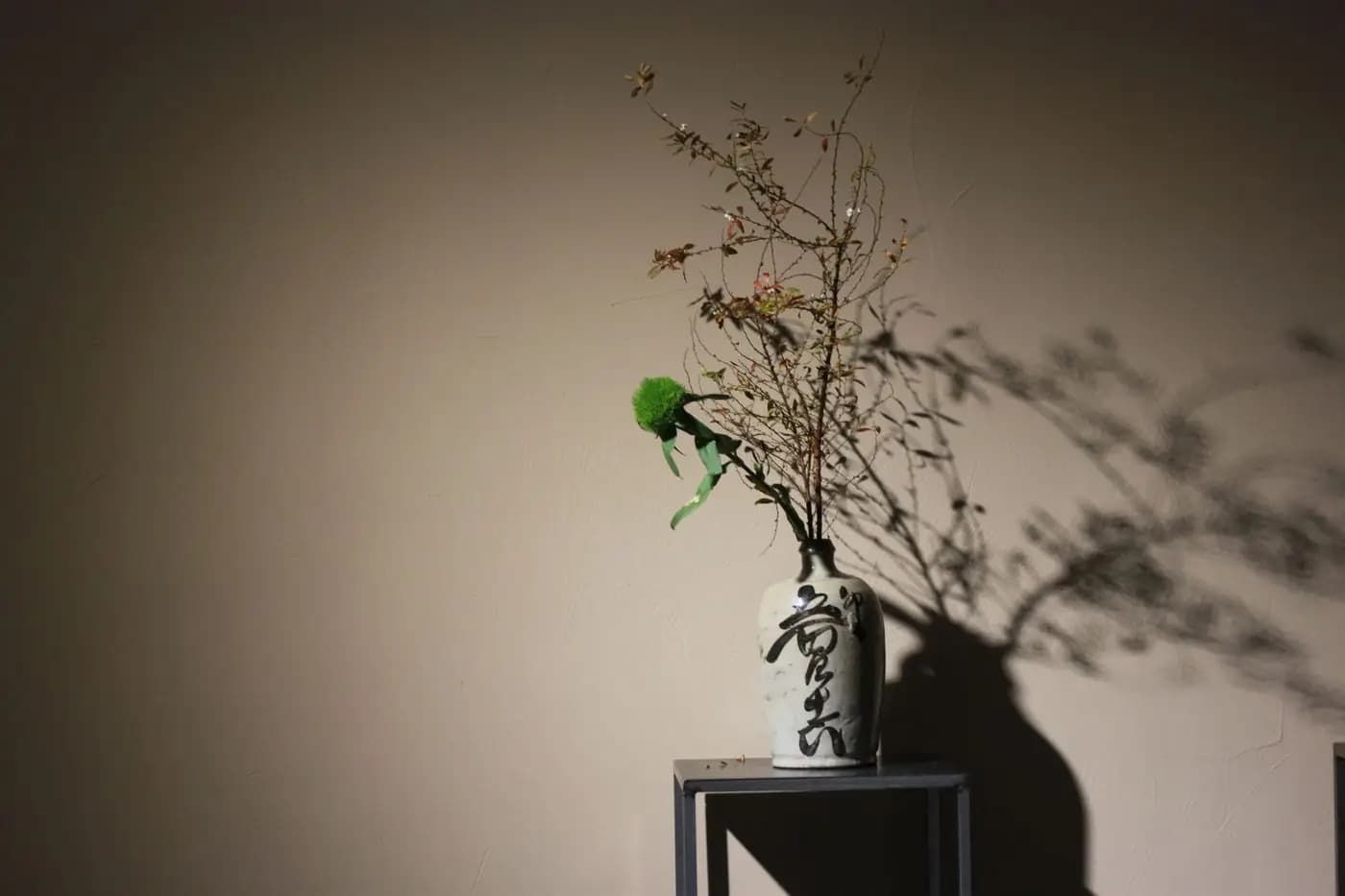
The teacher opens with a short introduction to ikebana and its principles: asymmetry, the role of empty space, the line of the branches and the choice of material according to the season. They then build an arrangement in front of the group, explaining each step. Every participant has a vase, a pin holder (kenzan), shears and a selection of plants, and creates their own piece. The teacher moves from table to table to adjust an angle or shorten a stem, and comments on every arrangement at the end. An interpreter translates throughout.
For a corporate group, the exercise has a particular value: everyone starts with the same material and the same amount of time, yet the results are very different. The debrief naturally turns to decision-making, to what you choose to remove rather than add, and to the value of an expert's eye. The workshop fits well between two working days, before a dinner or in a partner program. Above about fifteen people, we arrange several teachers in the same room or two rotations.
Ikebana, literally “living flowers”, has its roots in floral offerings at Buddhist temples. Over the centuries it developed into schools with distinct styles, several of which are very active in Tokyo. The material follows the calendar: plum and cherry in spring, iris in early summer, maple in autumn, pine and camellia in winter. The arrangements can be displayed the same evening at the dinner venue, which extends the workshop and gives the group its own decoration.
Objectives
- Practice observation and decision-making by subtraction
- Provide a calm, hands-on break within a busy meeting program
- Spark conversation around each participant's arrangement
How it works
- 1Room set-up before the group arrives: tables, vases and plant material prepared for each participant.
- 2Introduction and demonstration by the teacher, with interpretation.
- 3Each participant creates an arrangement, with individual guidance.
- 4Review of the arrangements, teacher's comments and group photo.
- 5Optional: arrangements displayed at the dinner or reception venue.
Good to know
- Seated at tables, no kneeling; no prior experience needed.
- About 15 participants per teacher; larger groups use several teachers or two rotations.
- Venue options: the seminar hotel's function room, a private Japanese-style room or the company's own office in Tokyo.
- Cut plants rarely clear plant-health checks on the way home, so we favor displaying the arrangements on site and taking photos.
- A small vase or kenzan can be given as a keepsake (the kenzan has metal pins and must travel in checked luggage).
Indicative budget
From ¥43,000 per person (private session, small-group basis). Lower group rates quoted according to numbers; interpreter and transfers optional.
Frequently asked questions
Do participants need any flower-arranging experience?
No. The teacher starts from the basics and guides each participant step by step. People with no interest in flowers often produce striking arrangements, which makes the final review lively.
How many people can take part at the same time?
From 4 to 40 people. One teacher covers up to about 15; beyond that we add teachers in the same room or run two rotations while the other half of the group does another activity.
Can the workshop take place at our seminar hotel?
Yes. The teacher brings the tools and plant material; a room with tables and access to water is enough. Set-up can happen during a plenary session so the program flows without a break.
Can participants take their arrangement home?
They can take it back to the hotel, but cut plants are often refused at customs in the home country. Instead, we suggest displaying the arrangements at dinner and giving each participant a small vase as a keepsake.